


Choosing a Keap alternative isn't about finding the longest feature list. It's about choosing the stack that matches how your team works, whether that means agency sub-accounts, simple sales pipelines, lifecycle email, memberships, webinars, or a lower-cost all-in-one system. The market has shifted enough that buyers now expect CRM plus automation in one place, not a patchwork of disconnected tools, and that's why the best replacement depends on your operating model, not on generic comparison charts. For broader context on CRM selection, see this CRM platform comparison.
Keap itself has a long history, but the reason alternatives keep gaining attention is plain. Small-business CRM adoption is now mainstream, and the marketing automation market keeps expanding, so the key question is whether you need a platform that replaces Keap's automation-first workflow, its client management, or its billing and booking stack. The wrong switch just recreates the same sprawl under a different logo.
Table of Contents
- 1. HighLevel
- 2. HubSpot Marketing Hub + HubSpot CRM
- 3. ActiveCampaign
- 4. Zoho CRM
- 5. Pipedrive + Campaigns by Pipedrive
- 6. Ontraport
- 7. Freshsales
- 8. EngageBay
- 9. SharpSpring
- 10. GetResponse
- Top 10 Keap Alternatives Comparison
- Match the Platform to Your Operating Model
1. HighLevel
HighLevel is the strongest Keap alternative for agencies and service businesses that need client separation, coordinated follow-up, and fewer disconnected tools. It pulls CRM, conversations, funnels, booking, payments, and reputation management into one workspace, so the shift makes sense when the core problem is tool sprawl, not just CRM gaps.
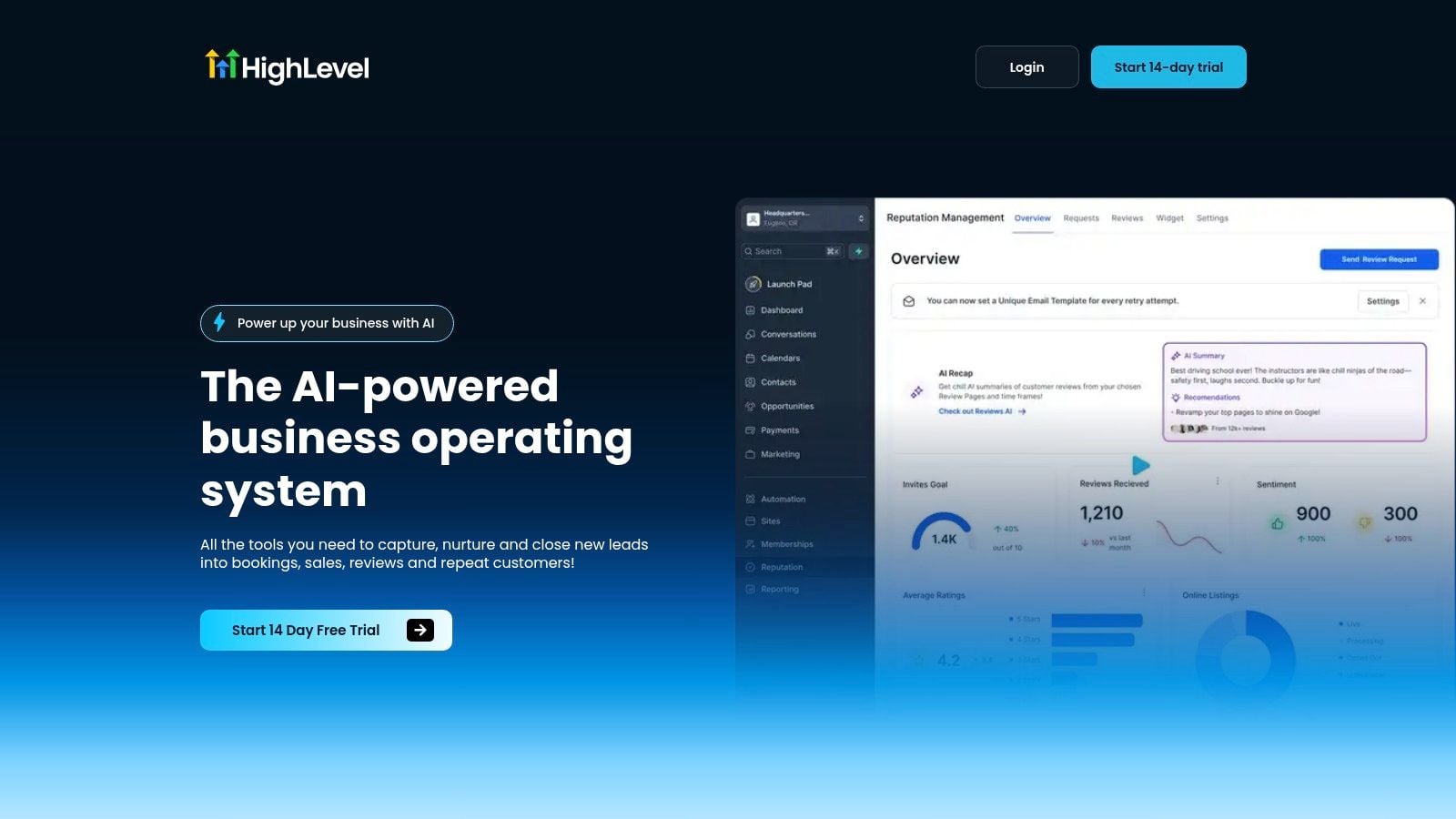
The pricing is straightforward on the surface. Its published plans start at $97/month for Starter, $297/month for Unlimited, and $497/month for Agency Pro, with a 14-day free trial on the site. More important than the price ladder is what it implies for migration. Keap users who rely on tags, pipelines, and campaigns need to map that logic into HighLevel sub-accounts, workflows, and client-specific views before they import data.
Why agencies choose it
HighLevel fits an agency operating model because sub-accounts, rebilling, and scale are built into the structure. It also brings CRM, unified conversations across SMS, WhatsApp, Messenger, Instagram DMs, live chat, visual workflows, paid calendars, invoices, Text-2-Pay, Tap-2-Pay, and broadcast campaigns into one place. That is a clean replacement path for teams that want acquisition, follow-up, and service delivery under one roof.
Practical rule: If Keap feels fragmented because your team keeps jumping between inboxes, funnel builders, booking tools, and payment tools, HighLevel is the more direct move.
The trade-off is setup friction. HighLevel covers a lot of ground, so implementation takes planning, and non-technical teams usually need a structured onboarding process. It also leans on company-reported usage claims and self-reported support messaging in the provided material, so compliance-heavy buyers should verify anything they care about before rollout.
Best fit: Agencies, resellers, local service operators, and SaaS-style operators that want one system for acquisition, conversion, follow-up, and retention.
Trade-off: More platform, more setup, more payoff once the workflows are built.
Website: HighLevel
2. HubSpot Marketing Hub + HubSpot CRM
HubSpot is the right Keap alternative for reporting-heavy growth teams that want marketing, CRM, attribution, and a large app ecosystem in one brand-safe stack. It's not the cheapest route, and that's the point. You buy HubSpot when you care more about structured growth operations than about keeping software spend minimal.
HubSpot's Smart CRM gives you the foundation, and the marketing hub adds visual automations, forms, landing pages, ads, and reporting. That combination fits teams that need a clear view of the customer journey and don't want to bolt together separate tools for attribution, nurture, and pipeline handoff. If your current Keap setup feels cramped because reporting is limiting your decision-making, HubSpot fixes that problem fast.
The trade-off is implementation friction. HubSpot's pricing structure can get complicated because contacts, seats, tiers, and add-ons all affect the final bill. That means your first job isn't migration, it's scope control. Decide which hub you need, then map the must-have lifecycle journeys before importing anything.
HubSpot works best when marketing and sales are already aligned. If they aren't, the platform will expose the gaps instead of hiding them.
For teams comparing ecosystems, this HubSpot vs alternative platforms resource is useful because it frames how HubSpot sits against lighter competitors. The advantage is depth, reporting, and education. The downside is that smaller teams can overbuy the system and underuse it.
Best fit: Growth teams that need attribution, reporting discipline, and a mature ecosystem.
Trade-off: Strongest reporting class here, but it comes with more cost and more setup.
Website: HubSpot
3. ActiveCampaign
ActiveCampaign is the best Keap alternative for lifecycle marketing teams that live and die by email automation. If your revenue depends on behavior-driven sequences, segmentation, and follow-up logic, it's the cleaner replacement. It's less of an all-in-one business operating system and more of a precision automation engine with a CRM layer.
ActiveCampaign's real advantage is that its automations are flexible without being heavy. You get visual workflows with conditions, goals, split actions, and site, link, and event tracking, which makes it a strong fit for lead nurturing, onboarding, and ecommerce-style lifecycle programs. That's a better match than Keap for teams that want deeper automation without taking on an enterprise-style implementation burden.
The main friction point is list growth. As your contacts expand, costs rise, and the CRM, while capable, won't feel as deep as a dedicated sales platform. So don't force ActiveCampaign to be your sales command center if your team needs more pipeline discipline than email sophistication.
Where it fits best
Use ActiveCampaign when marketing is the primary motion and sales is downstream. It handles the automation piece elegantly, and the modular add-on structure keeps you from paying for every capability on day one. That makes it ideal for teams that need advanced journeys but don't want a broad platform that invites unused features.
If you're building nurture flows for SaaS or service businesses, this guide on marketing automation for SaaS gives useful context on how to structure lifecycle campaigns before migration. The important point is that ActiveCampaign rewards clean segmentation and disciplined event tracking.
Best fit: Email-led lifecycle programs, ecommerce nurture, and teams that need strong automation logic.
Trade-off: Excellent automation depth, but not a full all-in-one replacement.
Website: ActiveCampaign
4. Zoho CRM
Zoho CRM is the Keap alternative to choose when you want configurability, broad app coverage, and serious value without paying for a premium suite. It works best for organizations that are standardizing on multiple apps and want the CRM to sit at the center of the stack.
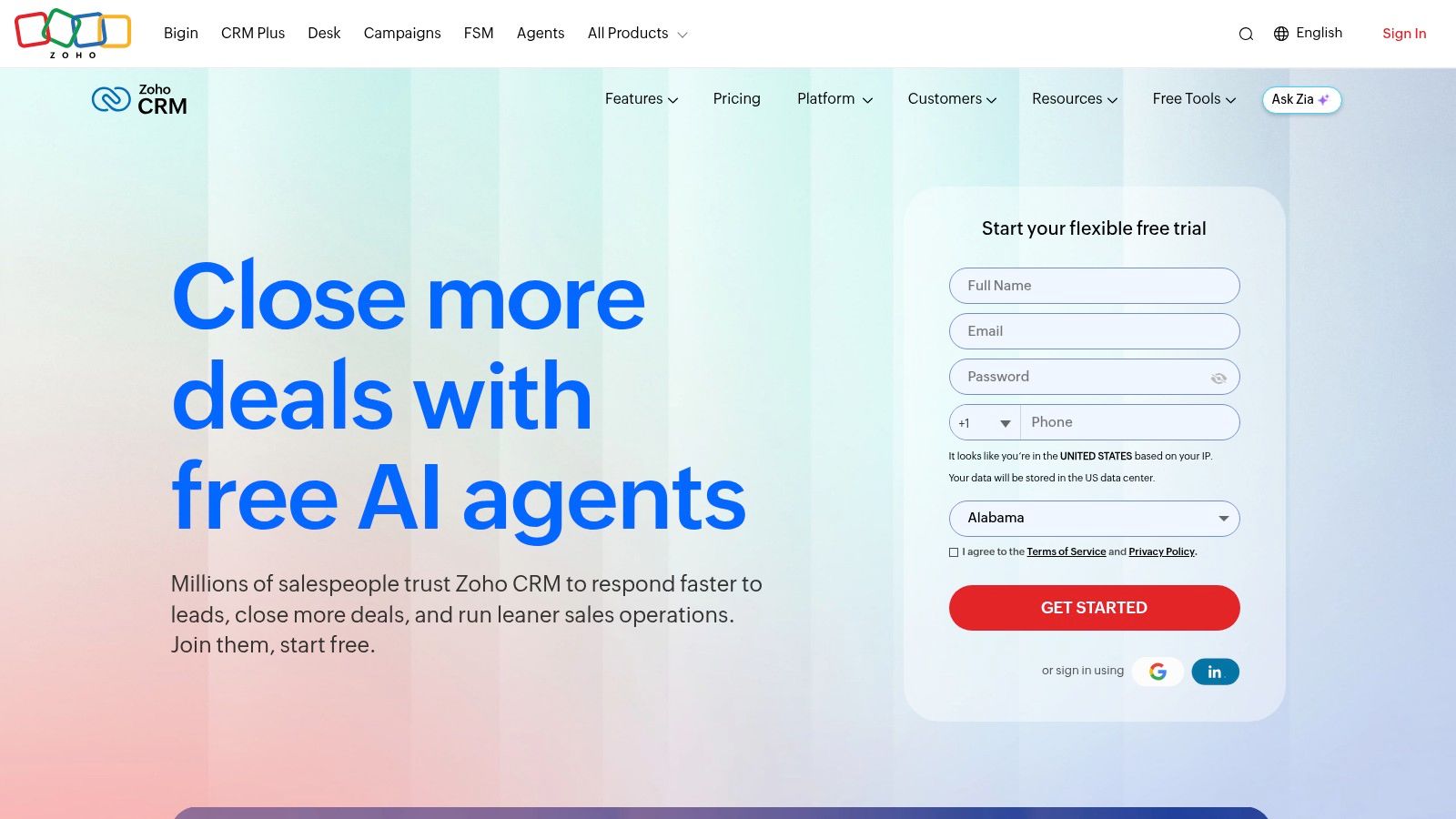
Zoho CRM gives you sales pipelines, workflow rules, blueprints, and, in higher tiers, AI insights through Zia. It also connects tightly with Zoho Campaigns, Desk, and Analytics, so you can grow from a CRM into a wider operating system without switching vendors. For teams that want one vendor across sales, support, marketing, and reporting, that matters.
The downside is setup time. Zoho is configurable enough that a sloppy implementation can become a mess. You need a clear field model, a defined pipeline, and a clean automation map before you start importing contacts or enabling add-ons. The platform can absolutely do the job, but it won't prevent bad process design.
Why it wins on breadth
Zoho's biggest strength is that it lets you build an entire operational stack without a large software bill. If you need quotes, inventory options, CPQ, and app connections alongside CRM, it covers a lot of ground. That makes it a practical replacement for businesses that want breadth more than polish.
For a sales-side perspective, this CRM comparison from HighLevel helps frame where Zoho sits relative to more automation-heavy options. Zoho is the better fit when your priority is control and value, not agency-style packaging.
Best fit: Multi-app operations, standardized internal teams, and budget-conscious organizations that still want enterprise-style flexibility.
Trade-off: Powerful, but the UI and configuration require real setup work.
Website: Zoho CRM
5. Pipedrive + Campaigns by Pipedrive
Pipedrive is the sharpest Keap alternative for sales-led teams that want pipeline clarity first and email marketing second. If your reps need a clean visual workflow and don't want to fight a bulky interface, Pipedrive is the easiest choice on this list.
Pipedrive keeps the focus on deals, activity scheduling, and automation templates. Add Campaigns, and you get email marketing and simpler automations without turning the platform into a full marketing suite. That's the right move when your team needs basic nurture around a sales process, not a heavyweight automation engine.
The implementation benefit is speed. Sales teams usually adopt Pipedrive quickly because the UI is straightforward and the pipeline logic is easy to understand. The risk is scope creep. Once you start stacking add-ons, costs rise and the platform can start to feel less like a focused CRM and more like a modular billing exercise.
When Pipedrive is the smarter move
Choose Pipedrive if your pipeline is the product. It's strong for outbound, SDR workflows, and small teams that care about moving opportunities forward every day. It's weaker if you need deep multi-stage marketing automation, memberships, or a broader operating stack.
Practical rule: If your team spends more time asking “What stage is this deal in?” than “What journey should this lead enter?”, Pipedrive is probably the cleaner replacement.
If you want to compare it against more CRM-first options, the key distinction is that Pipedrive prioritizes adoption speed over all-in-one depth. That's exactly why it works for sales teams that don't need Keap's broader automation footprint.
Best fit: Sales teams that want a simple pipeline CRM with optional email campaigns.
Trade-off: Fast to learn, but marketing depth is limited.
Website: Pipedrive
6. Ontraport
Ontraport is the Keap alternative for course creators, coaches, membership businesses, and service operators that need monetization tools inside the same platform as CRM and automation. It's built for businesses that sell digital products or recurring access, not just leads.
The main advantage is consolidation. Ontraport combines visual campaigns, order forms, subscriptions, dunning management, and membership controls in one system. That makes it a practical choice when your funnel doesn't end at a lead form, it ends at an order, an access grant, or a recurring customer relationship.
The friction is usability. Ontraport is powerful, but the interface can feel dense if your only requirement is simple email follow-up. If you don't need subscriptions, memberships, or payments, the platform can be more than you need. That's not a flaw, it's a mismatch.
Best use case fit
Ontraport is strongest when the business model includes lifecycle revenue, not just acquisition. If you need one platform to handle lead capture, nurturing, payment collection, and access management, it earns its place. It's also useful for teams that want setup help and VIP services during migration.
The clear trade-off is that it's not the best choice for teams chasing minimalism. You're choosing a monetization platform with CRM features, not a lightweight CRM with a few automations bolted on.
Best fit: Membership businesses, course creators, coaches, and digital product operators.
Trade-off: Strong commerce and access control, but denser than simpler CRMs.
Website: Ontraport
7. Freshsales
Freshsales is the best Keap alternative for SMB sales teams that want a modern CRM with built-in calling, email, and AI lead scoring. It's a strong replacement when your team needs a practical sales workspace more than a marketing suite.
Freshsales keeps the workflow tight. You get deal pipelines, sequences, built-in telephony, calendar and email syncing, and AI-powered insights. That makes it attractive for teams that want one place to call, log, score, and follow up without stitching together separate tools.
The main limitation is marketing breadth. If you need fuller journeys, you'll usually pair it with Freshmarketer or another marketing tool. That's fine if you're disciplined about split responsibilities, but it means Freshsales is not your all-in-one replacement for every Keap use case.
For teams comparing AI-assisted CRMs, this comparing AI CRM platforms resource is a useful frame of reference. Freshsales is the better choice when ease of use and sales execution matter more than large-scale automation architecture.
Freshsales is a good fit when your reps need to work fast and your manager needs better visibility, not a second marketing department inside the CRM.
Best fit: SMB sales teams, calling-led workflows, and teams that want a friendly UI.
Trade-off: Excellent for sales, but not enough by itself for full marketing automation.
Website: Freshsales
8. EngageBay
EngageBay is the Keap alternative for budget-conscious teams that want broad functionality without premium-suite pricing. It's a practical choice for small businesses that need CRM, email automation, landing pages, helpdesk, and chat in one place.
The value proposition is straightforward. EngageBay gives lean teams an all-in-one stack that's faster to deploy than the bigger suites, and the platform promotes migration help from other systems. That matters if you're trying to move off Keap without hiring a dedicated ops consultant.
The trade-off is depth. EngageBay covers a lot, but it doesn't match premium platforms on automation sophistication, reporting, or high-end integrations. That's fine if you're early-stage or cost-sensitive. It's not fine if your business depends on advanced segmentation or complex cross-channel orchestration.
Why it's a sensible starter stack
EngageBay is best when you want broad coverage and simple execution. You can run sales, marketing, and support from one database, which keeps your team from wasting time reconciling multiple systems. For many small businesses, that is the main advantage.
The only mistake is expecting enterprise polish at a budget price. Use EngageBay when the job is to consolidate quickly and keep overhead low, not when you need a platform built for multi-team complexity.
Best fit: Lean SMBs, early-stage teams, and buyers who want quick deployment at a lower cost.
Trade-off: Broad and affordable, but not as deep as premium platforms.
Website: EngageBay
9. SharpSpring
SharpSpring is the Keap alternative for agencies and resellers that want marketing automation with white-label positioning. It belongs in the conversation when your business model depends on client management, resale economics, and lifecycle tracking across multiple accounts.
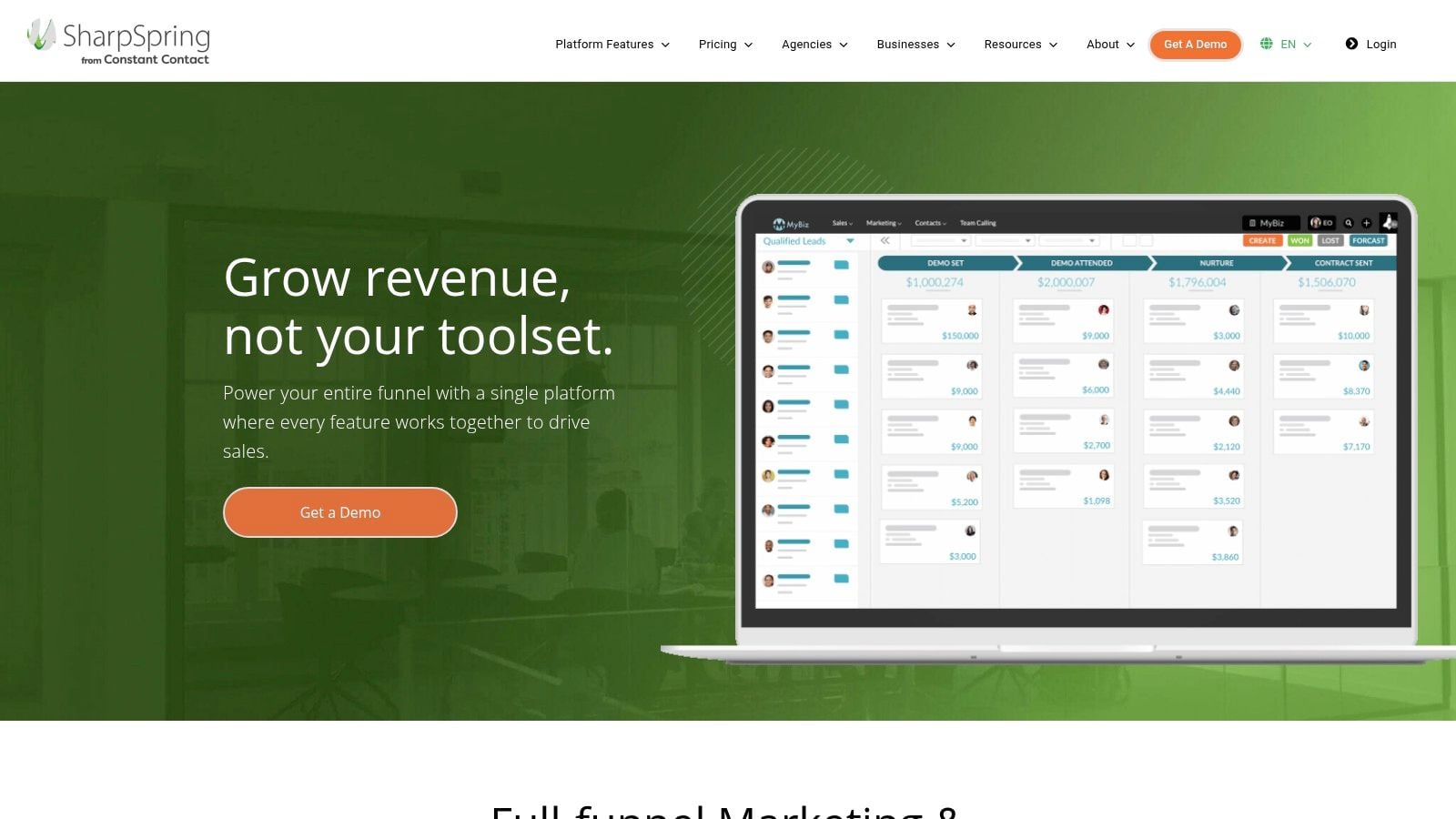
SharpSpring centers on visual workflows, dynamic content, lead scoring, and a life-of-the-lead timeline that tracks web, email, and CRM events. For agencies, that gives you the operational visibility you need to manage campaigns across clients without losing the story behind each lead.
The friction is obvious. Public self-serve pricing is limited, so you should expect a sales-assisted buying process. The UX and analytics can also feel older than newer entrants, which matters if your team values a cleaner interface. Still, for agency pricing and white-label delivery, it belongs near the top of the list.
Best fit for agencies
Use SharpSpring when you're reselling services or managing clients under your brand and you want automation plus CRM in one platform. It's less about slick design and more about practical agency economics. That makes it a natural fit for businesses that care about packaging, not just features.
If your team values client visibility and packaged delivery more than modern UI, SharpSpring is a sensible alternative. If you want the freshest interface, look elsewhere.
Best fit: Marketing agencies, resellers, and client-heavy service providers.
Trade-off: Agency-friendly economics, but less polished than newer systems.
Website: SharpSpring
10. GetResponse
GetResponse fits webinar-led teams that need email automation, funnels, landing pages, and native webinar hosting in one place. It is a practical Keap alternative for content-led conversion and event-based selling.
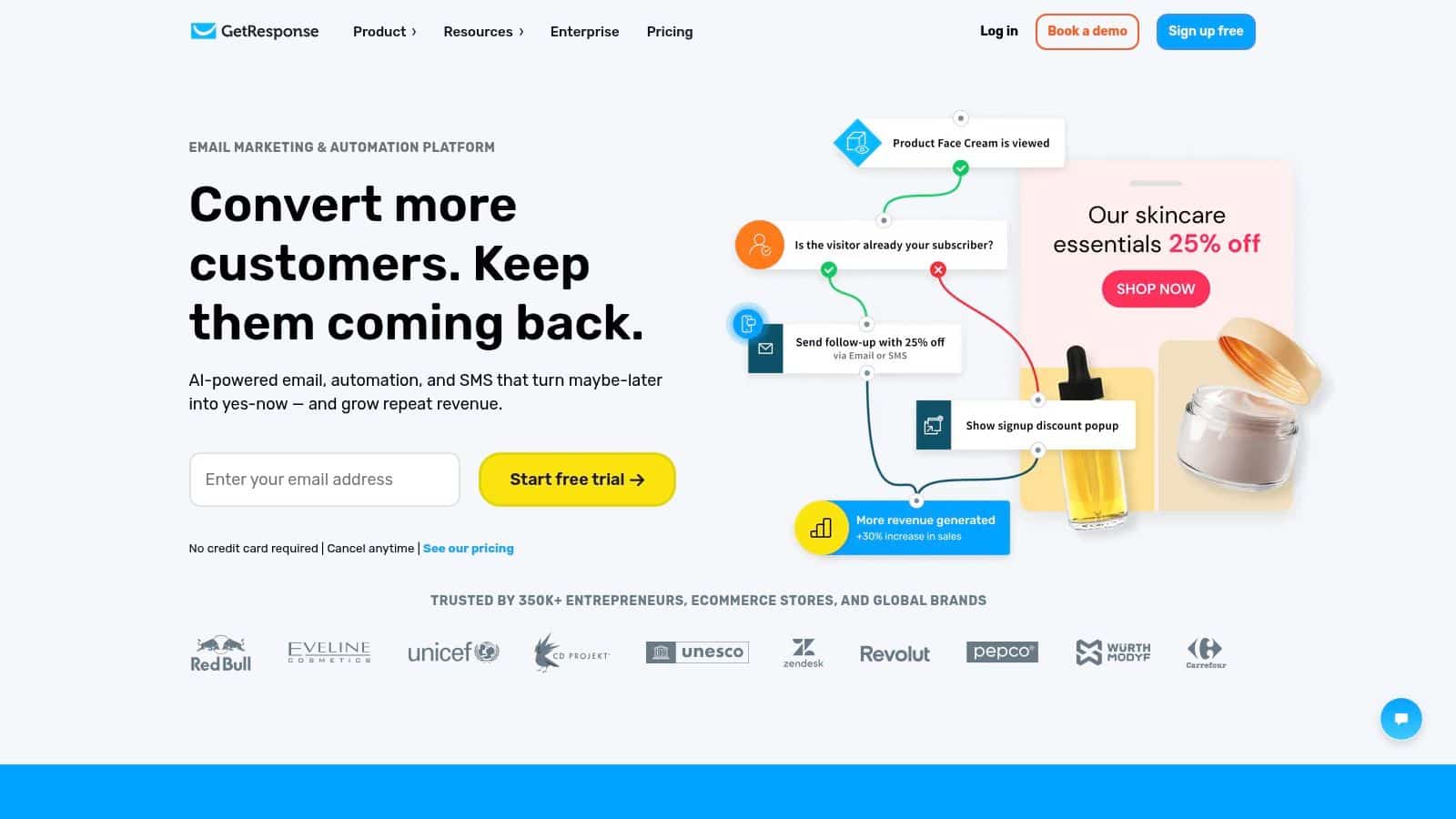
Its strength is operating model fit. Visual workflows, segmentation, conversion funnels, and webinars make sense for SMBs that want marketing execution without a heavy CRM. If your business runs on launches, live events, and nurture sequences, GetResponse gives you enough structure to move fast without building a separate webinar stack.
The trade-off is CRM depth. Once sales workflows get complicated, GetResponse feels light, so a dedicated CRM makes more sense than forcing it to do everything. That keeps the stack cleaner and avoids painful migration later.
For creators comparing audience-building tools, the alternatives to ConvertKit for growth guide is useful because it shows where GetResponse sits in the email and funnel stack. Its value is breadth for marketers, not full sales operations.
If webinars close the deal, keep the stack simple. A strong email and funnel system will do more than a bloated CRM.
Best fit: Webinar marketers, email-first SMBs, and funnel-driven businesses.
Trade-off: Strong marketing tools, but basic CRM functions.
Website: GetResponse
Top 10 Keap Alternatives Comparison
| Product | Core capabilities | Unique selling points (✨) | UX & quality (★) | Target audience (👥) | Price & value (💰) |
|---|---|---|---|---|---|
| HighLevel 🏆 | CRM + unified inbox, funnels, forms, workflows, booking, payments, reputation, broadcasts, native AI | ✨ Native AI across messaging/voice/content; true all‑in‑one; agency features (unlimited sub‑accounts) | ★★★★☆ | 👥 Agencies & SMBs needing an all‑in‑one, mobile AI OS | 💰 $97–$497/mo; Unlimited $297; 14‑day trial; high agency ROI |
| HubSpot Marketing Hub + CRM | Email, visual automations, forms/landing pages, ads, reporting, Smart CRM | ✨ Deep reporting, large app ecosystem, enterprise scale | ★★★★☆ | 👥 Mid‑market to enterprise marketing teams | 💰 Tiered pricing (contacts/seats/credits); higher cost at scale |
| ActiveCampaign | Email marketing, CX automations, CRM, site/event tracking | ✨ Flexible behavior‑driven workflows & goal tracking | ★★★★☆ | 👥 Email‑centric marketers, ecommerce, lead nurturing SMBs | 💰 Contact‑based pricing; strong automation value |
| Zoho CRM | Configurable CRM, pipelines, scoring, Zia AI; integrates with Zoho apps | ✨ Very competitive per‑user pricing; extensible via Zoho One | ★★★☆☆ | 👥 Cost‑conscious SMBs standardizing on Zoho apps | 💰 Low per‑user cost; good value for multi‑app stacks |
| Pipedrive + Campaigns | Visual pipeline, activity scheduling, simple automations, email campaigns | ✨ Fast onboarding; clear pipeline UI; modular add‑ons | ★★★★☆ | 👥 Sales teams & small businesses prioritizing pipelines | 💰 Per‑user + add‑ons; affordable but extras add up |
| Ontraport | CRM + visual campaigns, landing pages, native payments/subscriptions, memberships | ✨ Strong monetization tools for products, courses, memberships | ★★★☆☆ | 👥 Coaches, course creators, service businesses | 💰 Contact/tier pricing; good for subscription/membership ops |
| Freshsales (Freshworks CRM) | Deal pipelines, sequences, built‑in telephony, AI lead scoring | ✨ Native calling, AI insights, integrates with Freshworks suite | ★★★★☆ | 👥 SMB sales teams needing native phone/email workflows | 💰 Competitive per‑user tiers; add Freshmarketer for full marketing |
| EngageBay | CRM, email automation, landing pages, helpdesk, live chat | ✨ Budget‑friendly all‑in‑one; fast deployment | ★★★☆☆ | 👥 Small businesses & startups on tight budgets | 💰 Very aggressive pricing; strong cost/value ratio |
| SharpSpring | Marketing automation, CRM, life‑of‑lead tracking, white‑label options | ✨ Agency/reseller economics; white‑label & client management | ★★★☆☆ | 👥 Marketing agencies & resellers | 💰 Partner/quote pricing; agency‑focused value |
| GetResponse | Email automation, funnels, landing pages, native webinar hosting | ✨ Built‑in webinars + funnel templates for conversions | ★★★☆☆ | 👥 SMBs needing webinars, funnels, email marketing | 💰 Competitive for webinars; pricing by list size |
Match the Platform to Your Operating Model
The right choice comes down to how your business makes money and where Keap is creating friction. Agencies and resellers should pick HighLevel or SharpSpring because both align with multi-client delivery and platform consolidation. Reporting-heavy growth teams should go with HubSpot because the reporting and attribution stack are stronger than the lighter options.
Email-led lifecycle programs belong in ActiveCampaign because the automation logic is sharper and easier to scale than a broad generalist stack. Configurable multi-app operations should choose Zoho CRM when they want broad control, connected apps, and room to standardize across departments. Sales-first teams should choose Pipedrive or Freshsales, depending on whether pipeline clarity or native calling matters more.
Course, membership, and digital product businesses should use Ontraport because payments, subscriptions, and access control live closer to the core business model. Lean, budget-sensitive teams should choose EngageBay because it gives them the broadest practical stack without premium-suite overhead. Webinar-focused marketers should choose GetResponse because native webinar hosting changes the funnel instead of forcing another integration.
Migration matters as much as platform choice. Start by inventorying contacts and consent records, then document pipelines and automations before you touch the new system. Map fields and tags carefully, rebuild your priority journeys first, and test every form and payment flow before you import the full database.
Run a staged import, not a big-bang switch. Keep Keap live long enough to monitor deliverability, confirm conversion paths, and verify that no lead source breaks during the handoff. Retire the old stack only after the new one proves it can handle the workflows you care about most.
HighLevel gives agencies and SMBs a single place to manage CRM, follow-up, booking, payments, and reputation without duct-taping a stack together. If you're comparing keap alternatives and want an AI-powered operating system built for consolidation, visit HighLevel and see whether it matches the way your team works.
