


Choosing beyond the HubSpot all-in-one model starts with a harder question than most comparison posts ask. You’re not really choosing a “better CRM”, you’re choosing the job you want a platform to replace, whether that’s an agency operating system, an enterprise governance layer, a sales pipeline, a marketing automation engine, or a lean email-first stack. That’s why the best HubSpot alternatives split cleanly into two camps, broad replacements that collapse multiple workflows into one workspace, and specialists that do one function better or at a lower operating cost.
The market itself has moved in that direction. Affordable platforms now start in the same general budget band as standalone point tools, while review scores still sit in the mid-to-high 4-star range on major review sites, which makes “cheaper” a much weaker proxy for “weaker” than it used to be. At the same time, the category has become more segmented, so the best substitute for one team can be the wrong choice for another. A local agency, a B2B sales team, and an enterprise marketing department all buy for different reasons, and the migration burden changes just as much as the feature set.
Table of Contents
- 1. HighLevel
- 2. Salesforce Sales Cloud + Account Engagement
- 3. Zoho CRM and the Zoho bundles
- 4. ActiveCampaign
- 5. Pipedrive
- 6. Freshsales
- 7. Adobe Marketo Engage
- 8. SharpSpring
- 9. Keap
- 10. Mailchimp
- Top 10 HubSpot Alternatives Comparison
- Match the Platform to the Operating Model
1. HighLevel
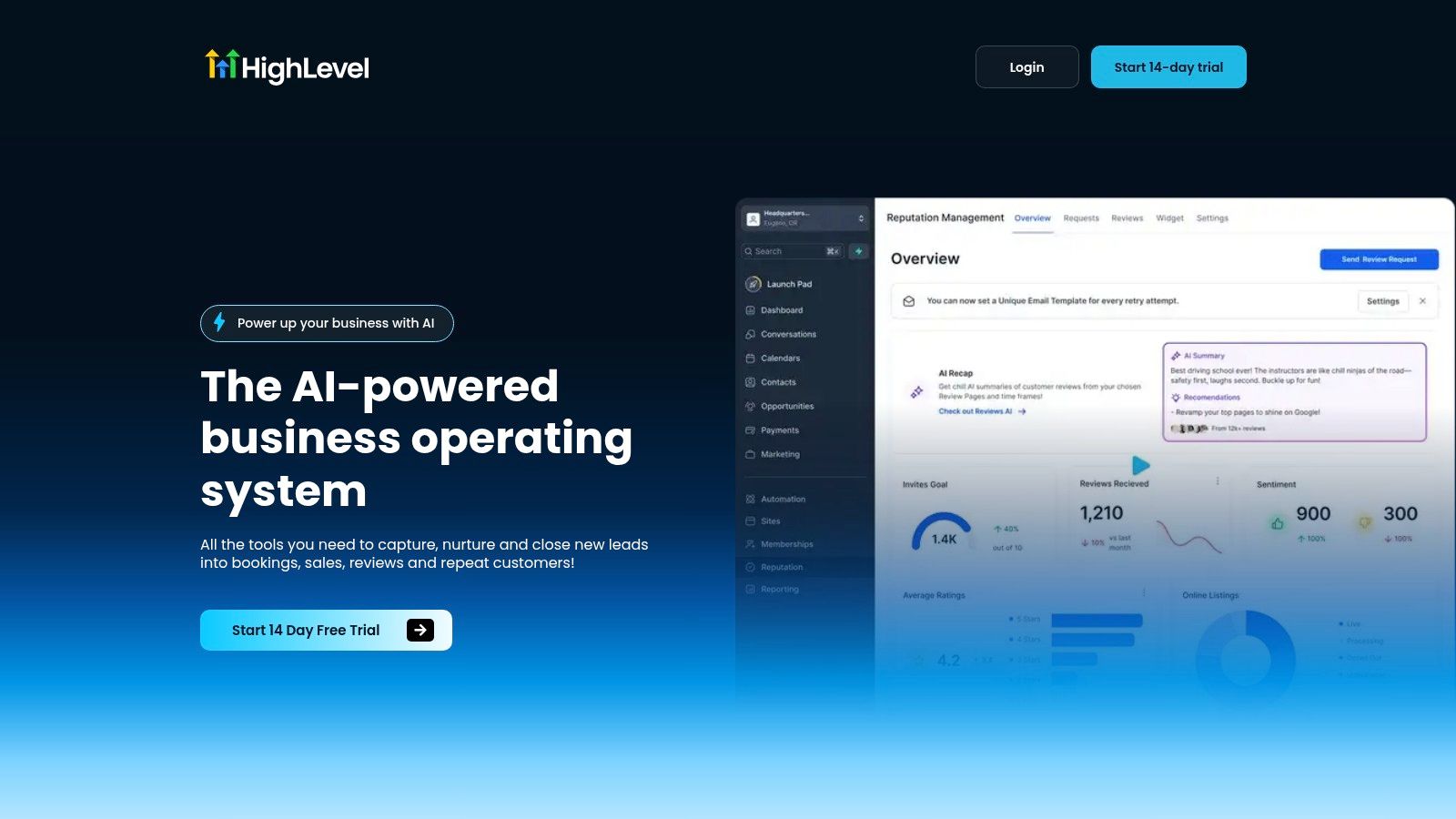
HighLevel is the clearest choice if you’re trying to replace tool sprawl, not just swap CRMs. It’s built as an all-in-one business operating system for agencies and SMBs, and its strength is that it pulls lead capture, follow-up, booking, payments, reputation, and reactivation into one mobile-friendly workspace. If HubSpot feels broad but still leaves you stitching together extra tools, HighLevel is aimed directly at that gap, especially for teams that need one system to run the front end and the back end of the pipeline.
The job it replaces
HighLevel replaces a stack more than a single product. The consolidated inbox covers SMS, Messenger, Instagram DM, WhatsApp, and live chat, while funnels, websites, webinar funnels, calendars, payments, and workflow automation sit in the same environment. For agencies, that matters because the platform is built around sub-accounts, rebilling, and a SaaS-style operating model, not just one company’s internal pipeline.
Practical rule: If your team keeps buying separate tools for follow-up, booking, reviews, and client communication, the migration pain is already part of your operating cost. HighLevel tries to remove that cost center.
The audience and the trade-off
This is the strongest fit for digital marketing agencies, multi-location businesses, coaches, course creators, and anyone trying to run a client-facing service model without assembling a patchwork of tools. HighLevel’s native AI also gives it a different feel from older suites, because conversation flows, voice, content creation, and review replies are all part of the same system rather than bolted on later.
The trade-off is complexity. A platform that can centralize this much work needs setup discipline, process mapping, and some learning time before it feels simple. If you want a narrow CRM that you can understand in an afternoon, this is probably too much. If you want a system that can reduce context switching and consolidate recurring client work, it’s one of the most compelling best HubSpot alternatives in the market.
Visit the platform itself at HighLevel if you want an all-in-one option built around agency operations, not just contact management.
2. Salesforce Sales Cloud + Account Engagement
Salesforce belongs in the conversation when the replacement job is enterprise control rather than ease of use. Sales Cloud handles the CRM core, while Account Engagement covers B2B marketing automation, so the combined stack is a logical move when a company needs governance, extensibility, and deeper coordination between sales and marketing. If HubSpot is popular because it connects functions, Salesforce is the option for teams that need that connection to survive scale, complexity, and internal process rules.
The strongest reason to choose it is breadth with structure. Salesforce offers forecasting, quoting, conversation intelligence, lead management, scoring, and a massive ecosystem through AppExchange, which makes it easier to add adjacent capabilities without rebuilding the core system. The downside is just as clear, implementation and administration can be heavy, and the add-on model can expand the total cost quickly.
Who actually benefits
Salesforce makes sense for organizations that already have a mature sales process, a defined marketing operation, and internal or partner support to administer the system. It’s not a casual swap for a small team that only wants lighter automation. The platform is closer to a control plane for revenue operations than a plug-and-play CRM, which is why it tends to fit companies that care about security, compliance, and custom workflows more than rapid rollout.
Best fit signal: If your CRM decision has to survive IT review, sales ops review, and marketing ops review, Salesforce usually belongs on the shortlist.
For buyers comparing agency-friendly software, the compare CRM software for agencies guide is a useful companion because Salesforce’s real value shows up when structure matters more than simplicity.
3. Zoho CRM and the Zoho bundles
Zoho is the most convincing answer when the goal is broad vendor coverage at an aggressive value point. Zoho CRM works as a capable standalone CRM, but the deeper story is the path into CRM Plus or Zoho One, where organizations can standardize across a much wider app stack. That makes it a strong fit for buyers who want one vendor relationship to cover sales, automation, analytics, and adjacent business functions.
Why it replaces HubSpot differently
Where HubSpot sells connection across hubs, Zoho sells density of features across a wider vendor family. That changes the migration logic. Instead of asking whether Zoho can match every HubSpot module one for one, the smarter question is whether you want a flexible CRM core that can expand into a bigger suite without locking you into a premium all-in-one pricing model. For cost-sensitive teams, that can be the decisive difference.
Zoho’s upside is obvious. It offers pipelines, workflows, blueprints, scoring, analytics, telephony, chat, and email, plus an upgrade path into broader app coverage. The downside is also consistent across user feedback, the interface can feel inconsistent across apps, and customization usually takes patience.
Where it fits operationally
Zoho is best for organizations that accept a little friction in exchange for a lot of surface area. If your team can tolerate a steeper learning curve, Zoho can replace a CRM, several light automation tools, and some operational apps under one umbrella. If your team wants the cleanest possible adoption path, the platform can feel like a trade, not a win.
That’s why Zoho often surfaces in lists of the best HubSpot alternatives, but for a different reason than HighLevel or Pipedrive. It’s less about agency operating speed and more about getting broad coverage without paying for the most polished ecosystem on the market.
4. ActiveCampaign
ActiveCampaign is the right choice when the job you’re replacing is marketing automation depth. It’s not trying to be the broadest CRM in the market. It’s trying to be the strongest automation engine for teams that live and die by segmentation, conditional logic, and follow-up design. That makes it a better alternative to HubSpot for marketers who feel constrained by simpler email tools but don’t want a heavier enterprise suite.
What it does better than a general CRM
ActiveCampaign’s core advantage is that its automation layer is much more central to the product than its CRM layer. It supports multi-step automations, cross-channel messaging, predictive sending, predictive content, and a large automation library. For ecommerce brands and info-product businesses, that matters because the platform is built around audience behavior, not just deal stages.
The CRM is there, but it’s lighter than a dedicated sales CRM. That’s not a flaw if your sales process is simple or mostly marketing-led. It’s a problem if your team expects a deep pipeline command center. In other words, ActiveCampaign is a strong replacement for email-heavy lifecycle marketing, not a universal substitute for every HubSpot use case.
The migration burden
Migrating to ActiveCampaign usually means rethinking your automation architecture rather than just importing contacts. If your existing HubSpot setup has a lot of workflows tied to lifecycle stages, scoring, and conditional branching, you’ll want to document those logic paths carefully before you move. The platform rewards teams that know exactly how they nurture leads, but it can feel like too much machine if your process is still loosely defined.
Practical rule: If your revenue depends on follow-up sequences, audience segmentation, and triggered messaging, choose the automation engine first and the CRM second.
For teams comparing marketing-led stacks, the top SaaS marketing automation KPIs 2026 resource can help frame what to preserve during migration.
5. Pipedrive
Pipedrive is the simplest recommendation for sales-pipeline clarity. It replaces HubSpot best when your team doesn’t need a full marketing suite and doesn’t want to pay for one. The product is built around a visual deal flow, fast onboarding, and a clean interface that sales teams can keep up with.
Why sales teams like it
The main benefit is focus. Pipedrive strips out a lot of the extra surface area that makes broader suites feel heavy, and that means reps can get into the system quickly. It supports visual pipelines, forecasting, email sync, scheduling, workflow automation, and a wide integration set, so you’re not giving up modern CRM basics. You are, however, giving up deeper native marketing automation.
That makes Pipedrive a better fit for teams whose revenue motion is straightforward. If your business depends on outbound follow-up, pipeline discipline, and quick rep adoption, the platform usually feels easier than HubSpot. If you need a connected marketing and service ecosystem, you’ll end up filling the gaps with other tools.
How to think about migration
Pipedrive typically introduces lower implementation friction than a broader suite, but the migration still matters. You’ll want to map stages, fields, and activity definitions carefully, because the platform works best when the pipeline reflects how the team sells. It’s a better operational match for businesses that want speed and simplicity than for businesses that want a single system to manage the whole customer journey.
For a broader comparison of lead-routing and capture tools, the compare lead tracking software tools guide is useful if your current HubSpot setup is mostly about pipeline movement rather than full marketing orchestration.
6. Freshsales
Freshsales sits in a very practical middle ground. It’s the alternative for teams that want integrated sales communications without moving into an enterprise-heavy suite. Built-in phone, email, chat, AI insights, and sales pipeline tools make it a good replacement for teams that spend a lot of time talking to leads across multiple channels.
The operational advantage
Freshsales works well when your team wants a single place to handle conversations and sales activity. The built-in telephony and chat reduce the need to stitch together separate communication tools, and the AI layer helps with insights and scoring. That’s a meaningful difference for sales teams that want a modern workflow without a huge admin burden.
The platform also has a clearer adoption story than many broad suites. It feels designed for sales teams first, with stronger communication tools than a minimal CRM and less complexity than an enterprise marketing platform. If your team needs CRM plus communication, that balance is useful.
Where it becomes less ideal
The drawback is segmentation. Advanced marketing automation sits in a separate SKU, which means Freshsales isn’t the cleanest answer if your replacement job includes serious lifecycle marketing. You can absolutely run a solid sales operation on it, but once you start asking for the marketing side to do more, the stack spreads out again.
Best fit signal: Choose Freshsales if your team wants a CRM with built-in calling and messaging, but not a full marketing suite bolted onto every workflow.
For buyers focused on AI-assisted CRM workflows, the find the right AI CRM guide can help sharpen the comparison.
7. Adobe Marketo Engage
Marketo is one of the strongest choices when the replacement job is complex B2B marketing orchestration. It’s not there to simplify your stack. It’s there to handle journeys, segmentation, lead and account scoring, ABM programs, and enterprise governance. That makes it a serious alternative for organizations that have outgrown simpler marketing automation and need more control over program design.
Who should look at it
Marketo fits enterprises that already run layered campaigns across multiple audiences, products, or business units. Its value is in program depth and integration with major CRMs like Salesforce, Microsoft Dynamics, and Veeva, plus enterprise features like workspaces, partitions, and sandbox options. That combination supports larger teams that need to coordinate complex demand generation without losing control of data or permissions.
The trade-off is obvious. Pricing is quote-based, and implementation usually requires experienced admins. That’s not a downside for a mature marketing ops team, but it is a real migration burden if you’re coming from a lighter platform and expect a simple lift-and-shift.
The decision point
Marketo is not the best answer for buyers who mainly want a friendlier UI or a lower subscription. It is the answer for teams that need segmentation, attribution, and B2B or ABM depth. If your current HubSpot setup is hitting limits because the campaigns are becoming more complex than the system or your team can comfortably manage, Marketo is one of the few alternatives that can handle that jump.
For teams managing SaaS pipeline complexity, the top SaaS marketing automation KPIs 2026 perspective is especially relevant because Marketo makes the most sense when measurement and governance are part of the operating model.
8. SharpSpring
SharpSpring stands out because it speaks directly to the agency delivery model. That makes it one of the most strategically relevant alternatives for readers who aren’t just buying software for one business, but for a multi-client service operation. The platform’s agency tools, including multi-client management and white-labeling, give it a purpose that generic CRM comparisons usually miss.
Why agencies care
Agencies need more than pipeline management. They need a system that supports recurring delivery, template reuse, client isolation, and a way to package marketing automation as part of retainers or managed services. SharpSpring is attractive because it’s designed around that operating style, and unlimited users can lower per-seat pressure for teams that manage several accounts.
It also bundles CRM, email, landing pages, forms, blog, social, and automation, so agencies can centralize more of the marketing stack without fragmenting client work across too many tools. That doesn’t make it as expansive as Salesforce or Adobe-class ecosystems, but it can be a much better economic fit for smaller delivery teams.
What to watch during migration
The migration burden is mostly about ecosystem expectations. SharpSpring won’t feel as large or as polished as the biggest enterprise vendors, and that’s part of the trade. If your team values agency workflow support more than a huge marketplace, the fit can be strong. If you need the broadest possible app ecosystem or the most mature enterprise controls, you’ll probably feel the limits faster.
Practical rule: Agency software should reduce duplication across clients. If a platform makes every new account feel like a fresh build, it’s working against your margin.
9. Keap
Keap is best for small businesses that want coached adoption as much as software. It combines CRM, automation, email, SMS, appointments, invoices, and payments, but its distinction is that it supports small teams with templates, onboarding, and professional services. That makes it appealing for owners who don’t have the time or desire to architect everything themselves.
Why it replaces HubSpot for small operators
Keap works well when the business needs to tie together sales, scheduling, and payment workflows without turning the stack into a puzzle. Keap Pay, invoicing, and visual automations give it a practical edge for service businesses that want to move from lead to revenue inside one system. The platform is especially attractive if you want a tool that comes with guidance, not just a login.
The trade-off is less about features than control. Pricing and plan details can change, and advanced reporting can take more work than a more analytics-heavy platform. That means Keap is usually a better fit for founders and small teams who value guided setup over custom operations.
The audience
Keap is strongest for owners who want one dependable operating layer and don’t want to spend weeks designing every workflow. It’s not the deepest enterprise solution, and it’s not the most flexible agency OS. It is, however, a credible best HubSpot alternatives option for SMBs that need CRM, automation, payments, and some implementation help in the same package.
10. Mailchimp
Mailchimp is the cleanest choice when the job you want to replace is email-first execution. It’s not built to be a deep CRM or sales system, and that’s exactly why some teams prefer it. If your current HubSpot usage centers on campaigns, forms, landing pages, and audience management, Mailchimp can be the simpler, more familiar path.
Why it stays relevant
Mailchimp’s strengths are usability, templates, and a familiar interface. It offers marketing automation flows, AI content tools, testing options, forms, landing pages, integrations, and optional SMS in supported markets. That makes it a good fit for marketers who need to launch quickly and don’t want a heavier CRM framework around every campaign.
The limitation is just as clear. CRM and sales pipeline features are basic, and advanced automation lives higher up the plan ladder. If you need sales, service, and operations in one environment, Mailchimp is the wrong replacement. If you mainly need reliable email infrastructure with simple audience handling, it’s a practical one.
When migration is easy and when it isn’t
Mailchimp migrations are easiest when you’re moving from email campaigns and lead capture, not from a interconnected CRM. If your HubSpot setup contains lots of lifecycle logic, scoring, and sales handoffs, moving to Mailchimp means simplifying the model rather than preserving it. That can be a good thing if your team is overcomplicating its stack, but it’s a real loss if cross-functional automation matters.
For landing-page focused marketers, the 2026 landing page benchmark data is a useful reference point when you’re deciding how much of your conversion layer should live inside the email platform.
Top 10 HubSpot Alternatives Comparison
| Product | Core capabilities (✨) | UX & Quality (★) | Pricing & Value (💰) | Target & USP (👥 / ✨) |
|---|---|---|---|---|
| HighLevel 🏆 | CRM + unified inbox (SMS/DMs/chat), funnels, paid calendars, Text‑2‑Pay, automations, reputation, mobile app | ★★★★☆, native AI, mobile‑first, 24/7 support | 💰 Starter $97/mo · Unlimited $297/mo (unlimited sub‑accounts) · Agency Pro $497/mo · 14‑day trial | 👥 Agencies, multi‑location SMBs, ✨ all‑in‑one stack, unlimited contacts/sub‑accounts, embedded AI |
| Salesforce Sales Cloud + Account Engagement | Enterprise CRM, sales/service, Account Engagement for B2B journeys, AppExchange integrations | ★★★★☆, highly configurable, enterprise governance | 💰 Quote/add‑ons; higher TCO but scales for large orgs | 👥 Enterprises & complex sales orgs, ✨ extensibility, ecosystem, compliance |
| Zoho CRM (CRM Plus / Zoho One) | Sales pipelines, workflows, omnichannel (telephony/email/chat), upgrade to 50+ app Zoho One | ★★★☆☆, value-rich; UI consistency varies | 💰 Very competitive; bundles for broad coverage (CRM Plus/Zoho One) | 👥 SMBs & cross‑dept teams, ✨ breadth of apps at low cost |
| ActiveCampaign | Email & marketing automation, CRM‑lite, segmentation, landing pages, predictive content | ★★★★☆, best‑in‑class automation & deliverability | 💰 SMB‑friendly; pricing scales with contacts | 👥 E‑commerce & info‑product marketers, ✨ deep automation library |
| Pipedrive | Visual pipelines, forecasting, scheduler, workflow automations, 500+ integrations | ★★★★☆, clean UX, fast onboarding | 💰 Affordable per‑user plans; paid add‑ons for lead gen | 👥 Sales teams & SMBs, ✨ pipeline clarity & quick adoption |
| Freshsales (Freshworks) | AI insights (Freddy), built‑in telephony/chat/email, multi‑pipeline, CPQ options | ★★★★☆, unified comms with AI assists | 💰 Clear pricing; 21‑day trial; marketing advanced in separate SKU | 👥 Mid‑market sales teams, ✨ built‑in phone + AI scoring |
| Adobe Marketo Engage | Enterprise marketing automation, ABM, advanced segmentation, analytics | ★★★★☆, powerful but complex; enterprise fit | 💰 Quote‑based; premium cost for enterprise programs | 👥 B2B enterprises & ABM teams, ✨ deep ABM & attribution |
| SharpSpring (by Constant Contact) | Built‑in CRM, email, landing pages, automation + agency multi‑client & white‑label tools | ★★★☆☆, agency‑oriented but smaller ecosystem | 💰 Competitive at high contact volumes; agency pricing | 👥 Agencies reselling services, ✨ white‑label & unlimited users |
| Keap | SMB CRM, visual automations, Keap Pay payments, appointments, invoicing, coaching services | ★★★☆☆, template + coaching driven UX | 💰 SMB plans; pricing/scale varies with usage and services | 👥 Small businesses & solopreneurs, ✨ integrated payments + onboarding help |
| Mailchimp (by Intuit) | Email campaigns, automation flows, audience mgmt, landing pages, SMS add‑on | ★★★★☆, familiar UI, strong deliverability | 💰 Flexible (tiered, PAYG, nonprofit discounts) | 👥 Marketers & small teams, ✨ ease‑of‑use, templates, deliverability |
Match the Platform to the Operating Model
The best choice depends on the operating model you run. Choose HighLevel when you need a consolidated workspace for conversations, funnels, automation, booking, payments, reputation, and reactivation, especially if you're an agency or a growth-focused SMB trying to reduce tool sprawl. Choose Salesforce or Marketo when the business needs enterprise governance, advanced permissions, and complex B2B program design. Choose Zoho when you want broad vendor coverage and a strong value story across multiple apps, even if the experience takes more getting used to.
Choose ActiveCampaign when marketing automation is the center of gravity. Choose Pipedrive when the sales pipeline is the only part that really needs to be simpler and faster. Choose Freshsales when your team needs integrated sales communications without the overhead of a broader marketing suite. Choose SharpSpring when the buyer is really an agency that needs multi-client delivery and white-label options. Choose Keap when a small business wants guided adoption, CRM, automation, and payments in one environment. Choose Mailchimp when the main job is email-first execution and audience management, not CRM depth.
Migration is where a lot of teams misjudge the total cost. Inventory the data before you move. Map fields and lifecycle stages, document consent and communication records, capture automation logic, and list every integration that depends on the current stack. Then test in stages, replace forms or redirects where needed, train the team before cutover, and monitor the first live workflows closely so problems show up early instead of after revenue slips.
The biggest mistake is comparing subscription price in isolation. Add-ons, implementation time, contact growth, admin overhead, and the effort required to keep multiple systems in sync all change the economics. That's why the most defensible choice isn't the cheapest logo on the shortlist, it's the platform that fits the way your business operates and the amount of complexity your team can sustain, which is the same lens a strong best seo agency for saas partner would use when advising on stack decisions.
HighLevel gives agencies and SMBs one place to manage conversations, funnels, follow-up, booking, payments, and reputation without stitching together a dozen tools. If you're comparing best HubSpot alternatives and want an AI-powered operating system built for real workflow consolidation, visit HighLevel and see how it can fit your team.
