


You’re not short on tools, you’re short on a system that your agency can sell, support, and scale. If you’ve got one app for leads, another for scheduling, a third for reporting, and a fourth for client billing, the stack looks busy but the business still feels brittle. That’s why the best white label CRM choices aren’t just about a rebranded logo, they’re about whether you can manage multiple clients, rebill cleanly, and keep the whole operation from collapsing under tool sprawl.
White-label CRM also sits in a market that’s already proven demand. One 2026 guide puts the white-label CRM segment at $2.8 billion with 34% annual growth, while broader CRM research in 2024 to 2026 roundups places the global CRM market around $73.4 billion to $126.2 billion depending on methodology and scope, and businesses using CRM software report 21% to 30% higher sales revenue after implementation, with CRM users 86% more likely to exceed sales goals than non-users, according to the same guide. On the adoption side, Freshworks reports 73% of businesses used CRM software in 2024, including 94% in tech and 71% of small businesses, and 81% planned to increase CRM budgets the following year. That’s the backdrop for this list, agencies already know CRM works, the key question is which platform lets you package it like a product instead of a patchwork.
Table of Contents
- 1. HighLevel
- 1. HighLevel
- 2. Vendasta
- 3. SharpSpring by Constant Contact
- 4. SuiteDash
- 5. DashClicks
- 6. vcita White-Label Partner Platform
- 7. Simvoly White-Label CRM and Sites and Funnels
- 8. Complete CRM GreenRope White-Label
- 9. EngageBay White-Label Reseller Program
- 10. Clientjoy
- Top 10 White-Label CRM Comparison
- Making Your Choice The Right CRM to Scale Your Agency
1. HighLevel
A client signs up for marketing help, then the account quickly becomes a pile of disconnected tools. Leads sit in one app, bookings in another, billing in a third, and your team ends up managing work instead of moving it forward. HighLevel fits agencies because it brings CRM, multi-channel inboxes, funnels, bookings, payments, reputation management, and broadcast campaigns into one workspace, so the day-to-day work stays tied to one client record instead of spread across a dozen tabs. That is why it is often treated as a white label CRM for agencies, especially when your business depends on client sub-accounts, rebilling, and recurring service packages.
Practical rule: if the platform cannot handle lead capture, follow-up, billing, and reputation in one place, you will still end up stitching together software behind the scenes.
Why agencies pick it
HighLevel’s agency-first structure is the main reason it keeps showing up in conversations about service businesses that want real control, not just a rebranded login screen. The published plans include unlimited contacts, the Unlimited plan includes unlimited sub-accounts, and it supports rebilling for phone and email with no markup, which matters once you want software to support margin instead of eat into it. It also includes basic API access, mobile-first workflows, and a public ideas board backed by 24/7 support and a large community, so product feedback has a place to go and the platform can keep adapting around agency use.
That said, HighLevel is not the cleanest fit for every team. Agencies that want a simple client portal with light CRM needs may find it heavier than necessary, and the breadth that helps larger operators can also mean more setup work before the system feels organized. For teams that need a tool built around multi-client management and rebilling, though, it gives enough structure to run delivery without forcing every client into a separate stack. If you want to compare it with other agency-ready options, the top white-label CRM options list is a useful next stop.
For agencies that intend to package CRM as a service, HighLevel gives you the operational pieces that matter most. It is built for recurring delivery, it supports account separation, and it gives you room to scale without rebuilding the process each time you add a client.
1. HighLevel
HighLevel earns the featured spot because it’s built for the exact agency problem of having too many disconnected tools and not enough operational control. It combines CRM, multi-channel inboxes, funnels, bookings, payments, reputation management, and broadcast campaigns in one workspace, which matters when your team needs to move leads from first contact to repeat business without exporting data between apps. You can see why it’s often treated as a white label CRM for agencies rather than just another sales tool, especially if your model depends on client sub-accounts, rebilling, and recurring service packages.
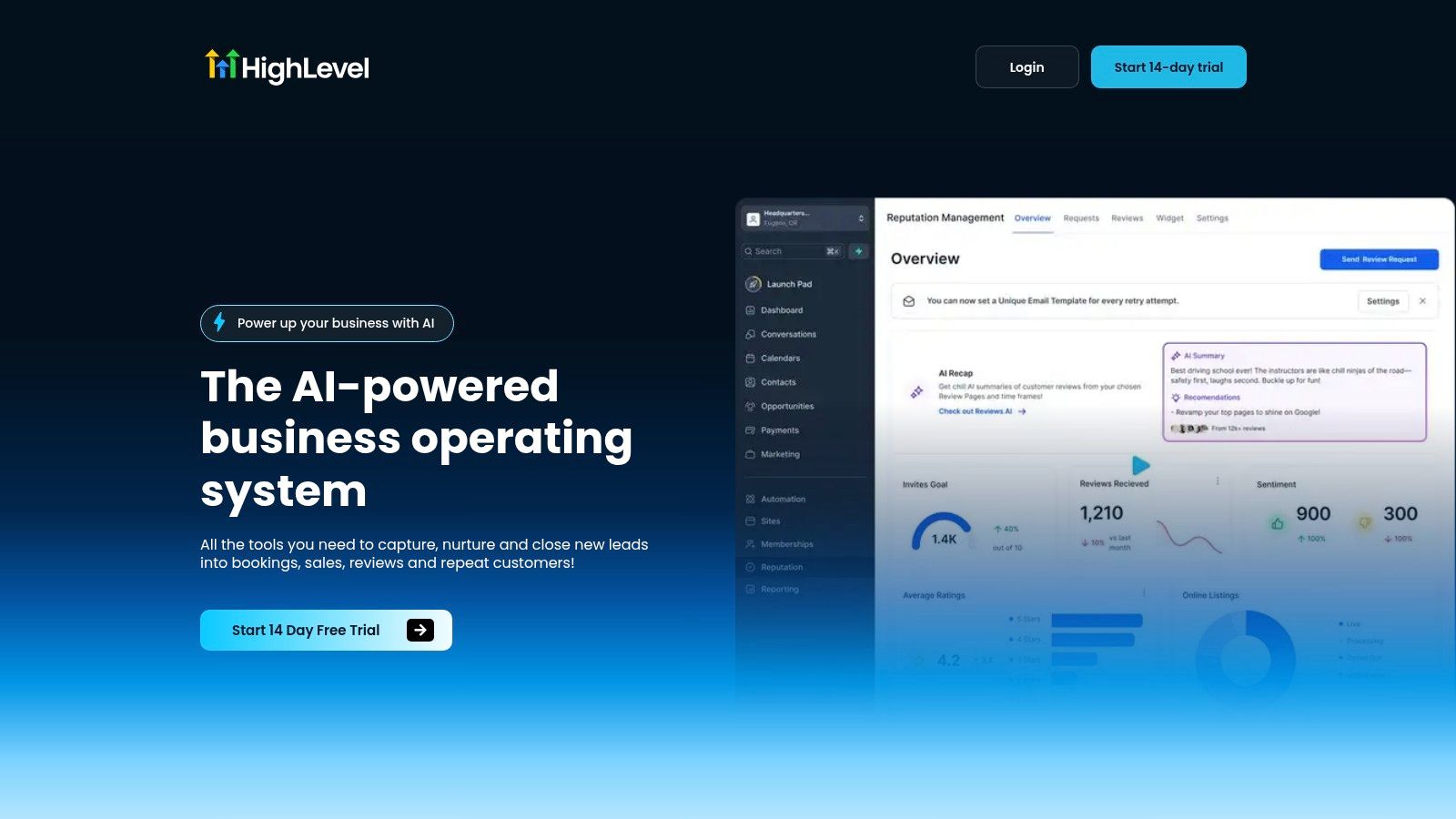
Practical rule: if the platform can’t handle lead capture, follow-up, billing, and reputation in one place, you’ll still end up stitching together software behind the scenes.
Why agencies pick it
HighLevel’s agency-first structure is a key differentiator. The published plans include unlimited contacts, the Unlimited plan includes unlimited sub-accounts, and it supports rebilling for phone and email with no markup, which is the kind of detail that matters once you’re trying to turn software into margin. The platform also includes basic API access, mobile-first workflows, and a public ideas board backed by 24/7 support and a large community, so product feedback doesn’t disappear into a black box. For agencies comparing the field, the top white-label CRM options roundup is a good reference point, but HighLevel usually wins when the brief is “replace the stack,” not “brand the stack.”
The automation side is where it feels built for revenue, not just record keeping. Native AI is embedded across conversations, reviews, and content, so teams can automate follow-up and move faster on lead response without building every workflow from scratch. It also bundles commerce features like Text-2-Pay, Tap-2-Pay, upsells, memberships, invoices, and gift cards, which makes it a strong fit for local services, coaches, and multi-location brands that need more than pipeline tracking.
What to watch
Setup takes real effort. If you want funnels, automations, inboxes, and calendars working cleanly across multiple clients, you have to configure it with care, and small agencies can feel the starter plan limits quickly once they outgrow the basics. That said, agencies that stick with it usually do so because the operational upside is obvious, the platform lets them look like a software company without building like one.
- Best for: digital agencies, local service firms, and SaaS-style resellers that want one operating system.
- Weak spot: there’s enough depth here that sloppy onboarding can turn into clutter.
- My take: if your revenue depends on recurring retainers and client-facing software, this is the most agency-ready option in the list.
Website: HighLevel
2. Vendasta
Vendasta feels like the choice for agencies that want a broader resale business, not just a CRM with a different logo. The white-label structure extends into a branded client app, a storefront, and a marketplace of resellable services, so you can bundle more than contact management under one umbrella. That’s useful when your offer already spans listings, reputation, ads, websites, or fulfillment, because it reduces how many vendors you need to coordinate.
The platform’s strength is breadth. A lot of agencies want to sell a business outcome, then discover they need separate tools for intake, reporting, delivery, and client communication. Vendasta’s Partner Center and marketplace approach solve that by giving you a central back office and a packaged customer-facing experience, which makes it easier to present one coherent offer instead of five disconnected services. The trade-off is obvious, the wider the ecosystem, the easier it is for onboarding to feel heavier than a single-purpose CRM.
Where it fits
This is the better fit if you care about reselling multiple products from one branded shell. The white-label CRM is part of a larger agency system, so it makes more sense for firms that already think in terms of bundled offers and recurring revenue stacks. It’s also attractive if you want mature partner enablement and documentation, because that reduces the amount of trial-and-error needed to get a client-facing program live.
For agencies that are still building their own delivery model, Vendasta can feel like a lot. There’s more to learn, more to configure, and more opportunities to add services than a lean agency may need. But if you’re already selling reputation, listings, and marketing services, the platform’s structure helps you present a more complete offer under your own brand.
Practical trade-off
What works here is the ability to centralize packaging and resale. What doesn’t work as well is the temptation to bolt on every available service and make the client experience harder to explain. Agencies that do best with Vendasta usually define the offer tightly, then add tools only when they support a clear workflow.
Website: Vendasta
3. SharpSpring by Constant Contact
SharpSpring is for agencies that still care about automation and email, and want a white-label structure that supports reselling without abandoning familiar marketing fundamentals. It’s not the flashiest platform in the list, but it remains relevant because so many agencies still need a strong visual automation builder, a native CRM, and the ability to manage multiple clients from one console. That combination is still valuable when your business lives or dies by nurture sequences and lifecycle follow-up.
One reason it stays on the shortlist is that it feels closer to a classic agency automation tool than a broad business operating system. That’s good if your team already has a mature marketing process and doesn’t need a full suite of scheduling, payments, and reputation features bundled in. It’s less convincing if you want omnichannel messaging across SMS, social DMs, and newer client communication channels, because the platform’s center of gravity is still email and marketing automation.
Where it works best
If your agency sells email strategy, automation setup, and pipeline nurture as a core service, SharpSpring makes sense. The white-label branding lets you present the tool as part of your own stack, and the multi-client structure supports the kind of back-office organization agencies need when they manage several retainers at once. It’s also easier to justify when your delivery model is built around campaigns and automation rather than appointment booking or direct payments.
Agencies that are already strong at lifecycle marketing usually get more out of SharpSpring than agencies trying to force it into an all-in-one ops role.
For teams comparing it with newer options, the 2026 agency marketing automation playbook can help frame whether you need a dedicated automation platform or a wider agency OS. SharpSpring tends to win on familiar automation depth, not on breadth.
Watchouts
The biggest drawback is channel coverage. If your clients expect everything from SMS to social inbox management to live chat inside one system, SharpSpring won’t feel as complete as some newer agency-first platforms. That doesn’t make it weak, it just means it serves a more specific use case.
Website: SharpSpring
4. SuiteDash
SuiteDash is the cleanest answer for agencies that want the client experience, billing, and project delivery wrapped into one branded environment. It’s less about marketing automation and more about operating the client relationship from intake to invoice. That makes it attractive if your agency spends a lot of time sending proposals, collecting signatures, delivering files, and chasing payment.
The white-label angle is broad here. You can brand the client portal, use a custom domain, and keep users inside one environment for proposals, contracts, e-sign, billing, recurring payments, projects, and learning materials. For agencies that deliver ongoing services, that reduces friction in the part of the business that’s usually the messiest, client communication after the sale.
Why it feels practical
SuiteDash is a strong fit when you don’t want to pay for several separate tools just to keep clients informed and paid. The flat, unlimited-user structure is appealing for scaling teams because you’re not constantly checking seat counts before adding another account manager or delivery lead. That predictability matters when you’re trying to standardize operations across a growing book of business.
It’s also a good fit for agencies with a lot of repeatable client workflows. If every project starts with a proposal, moves into onboarding, then loops through file sharing and billing, SuiteDash keeps the handoffs tidy. The LMS component adds another layer if you package training or client education as part of your offer.
Where it falls short
The limitation is marketing depth. If you need serious omnichannel outreach, ad management, or advanced campaign orchestration, you’ll still pair SuiteDash with other tools. It’s strongest as the delivery and client-portal layer, not as the engine for lead generation.
That’s not a flaw if your agency already has its acquisition stack sorted. It just means SuiteDash is better for operational maturity than for flashy top-of-funnel growth.
Website: SuiteDash
5. DashClicks
DashClicks is the platform you look at when you want software and fulfillment under one roof. The white-label CRM and client dashboards handle the front end, while the service marketplace helps agencies resell SEO, PPC, and web services without building every capability in-house. That makes it useful for shops that want to move quickly from selling to delivery.
The appeal is simplicity in vendor management. Instead of coordinating separate providers for reporting, fulfillment, and account management, DashClicks gives you a single brandable layer to present to clients. That can shorten your operational stack fast, which matters when you’re trying to launch offers without hiring a full internal production team.
What agencies get
The platform works especially well for agencies that sell packaged services and want a cleaner way to show progress. A branded dashboard and reporting layer help clients see activity without needing direct access to your internal systems. Combined with fulfillment services, that creates a more turnkey model than a standalone CRM.
It’s also easy to explain to prospects. You’re not pitching software as software, you’re pitching a service wrapper that happens to run through your brand. That is a good fit for agencies that still want to feel hands-on and managed rather than purely self-serve.
Where the fit is narrower
The CRM itself is aimed more at agency basics than deep sales operations. If your team needs advanced pipeline logic, complex permissions, or nuanced workflow automation, you may find yourself wanting more depth. The platform is strong as a service hub, but it’s not the tool I’d pick for elaborate multi-stage revenue operations.
For agencies that want one vendor for both delivery and reporting, it’s a practical choice. For those that need a highly specialized CRM, it may feel like a good wrapper around a lighter core.
Website: DashClicks
6. vcita White-Label Partner Platform
vcita makes the most sense for agencies serving appointment-driven businesses that need a simple, branded operational layer. Think local service pros, clinics, salons, and other businesses where scheduling, payments, and follow-up matter more than long, complex sales cycles. The white-label partner approach lets you package that experience under your own brand without asking clients to learn a heavyweight platform.
The product leans toward practical business management rather than advanced marketing. That’s a benefit when your clients just need to book appointments, send invoices, accept payments, and stay on top of basic communications. It lowers implementation friction and keeps the value proposition easy to explain.
Why agencies use it
The strongest use case is vertical specialization. If your agency serves local businesses, vcita gives you a software layer that aligns with how those businesses work. The branded client experience helps you look more established, and the lower complexity makes onboarding easier for both your team and your customers.
It also helps agencies that want to productize a simple service stack. You can bundle scheduling, invoicing, and light CRM functions into an offer that feels coherent rather than cobbled together. For small businesses that don’t need a complex omnichannel system, that’s often enough.
If the client’s business lives in the calendar, not the pipeline, vcita is usually a better fit than a heavyweight agency OS.
The limits
vcita is not built for advanced ad funnels or broad multi-channel outreach. If your clients want deeper automation, social engagement, or more robust client lifecycle orchestration, you’ll need complementary tools. That’s fine if your offer is service-led and appointment-heavy, but it’s a constraint if you’re trying to build a more expansive software platform.
Website: vcita Partner Platform
7. Simvoly White-Label CRM and Sites and Funnels
Simvoly is a smart pick for agencies that sell websites and funnels first, then need the CRM to follow the click. The platform is centered on visual site building, funnels, checkout, and A/B testing, with CRM functions tied closely to each workspace. That makes it useful for productized web services, especially when every client gets a branded environment and a measurable path from landing page to sale.
The funnel-centric design is what makes it different. Instead of treating CRM as a separate back-office tool, Simvoly attaches it to the site and conversion flow, so lead data stays close to the page that generated it. That’s efficient for agencies that build and iterate landing pages for a living.
Where it shines
Fast onboarding is a major advantage. Templates make it easier to get clients live without long implementation cycles, and one-click upsells and funnel analytics are a good fit for teams selling conversions as a service. The white-label SaaS structure also lets agencies present the platform as their own branded builder, which is a strong fit for recurring web or funnel retainers.
For agencies leaning into landing page strategy, this HighLevel landing page strategy is a relevant reference because the same principle applies here, the CRM works best when it’s attached to a page flow that already converts.
The trade-off
The CRM is tied closely to the site and funnel model, so deeper sales operations can feel limited without integrations. That’s not unusual for a tool in this category, but it matters if your agency needs more than web-to-lead tracking. Also, white-label pricing isn’t public in the same way as some other tools, so you’ll need to contact the company for availability.
Website: Simvoly
8. Complete CRM GreenRope White-Label
Complete CRM is the choice for agencies that want a broad suite and don’t mind a denser interface. The appeal is obvious, sales CRM, marketing automation, email, projects, events, and service desk functions are bundled into one rebrandable environment. That makes it useful when you want fewer tools and are willing to invest in setup and training.
This is not the most lightweight option on the list. It’s built for teams that value completeness over simplicity, and that usually means there’s more to learn before the system feels smooth. But once it’s configured, it can reduce the need for bolt-on tools across the agency.
Why it stands out
The pricing model is one of the more agency-friendly parts of the setup because it scales by contacts rather than seats, and all features are included at every tier. That can be attractive for agencies managing a lot of users across client accounts, especially when adding people shouldn’t trigger a pricing headache every time.
The white-label reseller angle also matters if you want recurring revenue without stitching together a separate billing or portal layer. It lets the platform function as a broad operating system rather than a single-department tool.
The best fit here is an agency that can handle complexity and wants a broad all-in-one stack more than a polished minimalist interface.
What to expect
The learning curve is real. Agencies that move fast may find the UI dense, and teams without a process owner may struggle to get full value from it. Still, if your agency has outgrown simple tools and wants to keep sales, marketing, and service in one branded system, it’s worth a serious look.
Website: Complete CRM
9. EngageBay White-Label Reseller Program
EngageBay is a strong budget-conscious option for agencies that still want a broad CRM, marketing, and service suite. It covers pipelines, email automation, and help desk functionality, then adds a reseller program for agencies that want to package it under their own brand. That combination gives smaller shops a practical entry point into white-label software without going straight to an enterprise-style platform.
The value proposition is straightforward. You get a unified toolset that can handle sales, marketing, and customer service in one place, which makes it easier to standardize client delivery. For agencies working with SMBs, that’s often enough.
Why it works
The learning curve is gentler than some larger automation platforms, so it’s easier to deploy across a small team or a budget-sensitive client base. That can be a real advantage if your agency is trying to productize without creating a heavy implementation burden. The white-label controls, custom domain support, and partner structure help you keep the client-facing experience consistent.
The white label CRM for marketing agencies guide is worth a read if your team is deciding whether a reseller program is enough or if you need deeper agency operations. EngageBay fits best when the answer is “we need a practical stack now.”
Limits to keep in mind
The ecosystem is not as broad as the larger agency platforms. If you need a deep marketplace, a mature fulfillment layer, or advanced multi-client operations, you may hit the ceiling sooner. That doesn’t make it a weaker product, it just means it’s better for leaner teams and simpler offers.
Website: EngageBay
10. Clientjoy
Clientjoy is built for agencies and freelancers that want a clean client experience without a heavyweight marketing stack. The platform centers on CRM, proposals, invoicing, and a branded portal, so it solves the part of the workflow where many agencies still rely on email threads and scattered documents. That makes it especially useful if your revenue depends on moving prospects from proposal to payment without friction.
The white-label capability matters because it gives you a client-facing environment that feels like your own product. That helps with trust, especially for smaller agencies that want to look more polished without hiring a development team to build a portal from scratch. The result is a simpler, more direct client journey.
Why it deserves a look
Clientjoy is straightforward to roll out. You can get a branded pipeline, proposals, billing, and reports into use quickly, which is a major plus if you’re replacing a messy stack rather than designing a full software business. For agencies with productized services, that can be enough to make the whole operation feel more professional.
It also keeps the focus on money movement. Proposals, invoices, and revenue tracking are front and center, which is exactly where many agencies lose time when they rely on fragmented tools. If you sell retainers or fixed-scope services, that operational clarity matters.
For teams evaluating proposal workflows, the best proposal software for 2026 resource is a good complement because proposal handoff is where Clientjoy earns its keep.
Where it’s lighter
It’s not the right choice if you need omnichannel marketing, paid ads management, or heavy automation. Agencies often pair it with other tools when they want broader outreach or deeper campaign delivery. That’s fine if your main priority is a branded client portal and a smooth billing flow, not a full agency operating system.
Website: Clientjoy
Top 10 White-Label CRM Comparison
| Platform | Core Capabilities ✨ | UX / Quality ★ | Value & Pricing 💰 | Target Audience 👥 | Unique Selling Points ✨ |
|---|---|---|---|---|---|
| HighLevel 🏆 | All‑in‑one CRM, multi‑channel inbox, funnels, bookings, payments, reputation, native AI | ★★★★★, mobile‑first, powerful (steep learning) | 💰 $97–$297/mo; unlimited contacts; agency plan with unlimited sub‑accounts | 👥 Digital agencies, freelancers, local SMBs, coaches, multi‑location brands | 🏆 Agency‑first + native AI across channels; commerce + reputation in one platform; 24/7 support ✨ |
| Vendasta | White‑label marketplace, branded client app, resellable services & storefront | ★★★☆☆, feature‑rich but complex | 💰 Tiered; add‑ons can increase cost | 👥 Reseller agencies, local marketing firms | ✨ 250+ resellable apps; one‑click marketplace & margins |
| SharpSpring | Marketing automation, email, visual automations, native CRM, multi‑client console | ★★★★☆, proven email + automation | 💰 Agency/reseller pricing (revenue‑share options) | 👥 Agencies reselling marketing automation | ✨ Strong email automation and reseller model |
| SuiteDash | Branded client portals, CRM, proposals, e‑sign, billing, LMS | ★★★★☆, broad, predictable UX | 💰 Flat/unlimited‑user pricing (predictable) | 👥 Agencies wanting branded client experience & billing | ✨ Deep white‑label + client delivery (LMS, invoices) |
| DashClicks | White‑label CRM + client dashboards + fulfillment marketplace (SEO/ads/web) | ★★★☆☆, simple entry, mixed depth | 💰 Entry pricing; fulfillment priced per service | 👥 Agencies needing software + done‑for‑you services | ✨ Integrated fulfillment + reporting under one vendor |
| vcita (WL) | CRM, scheduling, invoicing/payments, client portal with white‑label program | ★★★★☆, simple, appointment‑focused | 💰 Budget‑friendly partner pricing | 👥 Appointment‑driven SMBs (salons, clinics) | ✨ Strong scheduling + invoicing for local pros |
| Simvoly (WL) | Visual sites/funnels, per‑site CRM, e‑comm, A/B tests, SaaS white‑label | ★★★☆☆, fast onboarding; funnel‑centric | 💰 Contact for white‑label tiers; per‑site models | 👥 Web/funnel‑focused agencies | ✨ SaaS white‑label funnel builder with integrated CRM |
| Complete CRM (GreenRope WL) | Full‑stack CRM, marketing automation, service desk, projects; contact‑based pricing | ★★★☆☆, comprehensive but dense | 💰 Pricing by contacts; all features included per tier | 👥 Agencies wanting full feature set without per‑seat fees | ✨ Non‑seat pricing; full feature parity across tiers |
| EngageBay (Reseller) | CRM, email marketing, automation, help desk with reseller program | ★★★☆☆, value‑focused, easy to learn | 💰 Affordable reseller pricing; value bundle | 👥 Budget‑conscious small agencies | ✨ Cost‑effective unified stack for resellers |
| Clientjoy | CRM, proposals/quotes, invoicing, client portal; white‑label on eligible plans | ★★★★☆, straightforward, proposal‑centric | 💰 Lower cost; white‑label on select plans | 👥 Freelancers & small agencies focused on billing | ✨ Purpose‑built proposal + billing workflow |
Making Your Choice The Right CRM to Scale Your Agency
The right white-label CRM is less about feature count and more about whether the platform matches your agency's delivery model. If you're trying to resell software under your own name, you need more than branding controls. You need a system that supports multi-client management, lets you rebill cleanly, and doesn't trap you in a workflow you can't scale later.
Start with the business model, not the demo. Agencies that sell marketing and retainers usually do better with a platform like HighLevel, Vendasta, or SharpSpring because those tools support the operational rhythm of recurring services. Agencies focused on portals, proposals, and billing may get more immediate value from SuiteDash or Clientjoy, while appointment-driven local service work often fits vcita better than a broader agency OS. If your core offer is web and funnel building, Simvoly gives you a tighter connection between traffic, conversion, and CRM data.
Support and onboarding matter more than most buyers expect. Freshworks' CRM usage data shows CRMs can save employees 5 to 10 hours per week and shorten sales cycles by 8 to 14 days, but only if your team adopts the system and uses it consistently. The best platform for your agency is the one your people will keep using after the novelty wears off. That means the login experience, client handoff, and automation setup should feel usable on day one, not just impressive in a sales demo.
Data ownership and exit risk deserve more attention too. White-label CRM buyers are often reselling a vendor's product under their own brand, which creates more dependency than standard SaaS. Before you commit, test how easy it is to export contacts, pipelines, automations, billing records, and branded assets, and verify how support handles real client issues before launch. If migration is painful on paper, it'll be worse when a client wants to leave.
The agencies that scale with white-label software usually choose one of two paths. They either build a tightly controlled branded system around a proven platform, or they choose a lighter CRM and pair it with separate portals, billing, and reporting tools. The wrong move is trying to force every vendor into a full operating system it wasn't built to be.
If you're still comparing, shortlist the tool that best matches how your agency makes money today, then stress-test it against how you want to sell six months from now. Choose for workflow, support, and migration clarity first, because those are the details that decide whether a white-label CRM becomes a real asset or just another subscription.
If you want the most agency-ready all-in-one option in this category, take a close look at HighLevel. It's built to help agencies centralize CRM, follow-up, bookings, payments, and reputation under one branded workspace, which makes it a serious contender if you want to scale beyond basic client management.
