


If your agency's lead flow is messy, your follow-up is late, and your team keeps rebuilding the same client journeys by hand, you're already feeling the pressure that marketing automation for agencies is meant to solve. The demand is real. The market is projected to reach USD 15.58 billion by 2030 with a 15.3% CAGR, and 70% of marketing leaders plan to increase investment in automation in 2025 to keep up with rising expectations, according to inbeat's marketing automation statistics.
The opportunity isn't just bigger software budgets. Agencies that turn automation into a productized service get paid for speed, consistency, and measurable outcomes instead of endless custom work. The agencies that win in 2026 won't be the ones with the most workflows, they'll be the ones with the cleanest operating system.
Table of Contents
- The Strategic Foundation for Agency Automation
- Building Your Core Client Lifecycle Engine
- High-Impact Automation Recipes You Can Use Today
- Onboarding Clients and Migrating Systems Seamlessly
- How to Price and Package Your Automation Services
- Scaling Your Service and Proving ROI
The Strategic Foundation for Agency Automation
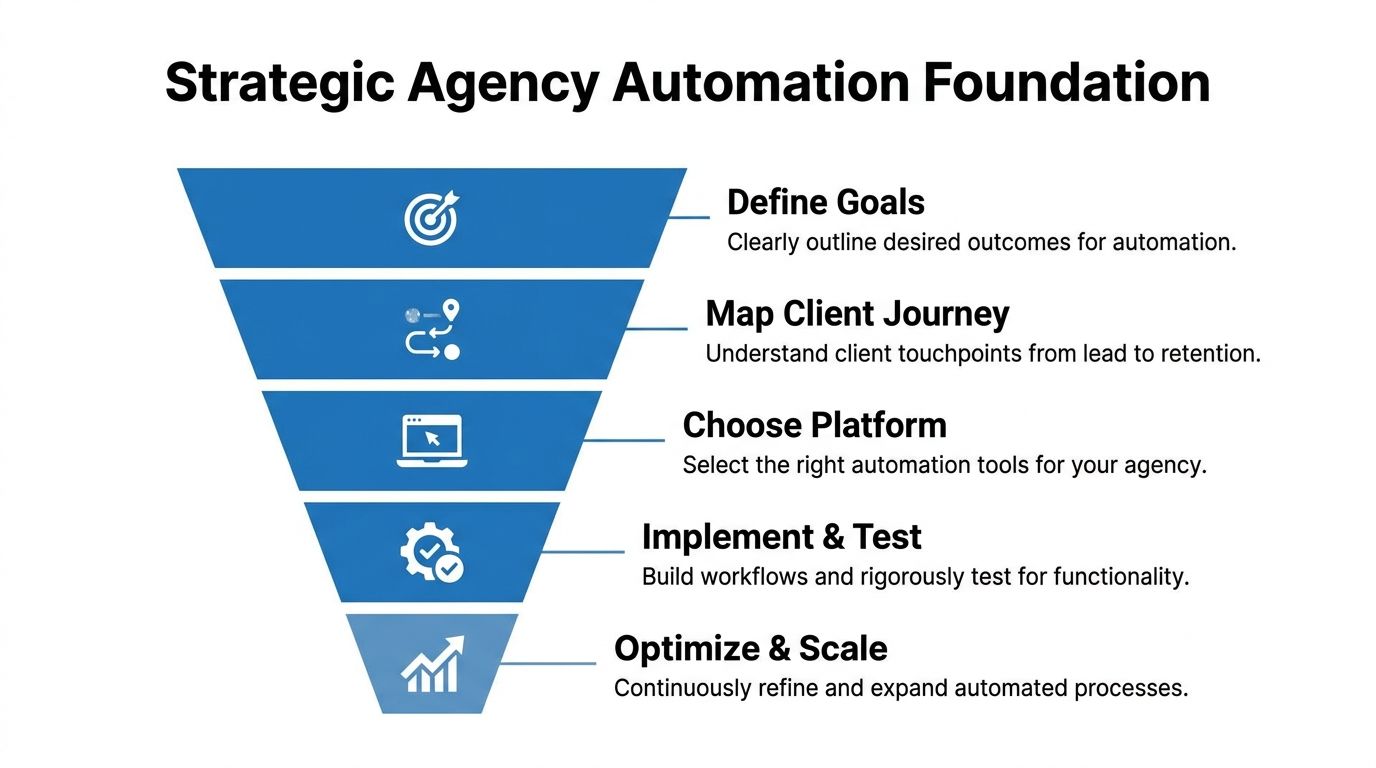
A workflow that does not map to a business outcome becomes busywork. Agencies lose trust when automation only creates motion, not results. Before touching a builder, set the one or two metrics the system must move, such as faster lead response, more booked calls, cleaner handoffs, or better show-up behavior.
Client expectations are shifting because automation is now part of normal service delivery. Market data from inbeat's automation market data shows that large enterprises still hold the largest share, while SMEs are the fastest-growing segment. For agencies, that means clients are increasingly buying repeatable systems, not custom fixes built from scratch every time.
Define the client outcome first
Strong automation starts with a baseline. If a client says they want more revenue, that is too vague to build around. Tie the workflow to a measurable stage in the journey, then decide what signal should trigger the next action.
Practical rule: automate the stage where handoff friction hurts most, not the stage that looks easiest to build.
That usually means lead response, qualification, booking, or post-sale follow-up. Once the target is clear, map the journey and decide where tags, smart lists, or pipeline stages should separate contacts into different paths. This is how an agency stops buying random features and starts building a service it can standardize and sell with confidence.
Map the journey before you segment
A useful journey map does not need to look polished, it needs to show decisions. Identify where leads enter, where they stall, and which actions prove intent. Then use those actions to move contacts between segments instead of relying on static lists that go stale quickly.
If you want a practical tool-selection lens for the workflow layer, Armox AI's guide to workflow tools is a useful reference point because it frames automation around connective logic rather than shiny features. That matters for agencies, because the stack has to support client delivery and internal operations at the same time.
Strong segmentation is less about volume and more about relevance. A contact who clicked a pricing page should not get the same sequence as someone who downloaded a top-of-funnel guide. The agency skill is not just building automations, it is deciding which behavior deserves a different message.
For agencies that need a CRM decision first, find a CRM for your agency before standardizing the workflows around it. The platform matters, but the operating model matters more. If the foundation is unclear, every automation becomes a one-off build that is hard to package, hard to support, and hard to scale.
Building Your Core Client Lifecycle Engine
The best automation services feel like infrastructure, not campaigns. When the core client lifecycle works, every new lead, booking, sale, review, and reactivation follows a predictable path. That's the difference between a one-off build and a service you can sell every month.
Build the front end of the journey
Lead capture should do more than store a name. Use forms, surveys, or chat entry points to qualify the contact immediately, then route the response into a workflow that reacts in real time. The point is to shorten the gap between interest and conversation, because stale leads go cold fast.
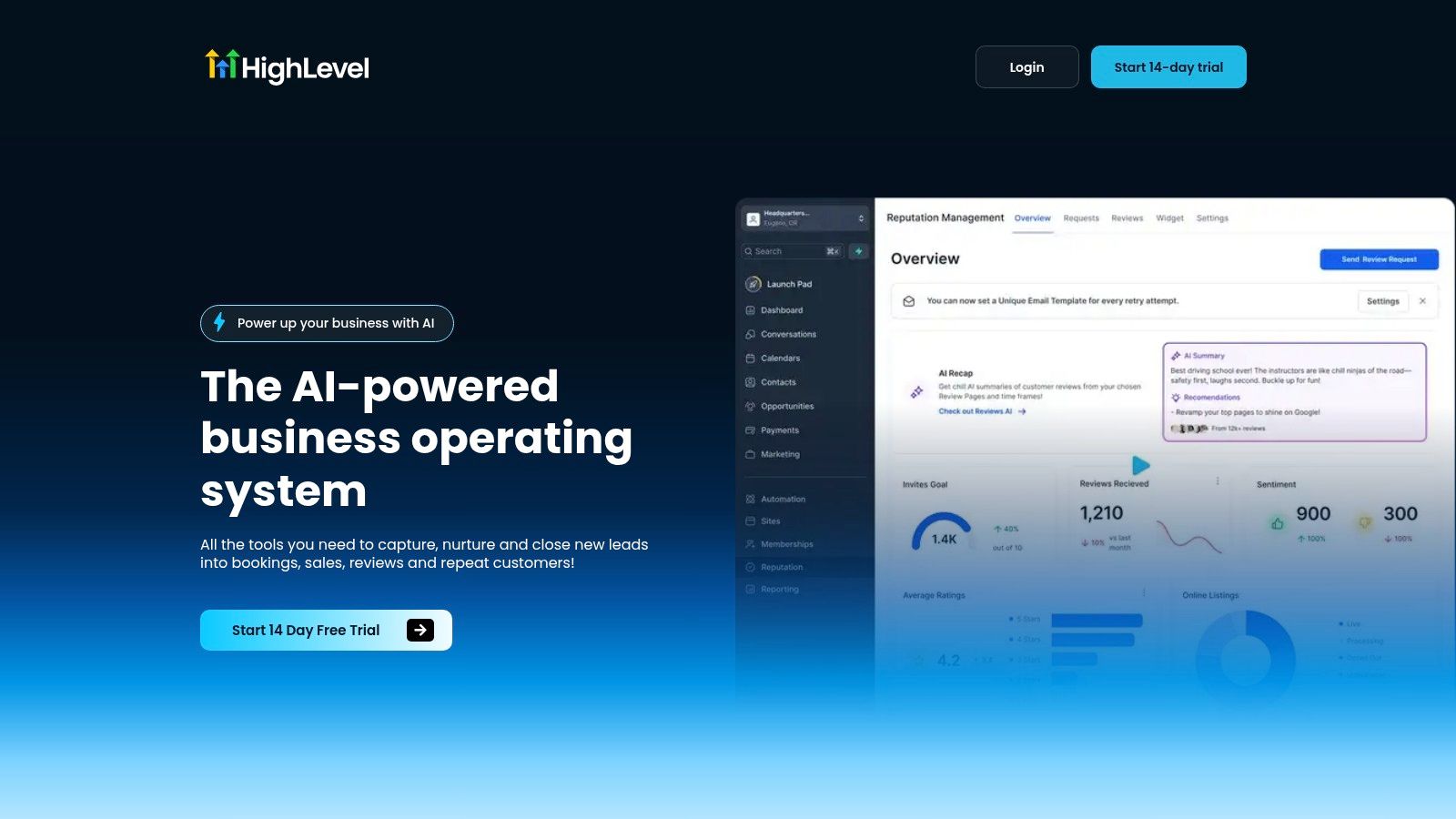
For agencies using an all-in-one platform, HighLevel can sit in the center of that lifecycle as the CRM, inbox, and workflow layer. If you need a decision point on the CRM side first, you can find a CRM for your agency and then standardize the workflows around it.
Turn nurture into a qualification engine
Nurture shouldn't just “stay in touch.” It should educate, score, and filter. A two-channel sequence with email and SMS can handle both the long-form explanation and the fast nudge, while behavior-based triggers decide who deserves a sales handoff.
According to Flowlyn's marketing automation statistics, businesses see an average $5.44 return for every $1 spent, which translates to a 544% ROI over three years, plus a 77% increase in conversion rates and an 80% increase in total lead volume. Those numbers only matter if the workflow is built to move people forward, not just send messages.
A simple lifecycle structure works well:
- Capture: instantly acknowledge the lead and tag the source.
- Nurture: educate with a sequence tied to the buyer's problem.
- Book: move qualified contacts into calendar scheduling.
- Close: update the pipeline and trigger follow-up tasks.
- Retain: request reviews, referrals, and reactivation later.
Good automation replaces delay with consistency. It doesn't replace judgment.
Use reminders, pipeline actions, and post-sale loops
Appointment reminders are one of the easiest places to create value because they remove avoidable no-shows and keep the calendar full. In the sales stage, use pipeline automation to create internal tasks, notify the right rep, and keep momentum when a deal changes status. After the sale, trigger review requests, referral prompts, and reactivation campaigns so the account keeps producing value after the initial win.
If you need a second view on workflow patterns, SharedTEAMS' insights on automation are useful because they show how routine handoffs and reusable sequences contribute to operational effectiveness. The point isn't more complexity. It's fewer missed moments.
High-Impact Automation Recipes You Can Use Today
A strong agency offer often starts with three repeatable recipes. These are the workflows clients understand quickly, and they're easy to demonstrate in a sales call. They also create immediate proof that automation is doing real work, not just moving records around.

Missed call text-back
A missed call is usually a hot lead, not a dead one. The workflow should trigger when an inbound call isn't answered, then send a text quickly enough to keep the conversation alive. Pair that with a task for the assigned rep so the lead doesn't get lost if the text gets ignored.
Here's how how agencies prevent lost sales becomes a real client story, because the fix is usually less about persuasion and more about response discipline. A clean version looks like this, “Sorry we missed your call. Reply with your name and the best time to reach you, and we'll follow up right away.”
Database reactivation
Old lists can still generate sales if the message is relevant. Start by segmenting past customers, dormant leads, and unconverted prospects into separate groups, then write a short sequence that acknowledges the gap without sounding apologetic. Use a new offer, a new angle, or a new reason to reply.
The key is timing and context. The workflow should not blast everyone at once, and it should stop once someone responds or books. That keeps the message relevant and prevents your brand from sounding like it only remembers people when it needs cash.
Automated review request
The review request sequence should go out after a clearly positive moment, such as a completed purchase or a successful service milestone. If the response is favorable, send the customer to the public review destination. If the response is negative, route it internally so the team can handle the issue before it becomes a public complaint.
According to Bonsai's guidance on agency automation, successful automation starts with mapping the customer journey, identifying drop-off risks, and using behavior-based triggers with dynamic segmentation. That principle fits review automation perfectly, because a happy customer and a frustrated customer should never receive the same next step.
Keep the copy short:
- Positive path: ask for a quick public review.
- Neutral path: ask for private feedback.
- Negative path: alert the account owner immediately.
Onboarding Clients and Migrating Systems Seamlessly
The onboarding process is where a lot of automation retainers often fail. If the setup is clunky, the client assumes the service will always feel clunky. A smooth migration builds confidence before the first workflow even goes live.
The first move is inventory, not importing. Audit every existing system the client uses, from contact capture to scheduling to follow-up, and identify which data needs to move and which processes should be retired. That keeps you from recreating broken habits inside a new platform.
Clean the data before you build
Most migration problems come from dirty lists, inconsistent tags, and duplicate records. Clean the contacts before import, then decide on naming conventions for pipeline stages, custom fields, and workflow labels. If the data model is sloppy, automation will just scale the mess.
Permissions matter just as much. Give each user only the access they need, then separate build access from day-to-day use. That reduces accidental edits and makes it easier to troubleshoot when a workflow behaves strangely.
Rebuild the client's operating rhythm
When agencies move clients off disconnected tools, the primary benefit is not consolidation for its own sake. It's reducing the number of places where a rep, marketer, or owner has to remember what happens next. A platform like HighLevel can centralize communications, booking, pipeline movement, and reputation management, which reduces tool hopping and makes the client experience easier to explain.
The migration should also include a short testing window. Send test leads through the full path, check the contact record, verify the notifications, and confirm that the right person gets the right task at the right time. If any of that breaks, fix it before the client sees the system.
Don't launch a client migration with the hope that “we'll clean it up later.” The cleanup phase is where trust gets lost.
That mindset protects retention. Clients don't judge your service only by the final workflow, they judge it by how calm the rollout feels.
How to Price and Package Your Automation Services
Pricing automation services well is mostly about product design. The more clearly you define the scope, the easier it is to sell, deliver, and renew. Agencies that treat every build like a bespoke project usually end up undercharging for maintenance and overcommitting on support.
The simplest model is a setup fee plus a monthly retainer. That works when the initial build is meaningful and the ongoing work is mainly monitoring, small edits, and performance review. It's easy for clients to understand, and it keeps your agency paid for both implementation and upkeep.
Compare the main pricing models
| Model | Best For | Pros | Cons |
|---|---|---|---|
| Setup fee plus monthly retainer | Agencies selling custom builds with ongoing care | Easy to explain, supports implementation and support, fits most client relationships | Can cap upside if the retainer stays too small |
| Tiered packages | Agencies productizing offers for different client sizes | Clear entry points, easier upsells, simpler sales conversations | Needs tight scope control or the tiers blur together |
| SaaS-style white-label offer | Agencies that want to sell software-like access | Strong recurring revenue potential, easier to position as a platform | Requires serious process discipline and support boundaries |
Tiered packaging usually works best when you can name the outcome instead of the task. “Starter,” “Growth,” and “Scale” only work if each tier has a different operating promise. One tier might cover lead response and review requests, another might include nurture, booking, and reporting, while the top tier adds deeper workflow governance and optimization.
Sell the outcome, not the builder hours
Clients don't care how many nodes are inside the workflow. They care whether leads are answered faster, bookings are cleaner, and the pipeline is easier to manage. That means your proposal should describe the business result in plain English, then show the automation that supports it.
The strongest agencies position automation as a system that reduces friction across the entire customer lifecycle. The price becomes easier to defend when the client can see what manual work disappears and what revenue behavior improves because the system now runs consistently.
Scaling Your Service and Proving ROI
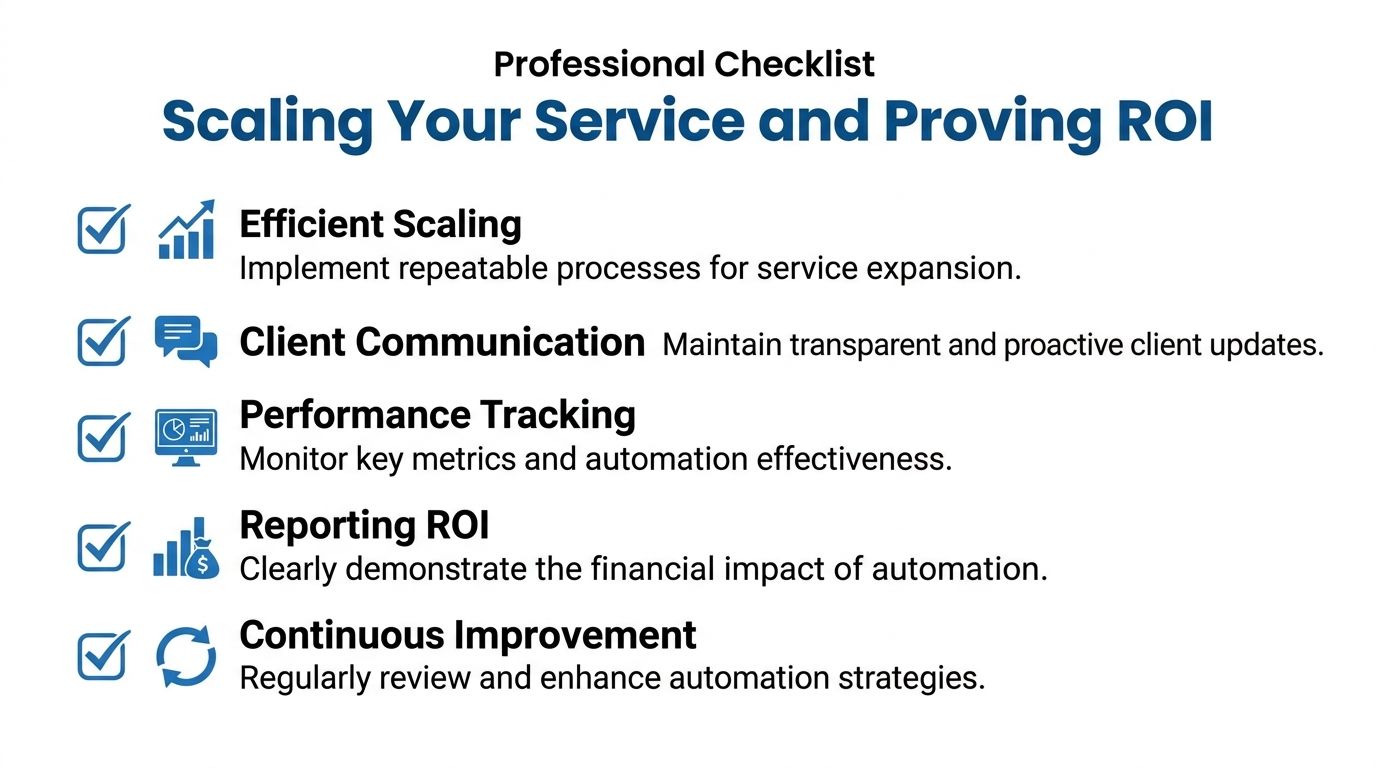
Scaling automation without governance creates messes fast. The technical work gets better, but the account management gets harder, and nobody knows which workflow owns which result. That's how agencies end up with automation sprawl.
According to Specbee's analysis of automation adoption, 73% of agencies underutilize automation because they lack a clear owner responsible for platform organization and performance review, and that gap leads to automation sprawl where disjointed workflows hurt data quality and ROI. The fix is operational, not cosmetic. One person or a very small team needs to own the system.
Assign ownership and audit regularly
An automation owner should review workflow performance, check naming conventions, remove dead branches, and confirm that the journeys still match the current offer. Buyer behavior changes, sales teams change, and client priorities change. If nobody owns the system, old logic stays in place long after it stops working.
The best KPI tracking goes beyond opens and clicks. Track the metrics that connect to revenue behavior, like pipeline velocity, appointment quality, and customer retention patterns. Those are harder to fake and easier to defend in a client meeting.
Don't confuse speed with effectiveness
A lot of agencies assume the fastest follow-up is always the best follow-up. That's not always true, especially in high-consideration services where the prospect needs time to think. Emerging AI-driven timing logic can pause or delay outreach when engagement signals suggest the lead isn't ready yet, which is a smarter approach than brute-force immediacy.
Use that principle carefully. Fast response still matters, but timing should match intent. If a lead is still browsing, pushing too hard can hurt the conversation instead of helping it.
Build a review cadence
A scalable automation service needs regular reviews, not one-time launches. Weekly or monthly audits should check broken triggers, stale segments, inconsistent tags, and underperforming branches. That discipline keeps the service stable enough to scale without adding chaos.
The agencies that treat automation as a living system earn the right to charge for strategy, not just implementation. That's the primary profit center.
If you want to turn automation into a repeatable agency offer, start by standardizing one lifecycle workflow, one reactivation workflow, and one review workflow inside HighLevel. Then document the build, assign an owner, and sell the result as a managed system your clients can rely on every month.
