


Stop juggling leads and start closing loans. If you’re a mortgage broker, you already know the routine, new inquiries come in from Zillow, realtors expect updates, borrowers want fast answers, and your pipeline ends up scattered across email, spreadsheets, and a few too many tabs. The best CRM for mortgage brokers is the one that pulls all of that into one place without slowing down your follow-up or forcing you to rebuild your process from scratch.
This guide gets straight to the list, then gives you a practical decision matrix, a comparison table placeholder, and an implementation checklist you can use before you sign a contract.
Table of Contents
- 1. HighLevel
- 1. HighLevel
- 2. BNTouch Mortgage CRM
- 3. Jungo Salesforce-Based Mortgage CRM
- 4. Surefire CRM by Top of Mind
- 5. Shape Software Shape Mortgage CRM
- 6. Total Expert
- 7. Bonzo
- 8. Whiteboard CRM
- 9. Cimmaron Mortgage Manager Cimmaron Software
- 10. Mortgage iQ CRM
- Mortgage Buyer Decision Matrix
- Feature Comparison Table
- Top 10 Mortgage Broker CRM Comparison
- Implementation Checklist
- Your Next Step Choosing a CRM to Grow Your Brokerage
1. HighLevel
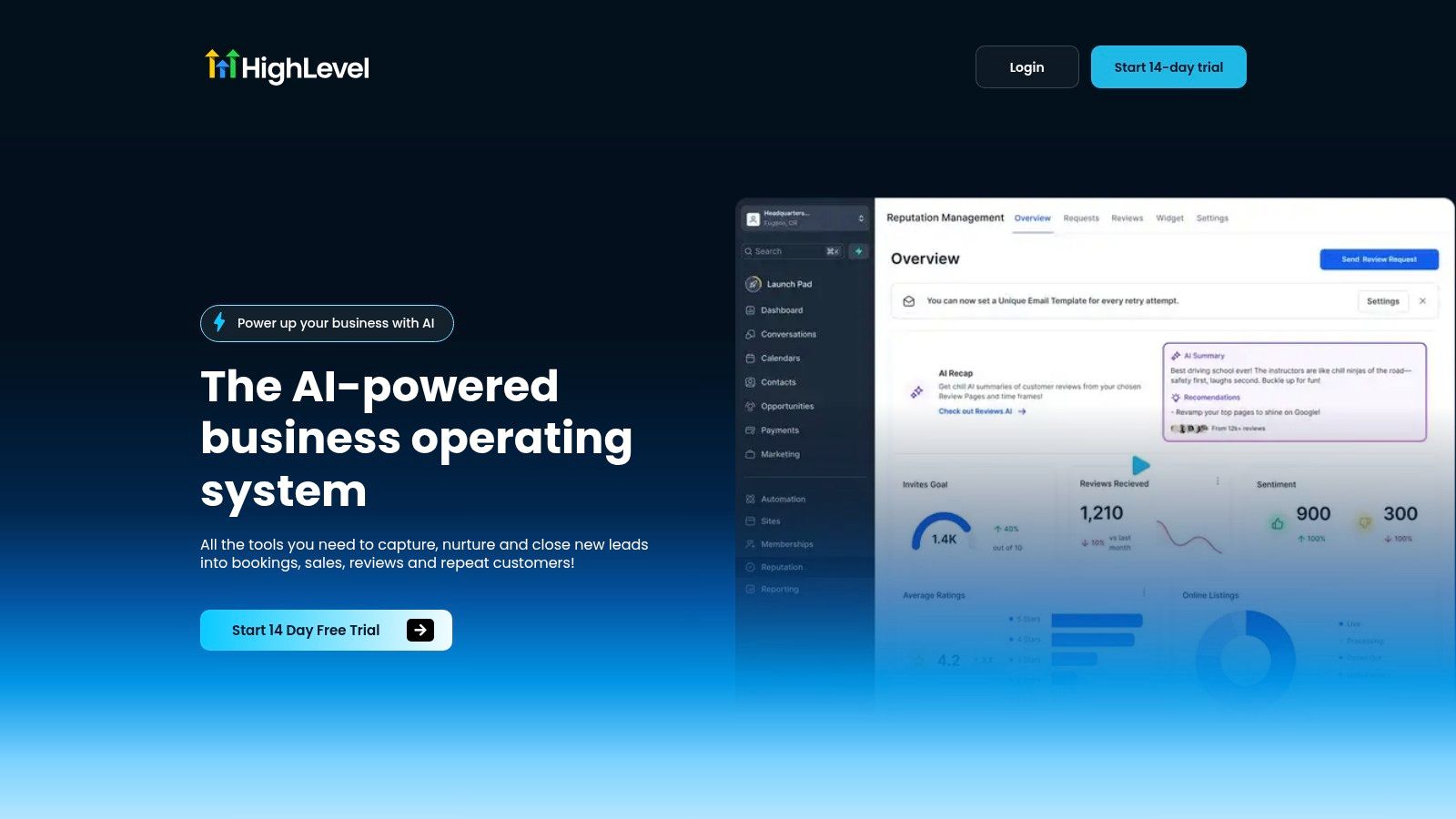
HighLevel works well for a mortgage shop that runs on fast follow-up and a lot of borrower touchpoints. The platform combines CRM, automation, messaging, booking, payments, and reputation management in one workspace, which helps teams that are tired of stitching together separate tools just to keep leads moving. In a market where brokers are still choosing between point solutions, that consolidation can matter more than another feature checkmark.
The practical fit is strongest for brokers who need speed across multiple channels. HighLevel includes SMS, Messenger, Instagram DM, WhatsApp, live chat, a unified inbox, and pipeline automation, so conversations stay tied to the borrower record instead of getting buried in scattered inboxes. Its mortgage setup support also maps well to stages like application, pre-approval, and closing, which makes the pipeline easier to manage for teams that want the system to reflect how loans move.
Practical rule: If replies are spread across too many inboxes, fix the communication layer first. Reporting matters less if your team misses borrower messages.
For mortgage shops that depend on marketing, the bundled automation can reduce vendor sprawl. Workflow builders, landing pages, calendars, invoices, and review automation live in the same system, which supports a unified marketing CRM advantage for teams that want lead capture and follow-up under one roof. That also means setup takes planning, because a system with this much flexibility can get messy if no one owns the workflow design.
The trade-off is real. HighLevel can cover a lot of ground, but brokers who only want a simple loan pipeline may find the platform heavier than they need. Teams with a more technical operator, or a clear admin who can configure automations and keep the process clean, usually get the most value. If you want to browse custom ERP options, the same thinking applies, more flexibility usually means more setup work.
For brokerages that want all-in-one communication and marketing without stacking extra tools, HighLevel is worth a close look. For smaller teams that want a lighter CRM with less configuration, it may be more system than they need.
1. HighLevel
HighLevel stands out when your mortgage shop is really a follow-up machine that happens to close loans. The platform is built to consolidate CRM, automation, messaging, booking, payments, and reputation management into one workspace, which is useful in a market where mortgage brokers are still comparing point solutions instead of one dominant standard. That consolidation angle matters because mortgage teams need a single place to manage borrower communication, pipeline movement, and reactivation without stitching together separate vendors.
The strongest practical fit is for brokers who care about response speed and channel coverage. HighLevel’s native communication stack includes SMS, Messenger, Instagram DM, WhatsApp, and live chat, plus a unified inbox and pipeline automation, so teams can keep conversations tied to the borrower record instead of chasing threads across tools. Its mortgage relevance also shows up in the vertical setup support and pipeline management approach for stages like application, pre-approval, and closing, which matches the way mortgage operations move.
Practical rule: If your current workflow breaks because replies live in different inboxes, start by fixing the communication layer before you obsess over reporting dashboards.
For mortgage shops that market heavily, the bundled automation is a major draw. You get workflow builders, landing pages, calendars, invoices, and review automation in the same system, which can reduce the integration burden that slows down smaller teams. The trade-off is that the platform’s breadth means setup takes discipline, especially if you’re migrating from a simpler CRM or want highly customized mortgage objects from day one.
HighLevel also fits brokerage owners who think beyond one loan at a time. Unlimited contacts on published plans, agency-style account structure, and a mobile-first workflow make it easier to support multiple producers or even white-label the system for different branches. For teams that want a CRM to be the operating layer for lead capture, nurture, booking, and reactivation, HighLevel is one of the most flexible choices in this list.
The public pricing starts with a 14-day free trial, then Starter at $97/month, Unlimited at $297/month, and Agency Pro at $497/month. If you want the platform to do more than store contacts, HighLevel is worth a close look, especially alongside its unified marketing CRM advantage.
Pros
- All-in-one structure: CRM, messaging, funnels, booking, payments, and reputation tools live together.
- Native AI depth: Conversation AI and Voice AI support faster borrower follow-up.
- Agency flexibility: Unlimited sub-accounts on higher tiers and SaaS-style positioning.
- Mobile-first operations: Useful for brokers who work from the road.
Cons
- Setup takes time: The breadth that makes it powerful also makes it harder to configure well.
- Advanced agency features cost more: SaaS mode and deeper API access sit on higher tiers.
Website: HighLevel
2. BNTouch Mortgage CRM
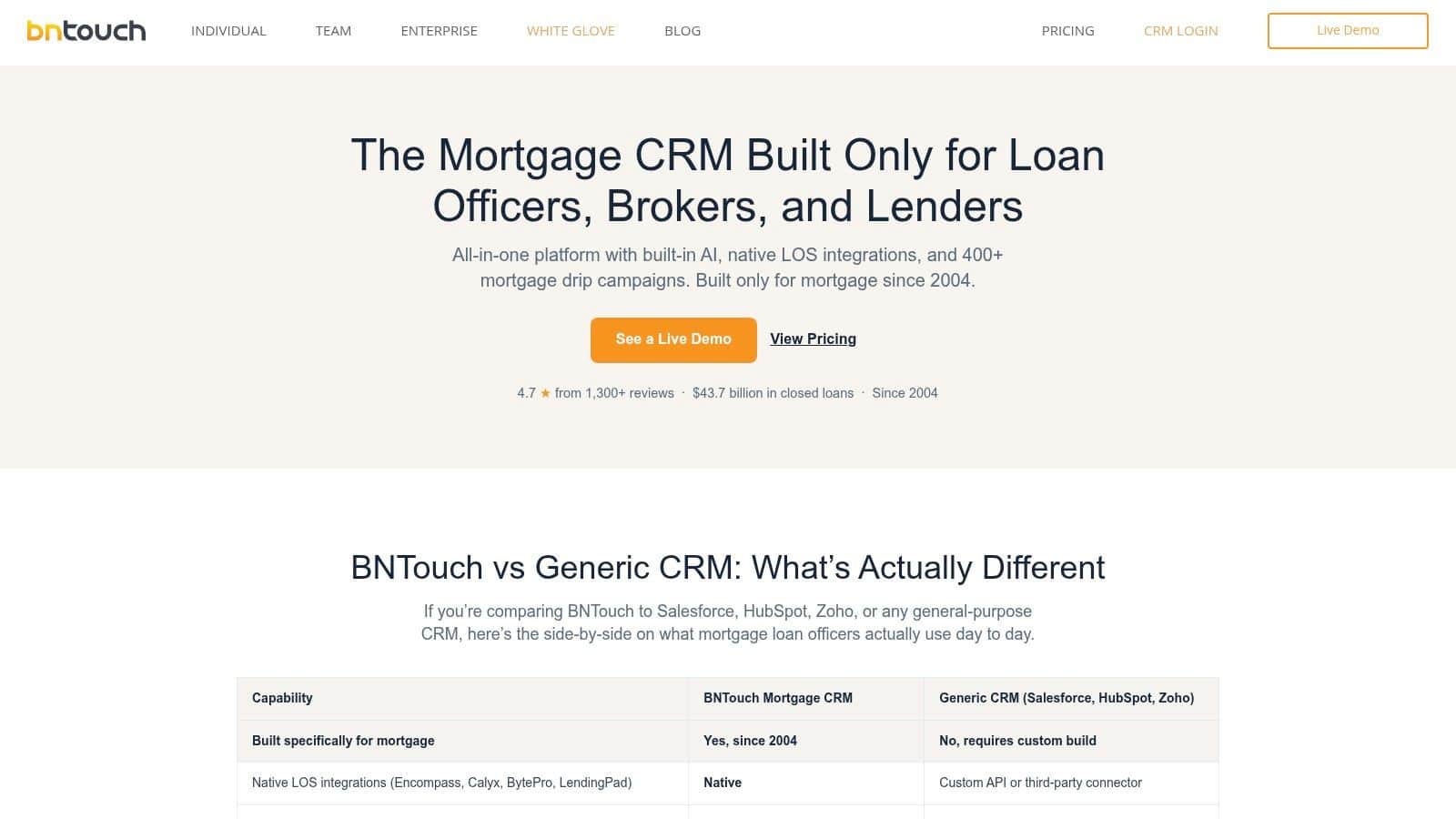
BNTouch makes sense for brokers who want a mortgage-first system without building all the nurture logic themselves. The product is designed for independent loan officers, broker teams, and lenders, and it bundles CRM, marketing automation, borrower portal functionality, website tools, and reputation features in one place. That combination is especially useful when your team wants ready-made mortgage campaigns instead of a blank canvas.
The best part is the speed-to-launch. Prebuilt campaigns for purchase, refinance, post-close, and partner co-marketing let a broker get moving quickly, which is a real advantage if your follow-up currently depends on manual reminders or copied email templates. Its LOS and lead-source integration approach also helps reduce the handoff mess that usually appears when lead data and borrower status live in different places.
BNTouch also fits a relationship-heavy brokerage model. The borrower portal and partner-facing workflows are built for the kind of communication mortgage professionals do every day, especially when realtors want updates and borrowers want reassurance. If your shop values mortgage-specific content, sequence templates, and a more guided rollout, this is one of the more practical options.
Practical rule: Choose BNTouch when you need mortgage marketing structure more than platform customization.
The trade-off is implementation complexity at scale. Ready-made campaigns are helpful, but larger teams can still end up adding features and services that raise the total cost of ownership. Public pricing is available for solo and team plans, but the final bill can still climb once you account for setup and extras.
If your brokerage wants a purpose-built CRM with a short learning curve and a clear mortgage focus, BNTouch belongs near the top of the shortlist. It is especially attractive for teams that need fast deployment, repeatable follow-up, and a stronger borrower experience without building every workflow manually.
Website: BNTouch Mortgage CRM
Browse custom ERP options can help you think through adjacent operations if your brokerage also needs broader back-office systems.
Where BNTouch Fits Best
- Solo loan officers: Good if you want mortgage templates ready on day one.
- Small broker teams: Strong when everyone needs the same follow-up cadence.
- Partner-driven shops: Useful when realtor updates and borrower nurture matter equally.
Lead tracking software for agencies is a good reference point if you’re comparing CRM logic across industries.
3. Jungo Salesforce-Based Mortgage CRM
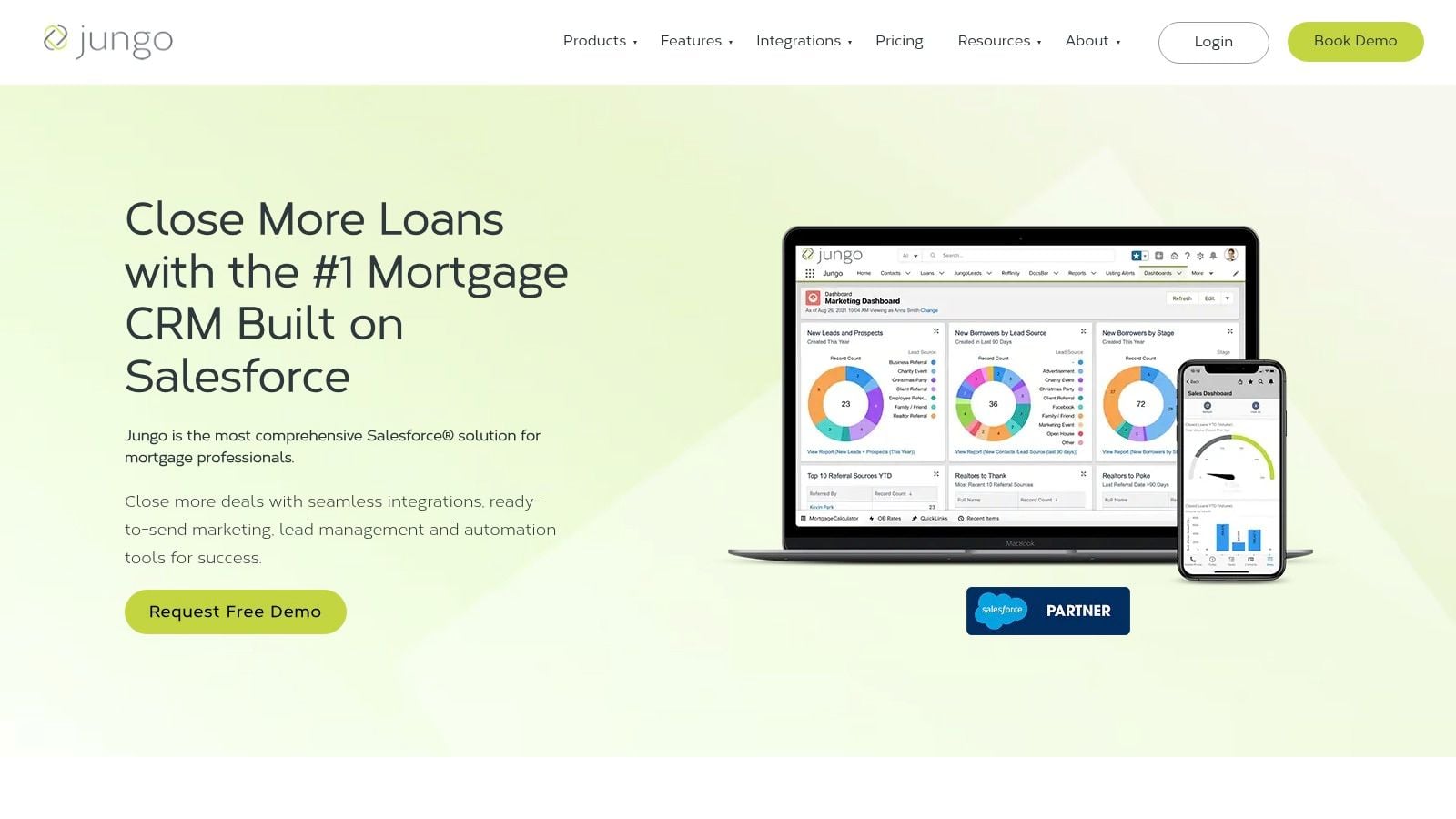
Jungo is the right kind of serious if your brokerage already lives in the Salesforce ecosystem. It’s built on Salesforce, which gives you the reliability and extensibility of that platform without forcing your team to invent mortgage workflows from scratch. For brokerages that care about deep LOS synchronization and referral management, that combination is hard to ignore.
The biggest practical benefit is that Jungo is designed around mortgage operations, not generic contact storage. Its LOS sync supports systems like Encompass, Byte, LendingPad, and Blend, and its routing and pipeline tools help teams keep borrower and referral data aligned as deals move. That matters because mortgage CRMs fail when stage-level information gets out of sync with the loan file.
Jungo also works well for organizations that use co-marketing and referral relationships as a core growth engine. The Agent Portal gives partners visibility, and the marketing hub supports email and SMS-related activity, so the platform can support both borrower nurture and realtor communication. If your shop wants Salesforce structure with mortgage-specific layers already in place, Jungo is a natural contender.
A few setup realities matter here. The platform is typically billed annually, and setup fees apply, so this is not a casual, plug-and-play decision. That makes it a better fit for brokerages that know their processes and are ready to invest in implementation rather than experimenting with a lightweight tool.
Website: Jungo
Why Teams Pick Jungo
- Salesforce-native stability: Good for teams that already trust the Salesforce ecosystem.
- LOS synchronization: Useful when borrower and pipeline data must stay aligned.
- Referral visibility: Helpful for co-marketing and partner relationships.
4. Surefire CRM by Top of Mind
Surefire is a strong fit when your brokerage wants mortgage-specific nurture at scale and doesn’t need to reinvent campaign content. Top of Mind positions it as the #1 Most-Used Mortgage CRM, which signals that adoption in this niche is concentrated around purpose-built systems rather than horizontal CRMs. That matters in mortgage, where the workflow is tied to borrower lifecycle messaging, partner communication, and compliance-sensitive marketing.
Its biggest advantage is the content engine. Surefire’s library and automated nurture approach make it easier to keep borrowers engaged across the entire relationship, not just during active loan processing. For lenders and broker networks, that matters because a lot of value sits in post-close follow-up, referral generation, and customer-for-life communication.
The platform also makes sense for shops already operating inside the ICE Mortgage Technology environment. Independent comparisons consistently rank systems that sync borrower, deal, and pipeline data with LOS workflows more highly for mortgage use, and Surefire is built for that kind of operational pairing. That alignment reduces manual handoffs and helps preserve stage-level data integrity, which is exactly where generic CRMs start to wobble.
Practical rule: Use Surefire when you want a mature mortgage marketing system, not a generic sales tool with a mortgage label.
The trade-off is simple. If you’re a solo loan officer or a very small brokerage, Surefire can be more system than you need, and pricing is quote-based. It’s better suited to broker networks and larger lending operations that need proven templates, deeper integration habits, and a platform built for regulated communication.
The article from HighLevel review automation steps is useful if part of your CRM evaluation includes reputation and review capture workflows, because those follow-up loops often get overlooked during buying.
Website: Surefire CRM by Top of Mind
5. Shape Software Shape Mortgage CRM
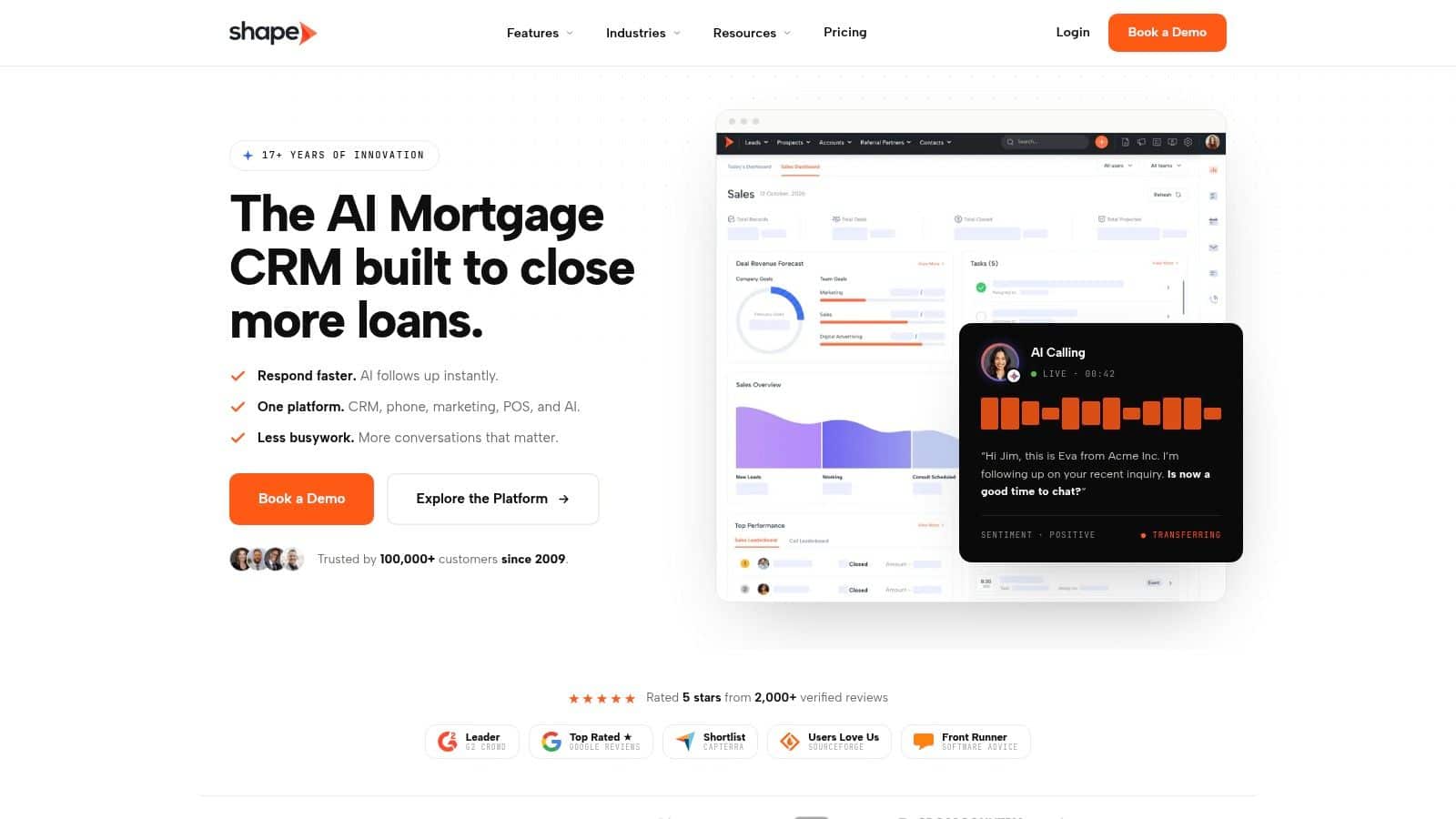
Shape is a strong option if you want mortgage-specific workflows without giving up flexibility. It combines lead management, automation, texting, reporting, and borrower experience tools in one vertical platform, which makes it attractive to brokers who want a CRM that feels built for lending rather than retrofitted from another industry.
The practical appeal here is integration freedom. Shape supports native LOS and lead-source connections, plus open API and Zapier support, so it can slot into a more complex stack without forcing you into a closed environment. That matters if your brokerage already has a mix of systems and you need a CRM that can keep pace with the rest of your operation.
It also tends to fit teams that care about the borrower experience layer. Mortgage is full of moments where a status update, document request, or follow-up message needs to go out at the right time, and Shape’s automation and AI-assisted tools help support that rhythm. The platform is also one of the better choices for brokerages that want reporting tied closely to lending workflows.
The main caution is cost visibility. Public pricing is individualized, so you’ll need a quote to understand the full package, especially if you want AI or telephony-related add-ons. That makes it less straightforward for smaller shops that want to compare pricing quickly.
Website: Shape Software
Shape Works Best For
- Mortgage teams with existing tools: Good if you need integrations, not another isolated system.
- Brokers who value workflow depth: Strong for automation tied to borrower journey stages.
- Operations-minded shops: Helpful when reporting and process control matter.
6. Total Expert
Total Expert is the enterprise answer for brokerages that live under compliance pressure and need customer engagement built for financial services. It combines CRM, marketing, and compliance tooling, which is useful when your team needs to run coordinated campaigns without giving individual loan officers too much room to improvise off-brand messaging.
Its strongest value is scale. Mortgage-specific journeys, partner co-marketing, borrower intelligence, and integration support make it a better fit for multi-LO brokerages and branch networks than for a solo producer. The platform is designed to support a more formal operating model, where brand control and approved workflows matter as much as lead capture.
The borrower-intent side is also a practical advantage. If your team wants to trigger actions around credit inquiries or life events, Total Expert is built to support that kind of intelligence-driven marketing. That can improve consistency across the customer lifecycle, especially when you’re trying to keep borrowers engaged after the first conversation and long after closing.
The trade-off is obvious. It’s quote-based, enterprise-skewed, and usually too much system for a one-person shop. If your brokerage needs flexibility more than governance, other options on this list will feel lighter and faster to deploy.
A useful comparison point for AI-forward CRMs is best AI CRMs for 2026, especially if you’re weighing how much automation you need versus how much complexity you can support.
Website: Total Expert
7. Bonzo
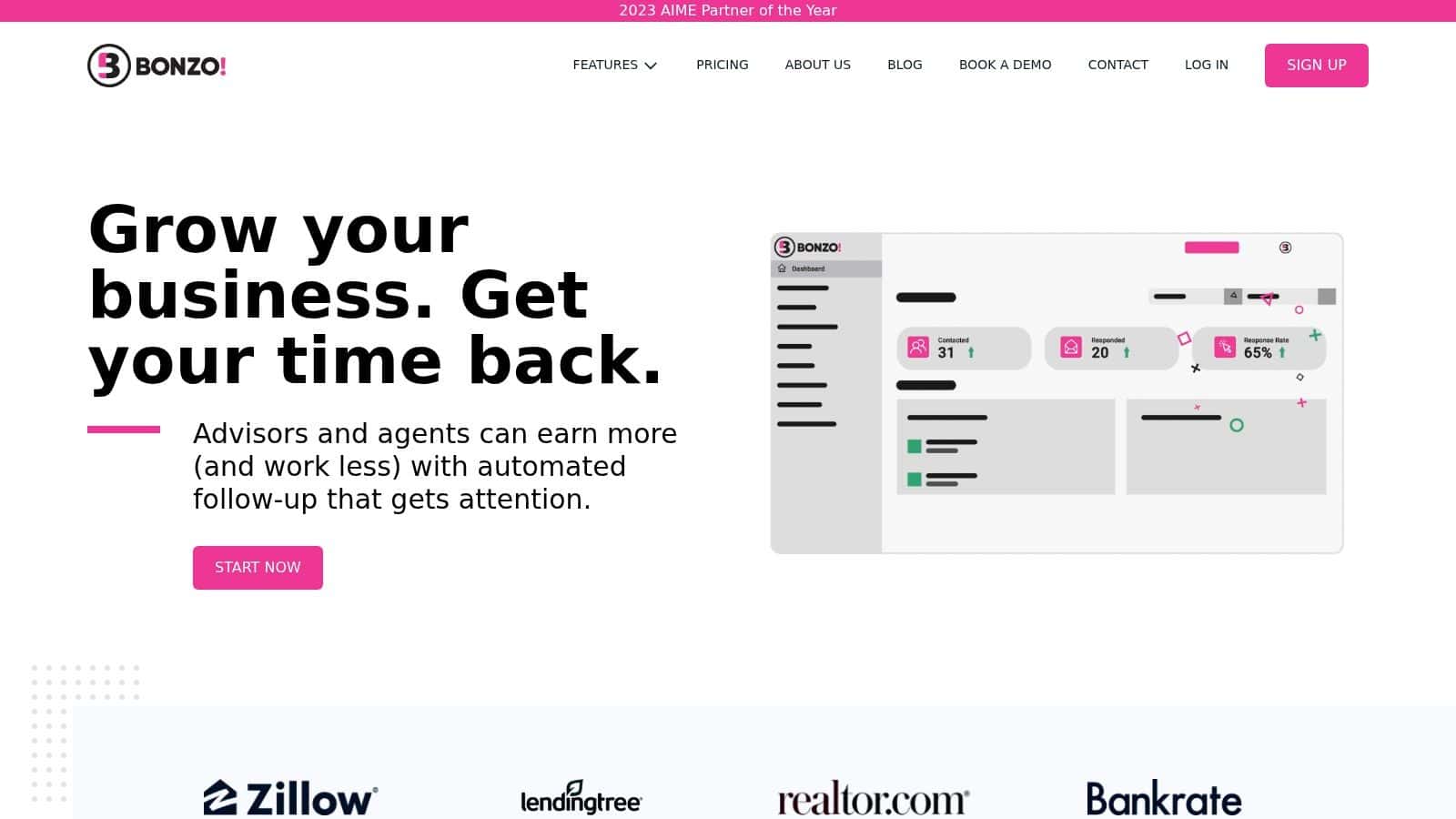
Bonzo is built for brokers who live in the follow-up sequence. If your day is mostly about texting leads, sending drip campaigns, and making sure no warm contact slips through the cracks, this conversation-centric CRM is worth a serious look. It’s especially practical for loan officers who want fast outreach rather than a heavy enterprise stack.
The mortgage fit comes from its messaging model and LOS integrations. Bonzo supports automated text, email, and ringless voicemail workflows, and it can sync with lending systems such as ARIVE and MeridianLink to trigger communication off loan details. That is the kind of utility a broker feels quickly because it reduces manual touchpoint management.
The platform also uses a token-based messaging approach, which gives teams flexibility for campaigns, but it also means you need to understand your usage model before you scale. That’s the main trade-off. Bonzo can be efficient for outreach, but pricing and add-on needs are less transparent than with some of the more public-facing options.
Practical rule: Bonzo is best when speed of outreach matters more than deep back-office complexity.
The optional lead store is useful if your brokerage buys or targets lists, but that also means it can become spend-sensitive at scale. For a producer who wants to work fast and keep communications tight, though, Bonzo is a clean fit.
Website: Bonzo
8. Whiteboard CRM
Whiteboard CRM is one of the more LO-centric tools in the space, which is exactly why some brokers prefer it. It focuses on loan officer task plans, milestone communications, realtor collaboration, and purchase-market playbooks, so the daily workflow feels customized to the way residential mortgage teams work.
That simplicity is its strength. If your producers want a clear process for purchase pipelines and co-branded partner activity, Whiteboard keeps the interface focused on the essentials. It isn’t trying to be an everything platform, which can make adoption easier for brokers who are tired of overbuilt systems.
The downside is that the feature set may feel lighter than enterprise suites. Pricing is not public, so you’ll need a quote, and teams that need deep marketing orchestration or complex reporting may outgrow it faster than they expect. Still, for brokers who value a straightforward mortgage brand with a clear daily-use design, it remains a credible choice.
Website: Whiteboard CRM
Why It Can Work for Smaller Teams
- Daily task clarity: Useful when the team needs a simple, repeatable sequence.
- Partner collaboration: Good for realtor-facing workflows.
- Residential mortgage focus: Keeps the product close to the brokerage use case.
9. Cimmaron Mortgage Manager Cimmaron Software
Cimmaron Mortgage Manager appeals to brokers who want a mature, mortgage-specific CRM with mobile access and established workflows. It includes loan officer dashboards, referral-partner tools, milestone communications, drip campaigns, and a mobile app, which makes it practical for teams that split time between desk work and field activity.
Familiarity and stability are key. Some mortgage shops do better with a tool that has documented updates and straightforward workflows than with a newer platform full of bells and whistles. Cimmaron fits that mindset, especially if your team wants a traditional CRM experience that still understands referral relationships and pipeline movement.
The limitations are also familiar. Pricing isn’t public, and the ecosystem feels more traditional than what newer tools offer. If your brokerage wants a more modern UI or a heavily automated marketing stack, this may not be the first choice.
Website: Cimmaron Software
10. Mortgage iQ CRM
Mortgage iQ CRM is the enterprise-style option for brokerages that need configurability across multiple lending channels. It supports retail, consumer direct, wholesale, and correspondent workflows, which is useful for organizations that don’t fit neatly into a single channel model.
The main appeal is scale and structure. Lead management, online loan applications, service modules, and configurable workflows make it suitable for teams with more complex routing and permission needs. If your brokerage has multiple producer types or channel-specific handoffs, Mortgage iQ gives you more room to design around that reality.
The trade-off is implementation weight. This is not the kind of system you casually roll out in a weekend, and public pricing is quote-based. For smaller brokerages, that can be a signal to look at something lighter unless enterprise coordination is your actual problem.
HighLevel call tracking insights are useful if your CRM decision also includes phone-level attribution, because call workflows can matter as much as email nurture in mortgage sales.
Website: Mortgage iQ CRM
Mortgage Buyer Decision Matrix
A mortgage CRM purchase gets easier when you stop asking, “Which tool has the most features?” and start asking, “Which bottleneck is hurting my pipeline right now?” Mortgage broker CRM selection is increasingly driven by LOS integration depth and workflow automation rather than generic contact management, because mortgage teams need a single source of truth across borrower communication, pipeline stages, and loan status updates (mortgage CRM comparison). That is the right lens to use here.
If your problem is slow lead response, choose a tool built for messaging and automation first. If your problem is manual file coordination, prioritize systems that sync cleanly with your LOS and preserve stage-level data integrity. If your problem is partner management, look for referral portals, co-marketing support, and borrower-facing visibility.
Buy for the bottleneck, not the brochure. The prettiest demo rarely fixes the thing that’s leaking revenue.
Use this practical filter when you compare vendors:
- Choose HighLevel if you want a consolidated operating system that can handle follow-up, booking, messaging, and reactivation in one place.
- Choose BNTouch if you want mortgage-specific campaigns and faster time-to-value.
- Choose Jungo if your brokerage is already anchored in Salesforce.
- Choose Surefire if you need a proven mortgage marketing engine with broad niche adoption.
- Choose Shape if your stack needs flexible integrations and mortgage-native workflows.
- Choose Total Expert if compliance, scale, and partner marketing drive your buying decision.
- Choose Bonzo if fast conversational follow-up is the main goal.
- Choose Whiteboard CRM if your team wants straightforward LO workflows.
- Choose Cimmaron if you prefer a mature, mortgage-focused system with mobile support.
- Choose Mortgage iQ if you need enterprise routing across multiple lending channels.
Feature Comparison Table
Top 10 Mortgage Broker CRM Comparison
| Product | Core Capabilities | Target Audience 👥 | Unique Selling Points ✨ | Quality ★ | Price/Value 💰 |
|---|---|---|---|---|---|
| HighLevel 🏆 | All‑in‑one: CRM, unified convo inbox (SMS/WhatsApp/FB/IG/chat), funnels, payments, automations, Conversation & Voice AI | Agencies, SMBs, local services, coaches | ✨ Native AI across messaging/voice/reviews; unlimited sub‑accounts (Unlimited); mobile app; built‑in commerce | ★★★★★ | 💰 $97 / $297 / $497 (14‑day trial) |
| BNTouch Mortgage CRM | Mortgage CRM: prebuilt campaigns, borrower portal, LOS & lead integrations, marketing automation | Independent LOs, broker teams, small lenders | ✨ Ready‑made mortgage campaigns for fast launch | ★★★★ | 💰 Public plans; add‑ons can increase cost |
| Jungo (Salesforce) | Salesforce‑native: LOS sync, round‑robin routing, marketing hub, SMS add‑on | Brokerages wanting Salesforce reliability | ✨ Deep Salesforce ecosystem + mortgage workflows | ★★★★ | 💰 Quote/annual contracts + setup fees |
| Surefire CRM (Top of Mind) | Large content library, automated borrower nurture, TPO support, ICE integration | Lenders, broker networks, enterprise teams | ✨ Compliance‑friendly content + BI/reporting integration | ★★★★ | 💰 Quote‑based (enterprise) |
| Shape Software | Mortgage pipelines, automations, open API, LOS & SMS integrations, borrower experience | Brokers wanting POS-style workflows & integrations | ✨ Flexible API/Zapier + strong LOS integrations | ★★★★ | 💰 Quote‑based; confirm AI/telephony add‑ons |
| Total Expert | CRM + compliance tooling, co‑marketing, borrower intent signals, PPE integrations | Regulated lenders, multi‑LO brokerages | ✨ Enterprise compliance & partner co‑marketing features | ★★★★ | 💰 Quote‑based (enterprise pricing) |
| Bonzo | Conversation‑centric outreach: text, email, ringless voicemail, pipeline automations, LOS sync | Loan officers focused on rapid outreach | ✨ Fast multi‑channel playbooks; optional lead store | ★★★ | 💰 Quote‑based; token/lead costs may apply |
| Whiteboard CRM | LO task plans, purchase playbooks, realtor co‑marketing, milestone comms | Loan officers & small teams | ✨ LO‑centric daily workflows and co‑branding tools | ★★★ | 💰 Quote‑based |
| Cimmaron Mortgage Manager | LO dashboards, referral partner tools, email drips, pipeline management, mobile app | Brokers valuing mature mortgage workflows | ✨ Mature product with documented updates/resources | ★★★ | 💰 Quote‑based |
| Mortgage iQ CRM | Enterprise CRM: configurable workflows, LOS connectivity, online apps, roles/permissions | Enterprise brokerages; multi‑channel lenders | ✨ Deep configurability for complex channels & scaling | ★★★★ | 💰 Quote‑based; heavier implementation |
Implementation Checklist
A CRM only helps if the rollout is tight. A lot of mortgage teams blame software when the actual issue is incomplete setup, bad field mapping, or no agreement on who owns each follow-up step. Successful CRM projects in financial services usually focus on creating a single source of truth across existing platforms rather than replacing everything at once, and that principle applies here too (CRM implementation guidance).
Start with your current workflow, not the software demo. Map where leads come from, where borrower data gets entered, where LOS status changes happen, and where follow-up usually stalls. Then decide which fields, automations, and alerts are essential before you configure anything.
Implementation rule: If a field, stage, or automation doesn't affect borrower movement or partner visibility, don't force it into launch.
Use this checklist before go-live:
- Define your loan stages: Match the CRM pipeline to the way your team works, from inquiry to closing.
- Map your data fields: Make sure contact, borrower, deal, and referral fields are consistent with your LOS and marketing tools.
- Assign owner rules: Decide who gets new leads, who handles partner updates, and who owns stalled files.
- Build the first automations: Set up the minimum follow-up sequences for new leads, reminders, and post-close nurture.
- Test mobile access: Producers who work in the field need the same visibility as office staff.
- Check integration depth: Confirm how the CRM syncs with your LOS, forms, calendar, and phone system.
- Train on daily habits: Teach the team how to log calls, update stages, and respond from the inbox every day.
- Review compliance needs: Larger brokerages should verify how marketing approval and data controls are handled.
- Track adoption early: Watch whether the team is using the CRM or falling back to email and spreadsheets.
- Refine after launch: Adjust pipelines and sequences based on what slows deals down in real use.
The mortgage CRM market rewards teams that choose carefully and implement deliberately. Market-position data suggests purpose-built platforms with automation and lender-focused workflows are seeing stronger adoption pressure than generic CRMs, and that lines up with what brokers need in practice, faster response, fewer handoffs, and better visibility into loan progress (Top of Mind). If your CRM doesn't help you answer, route, and move deals faster, it's not doing its job.
Your Next Step Choosing a CRM to Grow Your Brokerage
Choosing a CRM is a commitment. The best CRM for mortgage brokers isn't just a tool, it's the engine behind lead response, partner communication, borrower experience, and post-close reactivation. If you're still comparing options, use the decision matrix above to identify the one workflow problem that hurts you most, then evaluate each platform against that bottleneck instead of chasing the longest feature list.
For most brokerages, the smartest move is to narrow the field quickly. One team may need mortgage-first nurture and referral management, another may need deep LOS sync, and another may need a true all-in-one operating system that keeps communication, booking, and payments under one roof. The category is fragmented, which gives buyers room to be selective, but it also means you have to be disciplined about fit.
If you're ready to pressure-test your choice, revisit your lead sources, your LOS workflow, and your follow-up gaps, then score each CRM on how well it supports those exact steps. If you want a separate way to think about return on investment, the Lead Printer ROI tool can help frame the cost of your current inefficiencies against what a better system could improve.
HighLevel gives mortgage brokers one place to manage leads, conversations, booking, payments, and reactivation, which makes it a strong fit for teams tired of stitching together disconnected tools. If you want a CRM that can support mortgage workflows while keeping your follow-up organized and mobile, visit HighLevel and see how it fits your brokerage.
