


Starting a business consulting gets many wrong on day one. The move is to sound smart, stay broad, and sell “strategy.” That advice burns the first 90 days because clients don't pay for vague insight, they pay for outcomes, and the consultants who win build a narrow offer around a real operational problem.
The market is big enough to support that approach. Consulting now sits in a global industry valued at over $1 trillion, with a projected 8% compound annual growth through 2028 in one industry roundup, and independent work keeps expanding, with 48% of U.S. adults having worked as independent professionals at some point and that share expected to rise to 54% in the same year Consulting Statistics. That doesn't mean you should launch as a generalist. It means you should pick a niche, package a measurable result, and build a delivery system that doesn't collapse under custom work.
Table of Contents
- Why Most Consulting Launches Stall in the First 90 Days
- Picking and Validating a Profitable Niche in One Week
- Designing Your Offer, Pricing, and Delivery Workflow
- Legal Setup, Contracts, and Money Management That Holds Up
- Building a Sales Engine With One Platform
- Client Delivery, Retention, and Reactivation Systems
- Your 90-Day Action Plan and Pre-Launch Checklist
Why Most Consulting Launches Stall in the First 90 Days
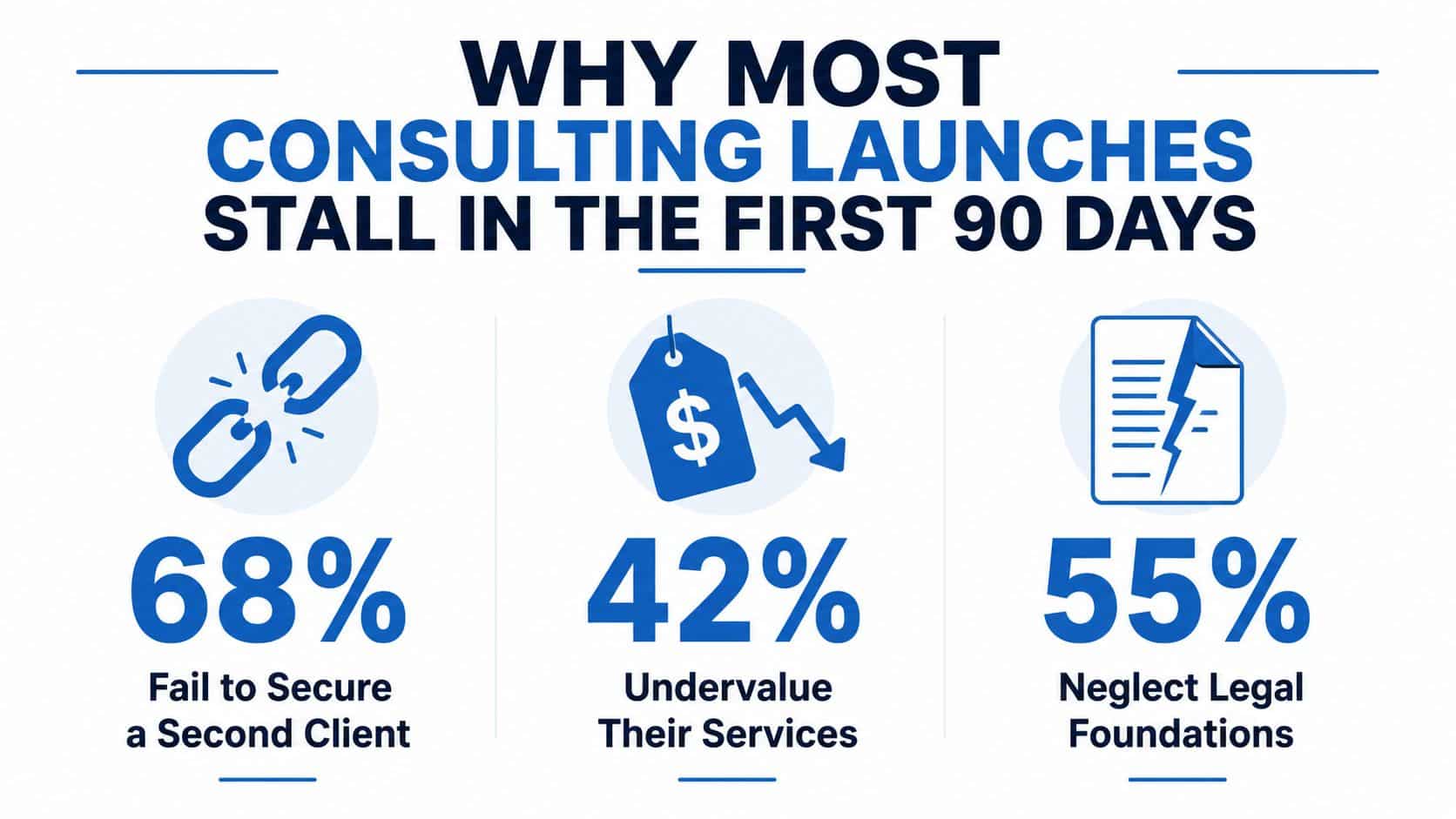
The common mistake is treating consulting like a personality contest. New consultants try to be helpful to everyone, then wonder why no one can tell what they do, why they're expensive, or why every proposal turns into a custom research project. The better model is a productized service with one clear audience, one painful problem, and one outcome you can describe in a sentence.
That approach matches how consulting businesses usually start. More than 50% of consultants quit a job and then launch their own practice, while 25% start while still employed Consulting Statistics. In other words, most firms aren't born from theory. They're built from prior domain experience, which is exactly why generic messaging wastes the first 90 days.
The first failure is weak positioning
A lot of new consultants think “I help businesses grow” is a value proposition. It isn't. It's wallpaper. The best consulting-business frameworks push you toward a one-sentence value proposition, measurable outcomes, and a repeatable delivery workflow so every client doesn't become a brand-new invention How to Start a Consulting Company Step by Step Guide With Examples.
Practical rule: If a prospect can't repeat your offer in one breath, you don't have a business yet. You have an interest.
For local and multi-location businesses, the mistake is even more obvious. They do not want abstract strategy decks. They want more bookings, faster follow-up, more reviews, and fewer leaks between marketing and operations. Consultants who win here sell execution, not advice theater, and they use one operating system instead of stitching together five tools. A practical place to start is a HighLevel lead generation playbook, because the first job is to build a repeatable way to capture and convert demand.
The second failure is too much custom work
The fastest way to stall is to reinvent your scope for every client. You spend your first month writing proposals, the second month rebuilding the service, and the third month discovering you're underpriced. A fixed-scope offer with a defined duration keeps the practice sane and makes results easier to benchmark.
The “starting a business consulting” phase should look more like launching a service line than hanging out a shingle. One practical playbook recommends a 7-day validation sprint and a 30-day paid pilot to test demand and customer acquisition cost before scaling How to Start Consulting Business.
If you want a simple way to think about it, stop asking, “How do I look credible?” Start asking, “What operational problem can I solve repeatedly?” That's the whole game.
Picking and Validating a Profitable Niche in One Week
A niche is profitable when the buyer already feels the pain, already spends money, and already knows the cost of leaving the problem alone. Start with where money is already moving, then narrow from there. If you begin with your interests, you waste the first 90 days talking to people who admire the idea but never buy.
For local and multi-location businesses, the money is usually tied to execution gaps, not vague strategy. They care about more bookings, faster follow-up, more reviews, and fewer leaks between marketing and operations. That is the lane to choose if you want to start a business consulting practice that sells real outcomes instead of slide decks.
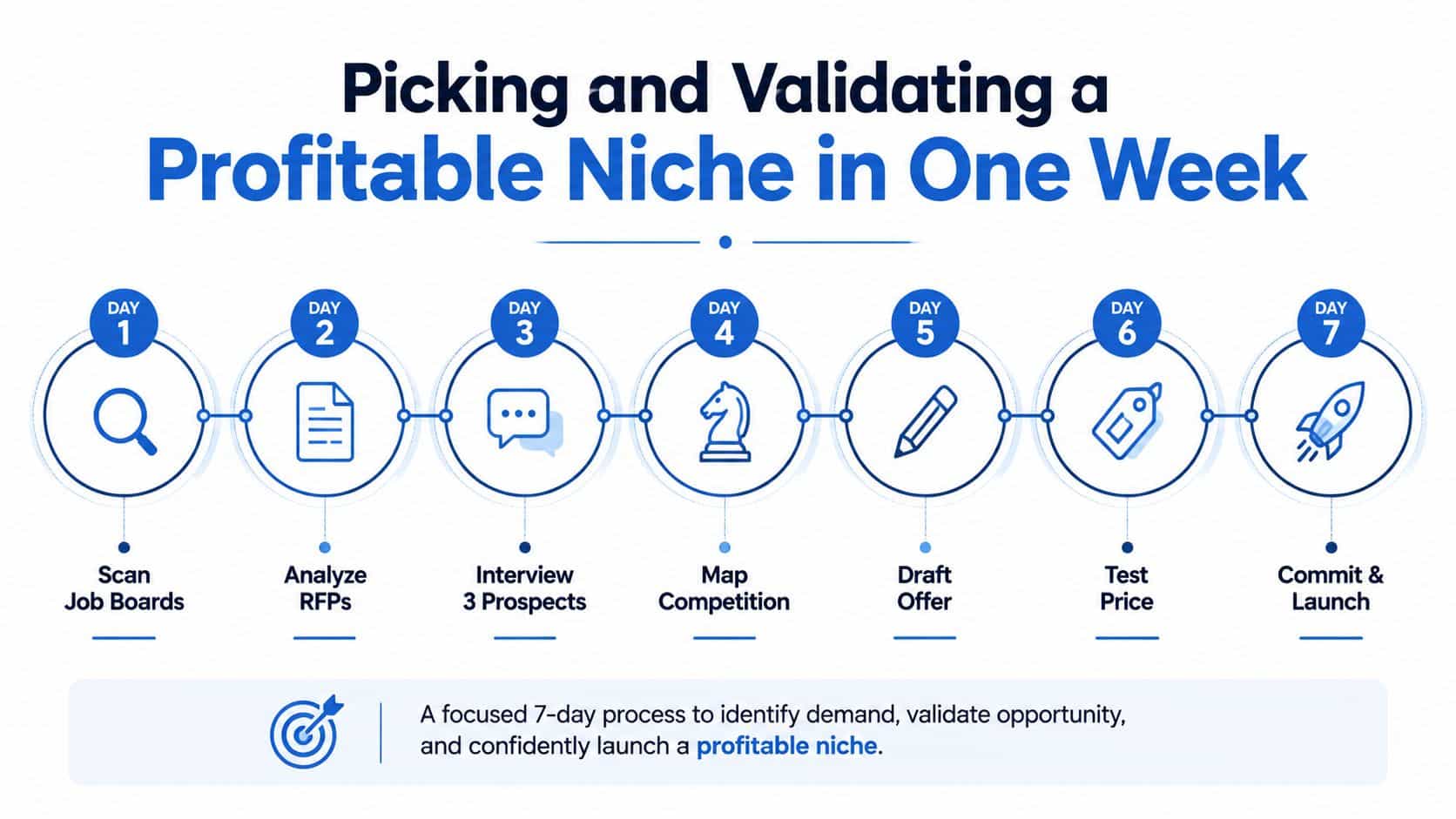
Day 1 is blunt. Scan job boards for roles tied to the problem you want to solve. Day 2, look through RFPs and service requests for language that shows urgency, not curiosity. Day 3, talk to three prospects and ask what they already tried, what it cost them, and what happens if they do nothing.
A fast validation sprint works better than endless research
Write a one-sentence value proposition after those first conversations. Keep it specific, like “I help multi-location service businesses fix lead follow-up and review generation so their existing demand turns into more booked jobs.” That beats “I help businesses improve marketing” because it names the buyer, the operational problem, and the result.
Then test three to five ideal client profiles, not twenty. You want enough variation to spot a pattern, not so much that you lose the thread. By Day 5, draft a paid pilot offer. By Day 6, test price. By Day 7, commit or walk away.
A niche is real when someone with budget says, “Send the proposal,” not when they say, “Interesting, keep me posted.”
A lot of consulting advice stops at “pick a niche” and leaves out the part that matters, proving there is a budgeted problem behind the conversation. How to Start a Consulting Business points you toward validation, but you still have to force a buying signal. That means asking for a pilot, a scope, or a next step that costs money.
If you need a practical lead-in for that pilot, use a simple magnet or diagnostic that helps you convert more leads with lead magnets using one clear promise and one clear next step. Keep it tight. Do not build a content machine before you know the market will pay.
The point is not to find the perfect niche. The point is to find one that answers yes fast enough to justify the next 90 days.
Designing Your Offer, Pricing, and Delivery Workflow
A consulting practice gets easier the moment the offer is boxed in. If you sell broad advisory hours, you end up selling your calendar. If you sell a fixed engagement with named outputs, you can manage scope, train support, and stop rewriting your process every week.
Build three tiers, not twenty custom options
The cleanest structure is a diagnostic tier, an implementation tier, and a continuation tier. The diagnostic opens the door, the implementation does the work, and the continuation handles optimization or ongoing support. That gives buyers a path without forcing you to invent a fresh package every time.
Here's a simple comparison.
| Consulting Pricing Models Compared | Best For | Cash Flow | Risk |
|---|---|---|---|
| Retainer | Ongoing support, advisory, execution oversight | Predictable after the first close | Scope creep if deliverables aren't tight |
| Fixed-scope project | Clear outcomes, defined timelines, launch work | Strong upfront control | Underpricing if discovery is weak |
| Value-based pricing | Buyers with a measurable business case | Highest upside when quantified well | Harder to sell early without proof |
For a solo consultant in year one, start with fixed-scope projects. You need clarity more than elegance. Retainers make sense only after clients trust your execution and you've proven a repeatable process.
Use a worked example for a multi-location client
A 6-week diagnostic for a multi-location business should be built around current-state analysis, a gap map, a priority roadmap, and a handoff call. Deliverables should be written before you sell the offer, not after. The scope should answer what gets reviewed, what gets documented, and what the client receives at the end.
The renewal path is simple. The diagnostic identifies the highest-friction leaks, then you offer an implementation sprint or a monthly advisory retainer to handle the fixes. That keeps the first engagement small without making it feel trivial.
Useful test: If you can't describe the deliverables without opening a blank document, the offer isn't ready.
Proposal tools can help here, especially if you want to speed up scope writing and keep your language consistent. If you're comparing options, this roundup of 10 best proposal software platforms for 2026 is worth a look when you're ready to standardize your sales process 10 Best Proposal Software Platforms for 2026.
Put the delivery workflow on rails
Delivery should not depend on your personal calendar memory. Use a repeatable sequence. Kickoff. Diagnostic. Prioritized recommendations. Review meeting. Follow-up plan. That structure makes client outcomes easier to explain, and it prevents the “what are we doing this week?” drift that kills momentum.
A narrow offer with a repeatable workflow is what makes a consulting business feel real. Everything else is decoration.
Legal Setup, Contracts, and Money Management That Holds Up
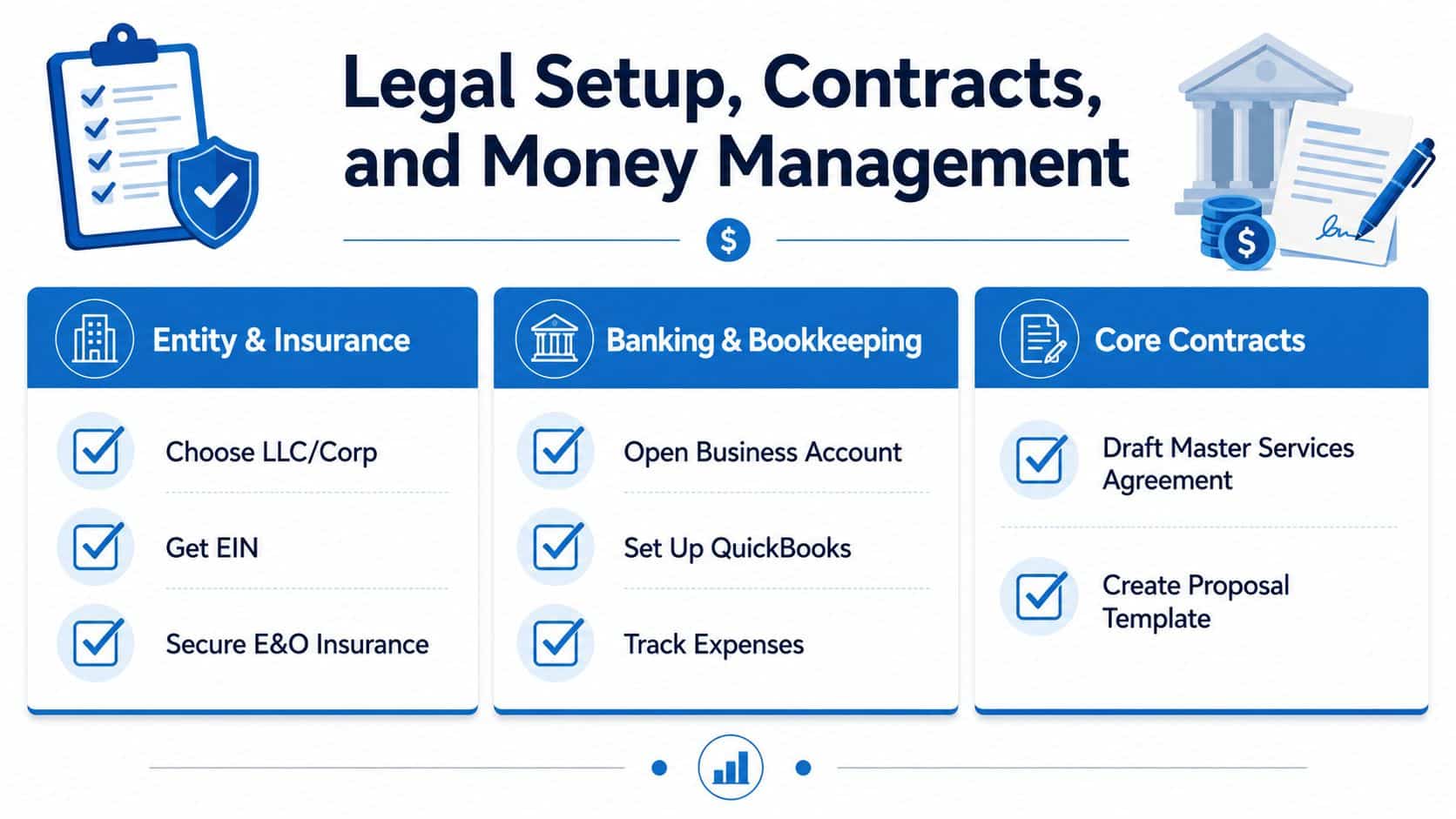
A consulting business does not need legal theater. It needs basic protection and clean records. Skip the sloppy setup, and you will pay for it later in messy invoices, tax confusion, and contracts that do not match the work.
Start simple, then formalize when the work justifies it
A sole proprietorship can work at the start if you are testing the market and the risk is low. Once the work becomes steady, an LLC or similar entity starts to make more sense because it separates the business from your personal finances and gives you cleaner administrative boundaries. If you are setting up in Australia, this Australia company registration guide is a practical reference for the registration side of things.
Insurance should be boring and specific. Professional liability, sometimes called errors and omissions, matters when your recommendations affect client operations. Banking should be separate from day one. Open a business account, stop mixing expenses, and use bookkeeping software so you are not reconstructing last quarter from screenshots and memory.
Use two contracts, not a pile of legal clutter
You need a master services agreement and a statement of work. The first sets the legal rules, and the second defines the exact job. That split keeps your offer flexible without forcing every project into a full legal rewrite.
Simple does not mean thin. Your paperwork should say what happens if scope changes, when payment is due, what the client owns, and how the engagement ends. That covers most early friction before it becomes expensive.
Keep the money system boring
Track revenue, expenses, deposits, and outstanding invoices every week. Do not wait for tax season to find out what you spent. If a client wants to pay late, bake that into your working capital plan instead of pretending the check will arrive on your preferred schedule.
The first 90 days punish consultants who improvise with cash. Separate accounts, consistent invoicing, and basic bookkeeping keep the business usable while you are still earning trust and closing your first projects.
If you want a quick decision rule, here is mine.
Solo consultant rule: Use the simplest entity and accounting structure that keeps your personal finances separate and your paperwork clean. Upgrade only when the volume of work or risk makes the next step obvious.
That is the right kind of caution. Not paralysis, just enough structure to keep the business from wobbling.
Building a Sales Engine With One Platform
A consulting practice needs a sales system before it needs a stack of disconnected tools. If your leads live in one app, your booking link lives in another, your proposals live in a third, and your follow-up happens in your inbox, you'll lose deals to silence and delay. One workspace is enough for the early stage if it can handle capture, follow-up, booking, proposals, and payments HighLevel.
Build the client journey as a single flow
Start with a landing page and a form. That page should capture the lead, tag the niche, and trigger an immediate response. Use email and SMS for the first touch, then move the prospect toward a calendar booking step once they've expressed intent.
A practical stack can live in an all-in-one marketing platform advantage workflow that keeps the handoff from lead to booking to proposal inside one system all-in-one marketing platform advantage. That matters because every extra tool creates one more place for a prospect to stall.
Then send the proposal from the CRM, not from a random attachment buried in email. Once the client signs, collect payment with an invoice or Text-2-Pay flow. That removes the “I'll pay later” drift that often slows down new consulting deals.
Use nurture to keep the lead warm
If a prospect doesn't book immediately, don't chase them manually forever. Put them into a short email and SMS sequence that answers common objections, shares one relevant case-type outcome, and nudges them back to the calendar. If you're still setting up outbound sending, the Best email warmup tools overview can help you think through deliverability hygiene before you scale outreach.
HighLevel consolidates CRM, lead capture, booking, payments, proposals, workflows, reputation management, and client reactivation into a single workspace, replacing disconnected tools with one platform for agencies and small-to-medium businesses HighLevel. That's the kind of setup that keeps a new consultant from wasting time stitching together five subscriptions and three browser tabs.
Keep the first funnel boring and visible
Use one offer, one landing page, one booking link, one proposal template, and one payment path. The goal isn't sophistication. The goal is to make every lead move through the same path so you can see where people drop off and fix it fast.
If a prospect replies, books, and pays without you nudging them through five manual steps, your consulting business already feels more professional than most new practices.
Client Delivery, Retention, and Reactivation Systems
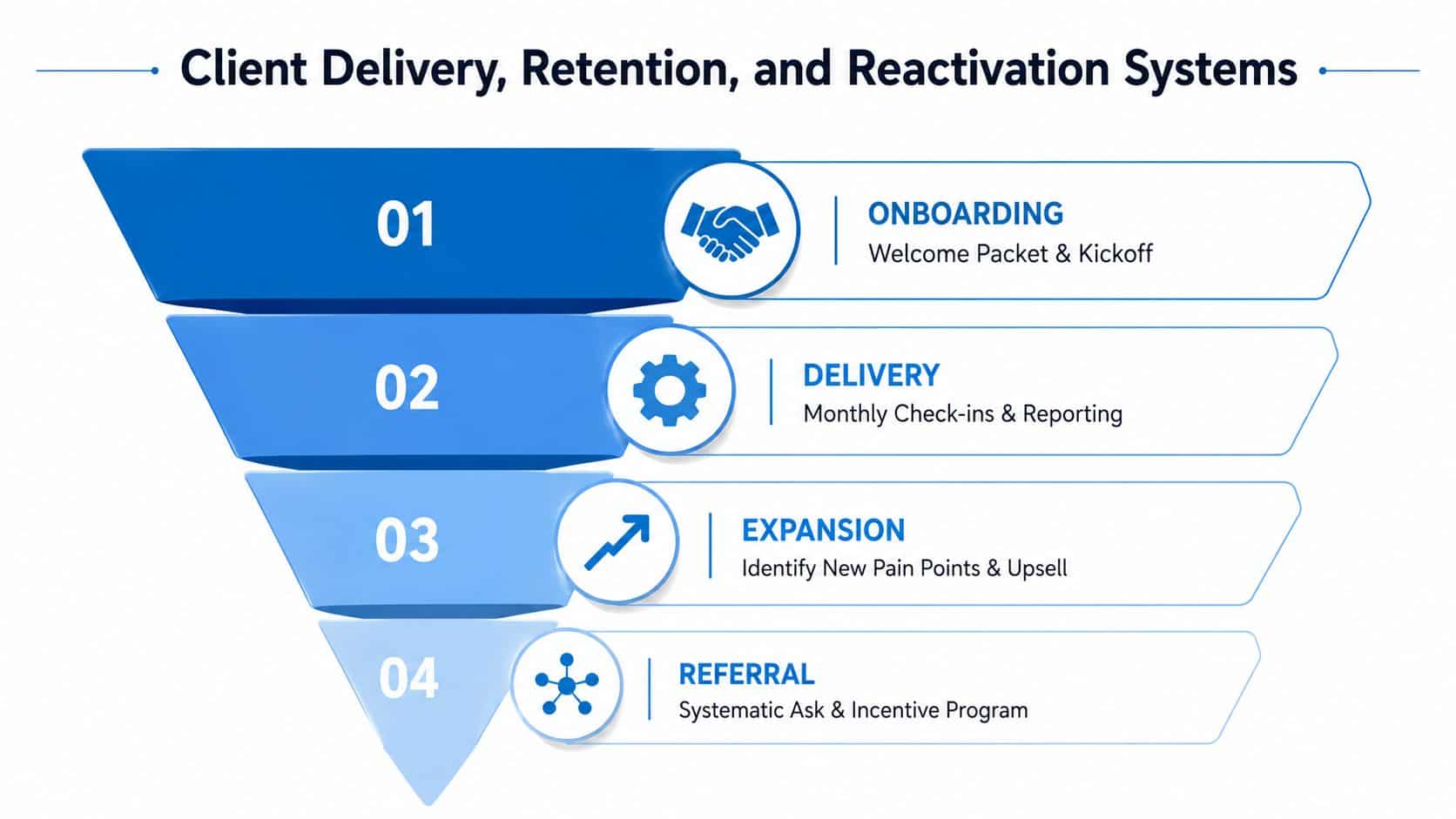
The first project is the test. If delivery is messy, the client will not renew. If renewal feels awkward, referrals stall. Consultants who grow past the first engagement build a system for the whole client lifecycle, not just the sale.
Run delivery like an operating rhythm
Every engagement needs a weekly check-in, a visible scope-change process, and a final outcome review. If the work shifts, document the shift. If the client adds a request, price the change clearly. That keeps resentment out of the relationship and protects your margins.
Review requests should happen after a visible win, not at random. Ask while the result is fresh and the client is still talking about it. If the work was local or multi-location, that review supports the next sale because buyers in those markets rely heavily on social proof.
For local businesses, a local seo platform can help keep review requests, follow-up, and reputation work in one place. That matters when your consulting touches booking, customer recovery, or repeat visits. If you also need to manage local reviews better, keep that work tied to the same client workflow instead of treating it as a separate service.
Turn the end of one engagement into the start of the next
Use smart lists and broadcast campaigns for post-engagement follow-up. Put past clients into a reactivation sequence 30, 60, and 90 days after the project closes. The message does not need to be clever. It needs to be relevant. Check in on results, surface a new pain point, and offer a short review call.
Do not wait for former clients to remember you. Give them a reason to hear from you again.
The best use of automation here stays simple. A kickoff packet starts the relationship, monthly check-ins keep it moving, an outcome survey captures proof, and a follow-up sequence turns the finished project into more work. HighLevel's reputation tools, broadcast campaigns, and smart lists fit that lifecycle because they keep follow-up, review requests, and reactivation in the same system HighLevel.
A 90-day post-engagement nurture sequence can look like this. Week 1, send a wrap-up note and recap the wins. Week 4, ask whether the team has hit new friction. Week 8, share a short recommendation tied to the original outcome. Week 12, invite the client back for a quick strategy check.
That is how a consulting practice compounds. Keep the people you already helped close to the business, and your pipeline gets easier to refill.
Your 90-Day Action Plan and Pre-Launch Checklist
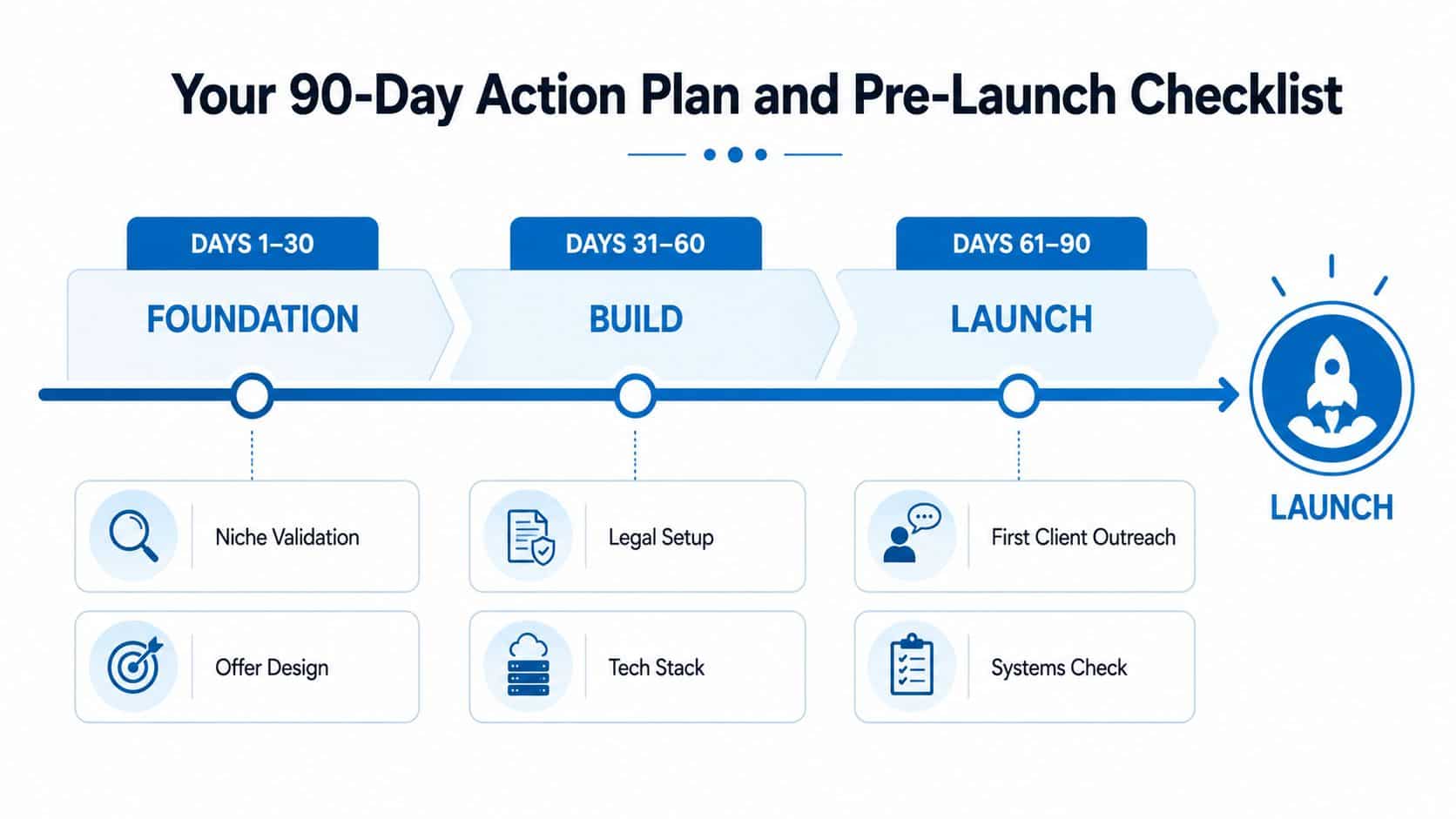
Start with a checklist, not a logo. You need a niche validated by real conversations, one fixed offer, your entity and contracts in place, one booking and proposal workflow, and a first outreach list that isn't vague. If those pieces aren't done, you're not ready to market.
Days 1 to 30, stay on foundation work. Validate the niche, write the offer, and confirm the problem is budgeted. Days 31 to 60, finish legal setup, build the tech stack, and prepare the proposal and payment flow. Days 61 to 90, run outreach, book calls, and close the first pilot or project.
FAQ
How long until revenue appears? It varies, but the shortest path is a paid pilot tied to a real operational problem, not a broad advisory pitch.
When should you hire help? After your delivery process is repeatable and the work is taking time away from selling or client results.
How do you know the niche is wrong? If prospects like the idea but won't pay for a pilot, the problem is probably not urgent enough.
The thesis stays the same throughout. Treat the consulting practice like a product business with a narrow offer, a measurable outcome, and a stack that runs the whole lifecycle. That's how you stop sounding like a generalist and start operating like a real firm.
If you want the intake, booking, proposal, payment, and follow-up side of a new consulting practice to live in one system instead of five, take a close look at HighLevel. It's built to centralize the work that usually gets scattered across too many tools, and that makes it a practical fit for consultants who want to launch cleanly and stay organized as they grow.
