


Most gohighlevel vs Kartra for agencies comparisons ask the wrong question. They obsess over features, then pretend the winner is obvious, as if an agency ever collapsed because it lacked one more page builder widget. The true issue is workload. A platform either removes internal ops burden, or it hands that burden to your team and waits until client count exposes the mess.
That's why the better comparison is not “which tool has more stuff.” It's “which system keeps onboarding, support, messaging, and process management from becoming your agency's second full-time job.” GoHighLevel and Kartra are not interchangeable choices with different skins. They're built for different operating models, and the wrong fit shows up later as manual handoffs, messy client management, and avoidable support drag.
Table of Contents
- Why Agencies Should Stop Comparing Feature Lists
- How GoHighLevel and Kartra Were Built Differently
- Pricing Math That Actually Matters for Agencies
- Matching Daily Agency Workflows to the Right Platform
- The Hidden Operating Costs Most Comparisons Ignore
- Choosing the Right Platform for Your Agency Stage
- The Honest Verdict and What to Do Next
Why Agencies Should Stop Comparing Feature Lists
Agencies waste time when they compare GoHighLevel vs Kartra for agencies like they are shopping for a prettier checklist. The key question is simpler: which platform lowers internal operating cost once you start onboarding clients, managing follow-up, and keeping accounts organized. If a tool looks good in a demo but creates more coordination work in practice, it is the wrong choice for an agency.
A feature list tells you what the software can do. It does not tell you how much labor your team absorbs to keep those features useful every week. That difference shows up in onboarding, support, and reporting, where small gaps turn into recurring admin work. If your staff has to move data between tools, rebuild workflows for each client, or answer the same setup questions over and over, the platform is increasing workload instead of reducing it.

Practical rule: if a platform is easier to sell than to operate across client accounts, it is pushing labor back onto your team.
GoHighLevel frames the comparison around CRM, pipelines, multichannel messaging, white-label SaaS, and agency support, while Kartra is framed more like a business-in-a-box for funnels, memberships, checkout, video, helpdesk, and affiliates (GoHighLevel vs Kartra comparison). That difference matters because it shapes how your team works day to day. One model is built for agencies that need a central operating layer. The other is built for a single brand managing one customer journey.
Internal overhead is the core filter. If your agency spends too much time stitching together client communication, support paths, and reporting, the software is not solving the problem, it is moving the problem around. That is the point behind when HighLevel replaces other tools, because the shift only makes sense when it reduces coordination work instead of adding another system to babysit.
How GoHighLevel and Kartra Were Built Differently
GoHighLevel was built for agencies that manage many client accounts at once. Its packaging centers on sub-accounts, CRM, SMS, workflow automation, calendar booking, and white-label support, with entry pricing starting at $97/month, the Unlimited plan at $297/month with unlimited sub-accounts, and SaaS Pro at $497/month for white-label capabilities. The product structure and the pricing ladder point in the same direction, a central operating layer for agencies, not a single login for one business.
Kartra is built around a different operating model. It is positioned more toward course creators, infopreneurs, funnel builders, and online businesses, with strengths in landing pages, memberships, and email marketing. That setup works cleanly when one brand owns the customer journey and one team controls the content, offers, and follow-up.
What that means in daily use
The difference shows up fast in communication. Independent comparison content notes that Kartra lacks built-in SMS, calls, or messenger automation, while GoHighLevel includes multi-channel communication and client-account management features that agencies usually need (independent comparison). Agencies live in the gaps between lead capture, fast follow-up, booking, and retention. If the platform cannot handle those handoffs natively, your team starts building workarounds, and internal workload goes up.
White-labeling works the same way. GoHighLevel treats reselling and client portals like part of the product. Kartra treats the brand as singular. That makes Kartra feel polished for a creator business and clumsy for an agency that needs to spin up many client environments. If your model depends on running campaigns across separate brands, a HighLevel white label platform fits that reality in a way Kartra does not.
In plain terms, Kartra fits one business selling content or memberships. GoHighLevel fits an agency that owns the system across multiple client accounts. Pick the operating model first, then the tool. If you reverse that order, you end up buying software that looks fine in a demo but pushes coordination, support, and setup work back onto your team.
Pricing Math That Actually Matters for Agencies
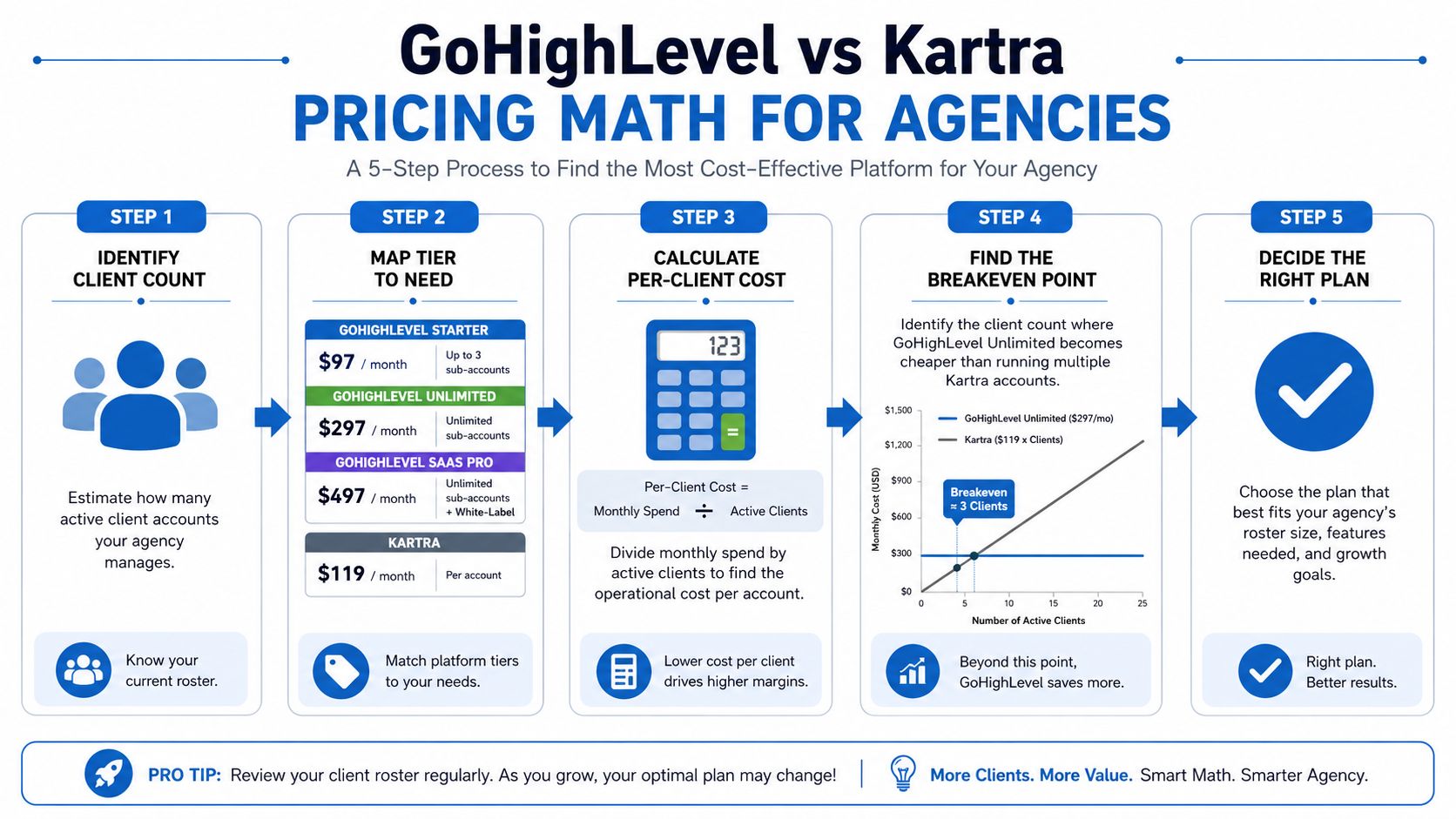
The pricing headline is easy enough to recite. GoHighLevel starts at $97/month, the Unlimited plan starts at $297/month with unlimited sub-accounts, and SaaS Pro is $497/month with white-label capabilities. Kartra starts at $119/month. The important part is not the sticker price. It is how each plan changes the amount of admin, support, and setup work your team absorbs as client count grows.
A solo operator with one or two client accounts may still see Kartra's entry price and feel pulled toward it. That reaction makes sense. At low volume, the lower monthly bill can look easier to justify. Once you are managing more accounts, the question becomes whether you are paying for software or paying your team to cover for software gaps. A cheap plan on paper can become the expensive one inside the agency.
The hidden cost shows up in time, not invoices. If a platform forces manual follow-up, extra handoffs, or separate workarounds for each client, the monthly savings disappear fast. GoHighLevel's higher plans only make sense if they reduce those internal touches. That is the math agencies should care about.
The breakeven test agencies should run
Start with the monthly fee, then divide by active client accounts. If that number looks good only because your team is spending hours on setup, reporting, or follow-up outside the platform, the calculation is incomplete. The Unlimited plan changes the equation because unlimited sub-accounts let one system absorb the messy parts of multi-client management. That is why agencies usually move away from single-brand tools once the work gets repetitive.
The cleaner way to evaluate the stack is to count the tasks your team no longer has to patch together. Fewer tools means fewer logins, fewer client-specific exceptions, and fewer support tickets created by internal confusion. The point of build an agency OS with HighLevel is not to buy more software. It is to reduce the amount of operational glue your team has to maintain.
Agency finance rule: do not choose the plan that feels cheapest this month, choose the one that removes the most babysitting from your team.
Kartra's lower entry point still works for a narrow use case. If your agency mainly supports one brand, or you operate more like a creator business with contractors around you, Kartra's packaging can be acceptable. For agencies with multiple client accounts, the pricing conversation has to include the cost of extra tools, extra handoffs, and extra time spent making a creator-first platform behave like an agency system. That is where the economics usually flip.
Matching Daily Agency Workflows to the Right Platform
Agency work is a chain of handoffs. A lead comes in from an ad, a follow-up goes out, a call gets booked, the pipeline updates, a review request fires after delivery, and someone on the team responds without bouncing between five tabs. GoHighLevel handles that chain well because its funnel actions can trigger CRM record updates, pipeline-stage movement, and omnichannel automation across email, SMS, voicemail, and Messenger (workflow comparison). That matters because agency operations break when each step has to live in a different tool.
Kartra works better for fast launches with a narrower scope. Its funnel builder is cleaner when one team is pushing a single campaign and wants speed over flexibility. The trade-off shows up the moment a workflow needs client-specific logic, branch-based follow-up, or multiple channels. Then “simple” turns into rigid, and rigid systems push the exceptions back onto your staff.
Where the workflow split shows up
- Lead capture and response: GoHighLevel fits the usual agency workflow better because a form submission can move straight into CRM and multichannel nurture without forcing a separate toolchain.
- Appointment setting: if booking is part of delivery, GoHighLevel's calendar and workflow stack lines up more naturally with agency operations.
- Pipeline movement: when deal status needs to change based on behavior, GoHighLevel handles that chain cleanly.
- Content launches: Kartra still makes sense when the job is getting one funnel live quickly for one brand.
- Multi-client orchestration: once each client needs its own logic, Kartra asks your team to do more manual coordination.
That difference is why agencies should judge workflow systems by the amount of internal labor they remove. An all-in-one platform for agencies only earns that label if it cuts handoffs, reduces exception handling, and keeps support requests from piling up on your team.
The Hidden Operating Costs Most Comparisons Ignore
Most platform comparisons stop at software features because those are easy to list. Agencies pay for the work the software creates around the software, and that cost shows up in onboarding time, support load, deliverability management, and process complexity. GoHighLevel's own comparison points out that many side-by-side reviews miss the operational burden once an agency is managing many client accounts. That is the part that matters.
The four costs that decide whether a platform scales
Onboarding time is the first bill. A platform built around one brand can be simple to explain once, then expensive to repeat across a portfolio of clients because every account needs its own setup logic, client handoff, and internal training. If your team has to teach the same structure over and over, onboarding stops being a one-time setup and becomes a recurring project.
Support load comes next. More buttons do not automatically mean more tickets, but unclear ownership does. When a platform does not naturally support client-account management, your team becomes the human router for every login issue, workflow question, and campaign exception.
Deliverability management gets harder as volume rises. The more campaigns, domains, and automations an agency runs, the more attention email and message flow need. If the platform does not centralize that work cleanly, someone on your team has to watch it manually and clean up avoidable failures. That is exactly the sort of hidden labor agencies miss until inbox placement or reply rates start slipping.
Process complexity is the slow killer. As automations multiply, edge cases multiply with them. A platform with native sub-accounts and centralized messaging reduces part of that mess. A platform that assumes a single brand pushes more exceptions back onto the agency, and those exceptions end up living in Slack threads, spreadsheets, and internal handoffs.

Operational warning: if you need three workarounds to make a platform behave like a client system, you are not saving time. You are hiding costs.
An automated callback system for local businesses is a clean example of why native multi-channel automation matters. The less your staff has to bridge gaps between systems, the less internal labor each client account consumes. That is the core comparison. Not the feature checklist, the amount of work the platform creates for your team.
Choosing the Right Platform for Your Agency Stage
A freelancer with two accounts does not need the same operating model as a ten-person agency handling a stack of clients. That sounds obvious, but agencies still buy software for short-term convenience and then pay for it later in extra setup, support, and cleanup. The better way to choose is to match the platform to the amount of internal coordination your team can absorb.
Three common agency profiles
If you are a solo operator or a tiny shop with a couple of client accounts, Kartra can still make sense when the work is narrow, especially if you are mostly building funnels and memberships for one brand at a time. The launch experience is cleaner, and the entry cost usually feels easier to justify. Once you start building separate processes for each client, you are outside Kartra's sweet spot.
If you are a growing agency with multiple accounts and recurring follow-up work, GoHighLevel is the better fit. Its structure is built for client management, and that matters more than any single feature on a checklist. At this point, centralized CRM, sub-accounts, and white-label options stop being nice extras and become basic operating hygiene.
If you are a course creator who is becoming an agency, do not choose based on familiarity. Creator-first teams often prefer Kartra because it matches the content-selling mindset. Agencies need account orchestration, not just campaign publishing. That shift usually happens when one brand turns into many, and the software has to carry the complexity instead of dumping it back on the team.
Simple switch test: if client onboarding forces your staff to explain the same workflow more than once, you have outgrown a creator-first tool.
The same logic applies if you are building client delivery around outreach, follow-up, and messaging. In that setup, how agencies use DMpro is a useful reference point for how agency operations change when delivery systems are tied to the workflow instead of treated as one-off campaigns. The practical rule is simple, choose the platform that fits the shape of your client roster and the amount of internal work it creates. That is how you avoid replatforming six months later.
The Honest Verdict and What to Do Next
GoHighLevel is the stronger choice for agencies that are carrying real client volume. The reason is operational, not cosmetic. Its setup is built around multi-client management, sub-accounts, CRM, multichannel follow-up, and white-label workflows, so the team spends less time stitching systems together and more time servicing accounts. Kartra still belongs in the conversation if your work is centered on one brand's courses, memberships, and funnels, or if your agency is really a creator business with services layered on top.
The decision should come down to where your internal workload goes up. If every new client creates another round of manual routing, repeated onboarding, and support questions, GoHighLevel removes more friction. If your delivery is mostly tied to one content business and the client model stays simple, Kartra can still fit without forcing a platform change that your team does not need.
If you are on Kartra and the work is getting harder to coordinate, move the process that eats the most staff time first. For many agencies, that is lead follow-up and calendar booking. If you are already on HighLevel, start with the accounts that need the most handholding, then standardize the rest after the first migration proves the process. The first ninety days should tell you whether onboarding takes less effort, support tickets drop, and message routing becomes cleaner. If those three things do not improve, the platform choice is only shifting work around.
For agencies that rely on outreach and client communication, the true test is whether the platform reduces coordination overhead or just redistributes it. The best reference point is how agencies use DMpro, because it keeps the focus on delivery operations instead of feature lists. Pick the system that gives your team fewer handoffs, fewer exceptions, and fewer cleanup tasks. If you want the clearest path off a messy stack, trial GoHighLevel first and move the workflows that currently create the most internal work.
