


The best sales book depends on the bottleneck, not the popularity of the title. A framework that sharpens discovery won't fix weak positioning, and a prospecting cadence won't rescue an offer buyers don't understand. The useful question is not, “Which sales book should everyone read?” It's, “What is preventing this sales process from moving forward?”
These ebooks on selling address distinct problems, including discovery, qualification, positioning, lead generation, offer design, negotiation, follow-up, and broader go-to-market alignment. I've evaluated each one by the audience it serves, the sales problem it solves, where it falls short, and how its ideas can become repeatable workflows, lead magnets, or internal training assets in HighLevel.
Choose one primary framework and apply it to live opportunities. Use the remaining books as supporting material for coaching, onboarding, scripts, workshops, and campaign assets. If your immediate issue is conversion at the bottom of the funnel, pair the reading with practical closing tactics for sales pros, then build the process around the actual constraint rather than collecting more theory.
Table of Contents
- 1. SPIN Selling
- 2. The Challenger Sale
- 3. Predictable Revenue
- 4. From Impossible to Inevitable
- 5. $100M Offers
- 6. $100M Leads
- 7. GAP Selling
- 8. Fanatical Prospecting
- 9. Never Split the Difference
- 10. Obviously Awesome
- Top 10 Sales Ebooks Comparison
- Turn Reading Into a Repeatable Sales System
1. SPIN Selling
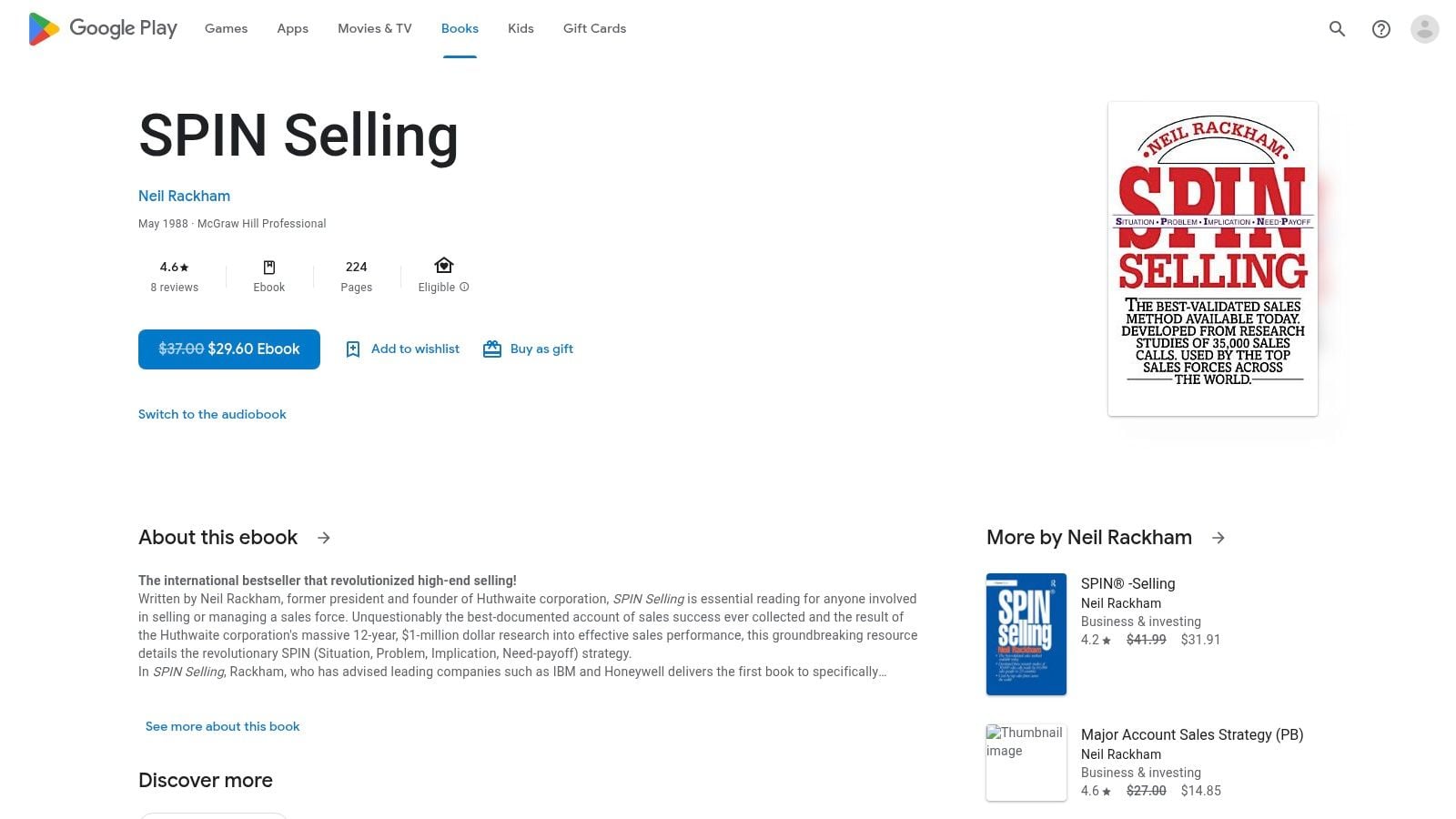
Complex sales conversations often fail because the seller moves to the solution before the buyer has fully described the problem. SPIN Selling, available through the Google Play Books edition, gives teams a structured way to slow down and diagnose the situation.
The framework uses four question types, Situation, Problem, Implication, and Need-payoff. Situation questions establish context. Problem questions uncover dissatisfaction. Implication questions explore the consequences of leaving the problem unresolved. Need-payoff questions help the buyer articulate the value of change in their own terms.
That sequence is particularly useful for enterprise, consultative, and high-ticket B2B sales. It gives managers something concrete to coach because they can review call notes and ask whether the rep uncovered consequences, not merely surface-level pain.
Where SPIN works best
SPIN is a strong choice when several conversations may occur before a proposal. It helps sellers qualify without turning qualification into a checklist, and it creates a natural bridge from discovery to value framing. The method also fits a clear pipeline definition with HighLevel because each stage can require evidence from the conversation before a deal advances.
Its limitation is equally clear. The book doesn't provide a complete modern multichannel prospecting system, and some examples may feel dated. Use it for conversation quality, then connect it to current email, SMS, calling, calendar, and CRM workflows.
Turn the framework into a HighLevel training asset by creating four call-note fields, one for each question type. Add a workflow that prompts the rep to complete those fields before a proposal stage becomes available. A short SPIN worksheet can also work as a lead magnet for sales managers who want a structured discovery process.
2. The Challenger Sale
Some buyers need a reason to question a familiar process, not another product explanation. The Challenger Sale, presented by Penguin Random House, focuses on insight-led selling through Teach, Tailor, Take Control.
The seller teaches a commercially relevant idea, tailors it to the buyer's situation, and takes control when the conversation reaches decisions, commitments, or next steps. That approach requires evidence and judgment. A rep should explain how an accepted assumption creates a business problem, then connect that problem to a practical change.
The book fits B2B SaaS, agencies, and sellers introducing a new category or operating model. It is most useful for teams whose discovery calls stall because prospects understand the product but do not see a reason to change. It is less useful as a standalone prospecting system, negotiation method, or follow-up playbook. Leaders must supply those workflows separately.
Turning insight into enablement
The framework becomes abstract when reps lack supporting assets. A credible Challenger conversation needs a point of view, diagnostic, short presentation, comparison, or benchmark that changes how the buyer frames the problem. Without that material, “challenging” can become an unsupported opinion.
Build the system in HighLevel:
- Create the insight asset: Publish a short report, diagnostic, or guide for a specific status-quo problem.
- Capture context: Use a form or survey to ask what the prospect currently does and where the process breaks.
- Route by relevance: Apply tags and lead scoring so email, SMS, and call follow-up reflect the buyer's situation.
- Train the conversation: Store teaching points, tailoring prompts, objection responses, and commitment questions in a membership or course.
A Challenger-inspired lead magnet should support converting visitors into qualified leads, rather than merely collecting email addresses. The form can identify the buyer's current process, while the workflow sends a relevant diagnostic and prompts a rep to prepare for discovery. Sales managers can also turn the asset into a call-review checklist, giving training a repeatable standard.
3. Predictable Revenue
Outbound teams often struggle because nobody knows where prospecting ends and selling begins. Predictable Revenue, introduced through the Predictable Revenue platform, is useful for separating responsibilities, clarifying handoffs, and building a repeatable pipeline process.
Its central operating idea is role specialization. Sales development focuses on creating qualified conversations, account executives handle sales opportunities, and account management supports customers after the sale. That structure helps leaders identify whether the issue is list quality, outreach, qualification, closing, onboarding, or retention.
The approach suits SaaS companies, agencies, and service businesses that need a defined outbound motion. It also provides a useful discipline for owners who currently handle every step themselves and can't tell which activity is consuming their time.
Adapt the playbook to current channels
The book's cold email and list-building guidance needs modern judgment. Deliverability, consent, data quality, personalization, and channel mix all affect whether an outbound motion earns attention. The framework is less helpful for product-led growth, inbound content, or complex social selling, so don't treat it as a complete go-to-market system.
Use this playbook from HighLevel to connect specialization to an actual operating system. Create separate pipeline stages for new lead, attempted contact, qualified appointment, sales opportunity, and closed outcome. Assign ownership automatically, trigger reminders when a handoff stalls, and keep email, SMS, calls, and social messages connected to the contact record.
A practical training asset is a role-and-routing map. It should define who owns each stage, what information must be captured, what qualifies a meeting, and what happens after a missed appointment. HighLevel workflows can then enforce the process without requiring every team member to remember every handoff.
4. From Impossible to Inevitable
Choosing the right market can matter more than refining another sales script. From Impossible to Inevitable, represented by the book's official website, connects market focus, positioning, sales motion, customer success, and growth. Its central sales problem is poor fit: a team may execute well while pursuing buyers who lack urgency, budget, or a strong reason to change.
The book is most useful for agency owners, SaaS leaders, and service businesses whose messaging has become too broad. Narrowing the target market makes discovery more specific, improves qualification, and gives salespeople a clearer promise to test. It also links acquisition decisions to retention, so the team can ask whether the customers it wins are likely to adopt, renew, and refer.
Its examples involving Twilio, HubSpot, and Salesforce help leadership teams discuss category focus and growth. They do not translate neatly to every local business or small agency. The framework also offers little guidance for call openings, objection handling, or negotiation, so it should guide commercial decisions rather than replace frontline training.
Turn positioning into a repeatable operating model
Run the framework as a quarterly decision process. Define the narrow customer by problem, buying context, and urgency. Record which discovery questions test that fit, which objections signal poor positioning, and which proof supports the promise. Then document inbound, outbound, referral, partner, and expansion routes separately, with an owner and follow-up rule for each.
Map the customer lifecycle from first promise through onboarding, adoption, renewal, and advocacy. Give marketing, sales, and customer success shared definitions for qualified lead, opportunity, active customer, and at-risk account.
In HighLevel, package the decisions into a niche-specific snapshot, funnel, pipeline, onboarding workflow, and reporting view. Turn the workshop into a training asset by adding a niche brief, qualification form, discovery prompts, follow-up templates, and manager review checklist. The test is operational: the chosen niche should change the landing page, offer language, calendar questions, sales script, and follow-up sequence. Otherwise, the exercise produced positioning language, not a working sales system.
5. $100M Offers
A prospect can accept the problem, trust the salesperson, and still reject the purchase because the offer feels unclear or risky. $100M Offers, available from Acquisition.com, examines packaging, value design, pricing, guarantees, urgency, and upsells through worksheets and practical prompts.
Its central sales problem is weak offer definition. Agencies, coaches, consultants, and service businesses selling an outcome through a landing page or sales call will gain the most. The framework requires a clear answer to four questions: what the buyer receives, how delivery works, which risks the seller can reduce, and why this package deserves comparison with alternatives.
Use the ideas during discovery and proposal review. If prospects repeatedly ask what is included, how long delivery takes, or what happens when results fall short, the offer needs sharper scope and proof. The book helps teams turn those questions into page copy, qualification prompts, proposal sections, and follow-up responses.
The trade-off is fit. Its examples suit information products and services more closely than enterprise procurement, complex implementation, or buying groups with several decision-makers. Guarantees and urgency also require restraint. They should reflect delivery capacity and a credible promise, not imitate a template.
In HighLevel, build the workflow around the buyer's decision:
- Offer page: State the target customer, problem, outcome, inclusions, exclusions, and next step.
- Qualification form: Test fit, urgency, budget context, and delivery constraints.
- Pipeline: Track application, consultation, proposal, decision, and payment.
- Payment path: Match estimates, invoices, order forms, paid calendars, or integrations to the sales motion.
- Expansion path: Offer a relevant upsell or membership after the initial purchase.
An offer audit can become a lead magnet and a training exercise for reviewing calls, pages, and proposals.
6. $100M Leads
A strong offer still needs a reliable way to reach potential buyers. $100M Leads, listed through Acquisition.com, organizes lead generation around offers, channels, creative, testing, and follow-up.
The book is a practical fit for local services, coaches, creators, and agencies that need more campaign ideas and a clearer execution rhythm. Its channel breakdowns can help a team move beyond the vague instruction to “post more content” or “run ads.” Readers can use the prompts to generate campaign concepts for paid media, organic content, partnerships, referrals, and direct outreach.
The trade-off is measurement complexity. A simple campaign can be evaluated quickly, but a B2B deal may involve multiple contacts, long sales cycles, offline conversations, and delayed revenue. The framework also assumes that the operator can supply either advertising budget or a steady flow of content and distribution effort.
Turn campaigns into a system
Create one campaign brief with the audience, problem, promise, creative angle, capture mechanism, qualification question, follow-up sequence, and success condition. Build the landing page and form in HighLevel, then connect the response to a pipeline, smart list, calendar, and unified conversation inbox.
Follow-up should reflect behavior. A person who downloads a guide but doesn't book needs education and a clear next step. Someone who submits a detailed application may need a prompt to schedule. A lead who starts a conversation through Instagram, WhatsApp, SMS, or Messenger shouldn't be forced into a disconnected channel.
Use the book as a source for campaign workshops, not as permission to launch every channel at once. Pick one audience, one offer, and one distribution path. Document what was tested so the next campaign improves the operating process rather than merely producing another batch of creative.
7. GAP Selling
GAP Selling, explained by Sales Growth, addresses a common sales problem: buyers may recognize an operational issue without understanding its commercial cost. The method organizes discovery around the buyer's current state, desired future state, and the distance between them.
That structure suits SaaS and service sales, where value depends on changing a process rather than purchasing a standalone product. Reps investigate how work happens now, what improvement would look like, which business consequences matter, and what inaction could preserve.
Use GAP Selling after initial prospecting has produced a credible reason to talk. SPIN offers a sequence of questions, while GAP Selling gives the conversation a diagnostic map. The trade-off is that the framework depends heavily on the rep's ability to connect symptoms with financial, operational, or customer impact. Shallow diagnosis produces polished notes with little influence on a decision.
Convert discovery into sales assets
Build a discovery record with four required areas:
- Current state: What happens today, who owns it, and where does work slow down?
- Future state: What would a workable process look like?
- Business impact: What does the gap cost in time, capacity, risk, missed opportunities, or customer experience?
- Decision path: Who needs to agree, what must be proven, and what could prevent action?
Capture these answers in HighLevel custom fields before a proposal is created. Use the fields to generate a recap email, proposal brief, qualification summary, or internal handoff. A manager can then review the gap between calls instead of relying on general impressions.
For training, turn anonymized call notes into role-play exercises. Ask reps to identify the operational symptom, test its consequence with a follow-up question, and document the evidence required for a decision. The same examples can become a short course, membership lesson, or lead magnet that demonstrates the cost of leaving a process gap unresolved.
8. Fanatical Prospecting
A pipeline doesn't stay healthy because a team once built a good list. Fanatical Prospecting, published by Wiley, focuses on the repeated behavior required to keep conversations moving through cold calls, email, social outreach, and SMS.
The book is a useful manual for owner-operators, SDRs, agencies, and small teams that need a prospecting routine. Time blocking, cadence planning, scripts, objection handling, and list-building guidance give sellers something operational to follow when prospecting keeps getting postponed.
Its weakness is the risk of confusing activity with relevance. Volume can support consistency, but generic messages and poor targeting create noise. Enterprise account-based motions, multithreading, and deeper personalization require additional structure.
Build a cadence people can execute
Start with a defined prospecting block and a short, audience-specific sequence. Each touch should have a reason, a useful observation, and a clear response path. Use HighLevel to automate reminders, record outcomes, trigger missed-call text-back, and keep replies in one conversation stream.
Teams comparing tools can also compare 2026 call tracking tools before building a call-heavy motion. The important question isn't how many channels appear in the cadence. It's whether the team can maintain quality, capture dispositions, and follow up when a prospect responds.
Practical rule: Automate the reminder and routing, not the judgment about whether a message is relevant.
A good training asset is a prospecting operating guide with approved audience definitions, opening messages, objection responses, call dispositions, and escalation rules. Pair it with a HighLevel dashboard that shows overdue tasks, active opportunities, booked appointments, and stalled conversations. That creates accountability without pretending every contact deserves the same script.
9. Never Split the Difference
Negotiation begins before the buyer says, “Your price is too high.” Never Split the Difference, available through Kobo, introduces conversational techniques such as tactical empathy, labeling, mirroring, and calibrated questions.
These tools are useful in pricing conversations, scope changes, renewals, payment issues, and upsells. A calibrated question can move the buyer from a demand to a discussion about constraints. A label can acknowledge concern without immediately conceding. Mirroring can encourage the other person to explain what they mean rather than letting the seller fill the silence.
The methods apply well to agencies and SMB sales because the seller often negotiates directly with the owner or decision-maker. They can also help account managers protect scope when a client asks for additional work without changing the agreement.
Use the language without sounding rehearsed
The limitation is stylistic. Repeating a technique mechanically can make the conversation feel artificial or manipulative. The seller must listen first, choose a natural phrase, and remain clear about what the business can and can't offer.
In HighLevel, connect negotiation to the proposal and payment workflow. When a proposal is viewed but not accepted, trigger a personal follow-up task rather than an aggressive automated sequence. Store objection categories in the CRM, then use them to improve offer pages, proposal language, onboarding expectations, and internal training.
For teams that need software for send proposals, the workflow should preserve context from the discovery call. The proposal should reflect the buyer's stated priorities, commercial impact, scope, timeline, and decision process. Negotiation becomes easier when the document makes the original value conversation visible.

10. Obviously Awesome
A product can be good and still be difficult to sell when buyers cannot quickly understand who it is for or why it differs. Obviously Awesome, described on April Dunford's books page, gives teams a process for clarifying target customers, competitive alternatives, differentiated capabilities, and value themes.
Its best use is message consistency. Agencies, B2B technology companies, and SaaS teams can turn the positioning into language for discovery calls, demos, proposals, pitch decks, landing pages, and follow-up. Reps no longer need to invent a different explanation for the same offer.
The trade-off is scope. The book does not provide a prospecting system, qualification method, negotiation playbook, or pipeline-management process. Positioning decisions also need input from marketing, sales, delivery, and leadership. A message approved by one person can fail when the rest of the team describes the offer differently.
Turn positioning into a working sales system
Start with a short positioning workshop, then convert the output into assets:
- Target customer: Which customers gain the clearest value?
- Alternative: What would they use or do instead?
- Differentiation: Which capabilities matter in that comparison?
- Value: What business change follows adoption?
- Proof: What evidence can the team present without overstating outcomes?
In HighLevel, use the approved language across landing pages, forms, email campaigns, pipelines, calendars, memberships, and courses. A lead magnet can help prospects compare alternatives. A training module can show reps how to connect positioning to discovery questions, demos, proposals, and follow-up tasks.
Review conversion and objection patterns by audience and alternative. If prospects still need a long explanation before they understand the offer, revise the positioning before adding another closing technique. This approach helps sales teams build repeatable messaging without pretending that positioning alone fixes weak targeting or inconsistent execution.
Top 10 Sales Ebooks Comparison
| Title | Core focus (✨) | Best for (👥) | Strength / USP (🏆) | Limitations | Practical value (💰★) |
|---|---|---|---|---|---|
| SPIN Selling | Structured discovery questions (Situation→Problem→Implication→Need-payoff) ✨ | 👥 B2B consultative & enterprise reps, agencies | 🏆 Research-backed, coachable questioning framework | Examples feel dated; light on multichannel prospecting | 💰 High for qualification, ★★★★☆ |
| The Challenger Sale | Insight-led selling (Teach–Tailor–Take Control) ✨ | 👥 SaaS/B2B sellers selling change into status-quo orgs | 🏆 Reframes buyer thinking; strong consensus tools | Abstract without enablement assets; risk of “pitch harder” | 💰 Strong for commercial sales, ★★★★☆ |
| Predictable Revenue | SDR/outbound architecture & metrics-driven pipeline ✨ | 👥 Agencies building outbound/SDR functions | 🏆 Clear role specialization and repeatable processes | Cold-tactics need modern deliverability updates | 💰 Excellent for scaling outbound, ★★★★☆ |
| From Impossible to Inevitable | Hypergrowth GTM playbook (market, motion, model) ✨ | 👥 Growth leaders, GTM teams, agencies | 🏆 Holistic alignment of market focus and KPIs | Less tactical detail for frontline reps | 💰 Strategic GTM alignment, ★★★★☆ |
| $100M Offers | Offer design, pricing, guarantees, funnel-ready templates ✨ | 👥 Agencies, SMBs, solopreneurs focused on conversions | 🏆 Highly actionable templates & offer math | Not tailored for enterprise sales cycles | 💰 Immediate conversion uplift, ★★★★☆ |
| $100M Leads | Campaign playbooks: channels, creative, follow-up ✨ | 👥 Local services, coaches, agencies needing predictable leads | 🏆 Tactically dense, easy to test & iterate | Assumes ad budget/content velocity; attribution limits | 💰 Strong for lead flow, ★★★★☆ |
| GAP Selling | Diagnosis-first selling; quantify gap & impact ✨ | 👥 B2B sellers focused on value-based proposals | 🏆 Disciplined discovery and value mapping | Overlaps SPIN; requires strong business acumen | 💰 Practical for proposals, ★★★★☆ |
| Fanatical Prospecting | Cadence, scripts, multi-channel prospecting discipline ✨ | 👥 SDRs, owner-operators, agencies who self-prospect | 🏆 Actionable cadences, scripts, and activity planning | Volume-oriented; may need more personalization | 💰 High for pipeline fill, ★★★★☆ |
| Never Split the Difference | Tactical empathy & negotiation techniques ✨ | 👥 Negotiators, AMs, founders (pricing/renewals/collections) | 🏆 Field-tested tactics (labeling, mirroring, calibrated Qs) | Can feel scripted; less on multi-stakeholder politics | 💰 Boosts close/terms outcomes, ★★★★☆ |
| Obviously Awesome | Positioning process to clarify differentiation & messaging ✨ | 👥 Product/marketing/GTM teams, agencies | 🏆 Practical, step-by-step positioning to improve win rates | Needs team workshops to realize full value | 💰 Improves conversion & demos, ★★★★☆ |
Turn Reading Into a Repeatable Sales System
The right book follows the problem in front of you. Use SPIN Selling or GAP Selling when discovery is shallow, qualification is inconsistent, or reps pitch before they understand the business impact. Choose The Challenger Sale or Obviously Awesome when buyers don't see the need to change or when the team can't explain its differentiation consistently.
For pipeline creation, Predictable Revenue is the stronger architectural choice when responsibilities and handoffs are unclear. Fanatical Prospecting is more practical when the immediate issue is inconsistent outreach by owner-operators or frontline sellers. Those books address related problems, but they don't solve the same one. One defines the operating model, while the other reinforces the daily behavior.
Agency and SMB growth teams can start with $100M Offers when the offer is difficult to understand or compare. Use $100M Leads when the offer is clear but the pipeline lacks a dependable acquisition process. Never Split the Difference belongs in negotiation, renewal, scope, and collections training. From Impossible to Inevitable is better suited to leadership teams aligning niche, market, sales motion, customer success, and growth priorities.
The mistake is turning reading into a substitute for implementation. Select one bottleneck, choose one primary framework, and extract three lessons that can change a live process. Then build one workflow around those lessons.
A useful HighLevel implementation might include a landing page, form, pipeline stages, calendar, unified conversation inbox, task reminders, lead scoring, and follow-up sequence. A book can also become a short internal course or lead magnet. Deliver the lesson through a membership or course, use a quiz or survey to check understanding, and connect completion to a practical assignment such as updating a discovery record or completing a role-play.
The same system can support ebook selling. HighLevel's digital product delivery feature can be used to mark a product as digital, upload the ebook, and provide the file after purchase. That lets an agency or creator connect the content offer to a landing page, checkout, payment confirmation, follow-up, and customer communication in one operating environment.
Teams that still manage leads in Gmail without a consistent pipeline can begin by defining the stages before importing another methodology. Decide what counts as a lead, qualified opportunity, proposal, decision, customer, and reactivation opportunity. Then make each stage require the information and action needed for the next one.
Review the workflow with live opportunities before adding another framework. Check whether reps captured better discovery information, whether prospects received more relevant follow-up, whether proposals reflected the buyer's problem, and whether stalled deals became easier to diagnose. The goal isn't to use every idea in these books. The goal is to create a sales process that people can repeat, coach, measure, and improve.
HighLevel brings lead capture, landing pages, forms, CRM stages, calendars, unified conversations, workflows, payments, and digital product delivery into one workspace, which makes it practical for turning sales-book ideas into live processes. Visit HighLevel to build a repeatable system for discovery, prospecting, follow-up, offers, and ebook delivery.
