


A campaign can look busy and still lose money. A lead arrives through a Facebook ad, another replies to an Instagram post, a third fills out a website form, and a fourth calls after finding a Google listing. Someone sends an email, someone else follows up by text, and a sales rep updates a spreadsheet. By the time a deal closes, nobody can explain which message created demand, which one removed friction, or whether the prospect was contacted twice.
That's the practical problem behind how to distribute content across channels that convert. Distribution isn't a publishing checklist. It's an orchestration problem. You need a clear audience, a deliberate sequence, reliable handoffs, and a measurement layer that connects conversations to pipeline and revenue.
The scale of this problem keeps expanding. The global distribution logistics market was valued at USD 9.4 trillion in 2023 and is projected to reach USD 15.2 trillion by 2032, with a CAGR of over 5% from 2024 to 2032, according to Global Market Insights' distribution logistics analysis. Marketing distribution is smaller in physical scope, but the operating lesson is similar: coordinated systems outperform disconnected handoffs.
Table of Contents
- Why Most Distribution Plans Break Before They Scale
- Building the Channel Mix That Fits Your Audience
- Orchestrating Email, SMS, and Social in One Sequence
- Designing the Automation Workflow Behind the Sequence
- Knowing When to Skip a Channel Instead of Adding One
- Measuring What Closed the Deal
- A 30-Day Distribution Rollout Plan You Can Actually Ship
Why Most Distribution Plans Break Before They Scale
A local roofing agency may use a form builder for quote requests, a CRM for contacts, an email platform for newsletters, a texting tool for reminders, and Meta Ads Manager for retargeting. Each tool works on its own. The failure happens between them.
A new lead submits a form but doesn't enter the right nurture sequence. The sales rep sees the lead in the CRM, but not the unanswered Instagram message. A text goes out after the prospect has already booked. The ad platform keeps showing a promotion after the appointment is confirmed. Nobody has deliberately designed these failures. They're side effects of a fragmented workflow.
Practical rule: If a team can't see the lead source, current conversation, pipeline stage, and next action in one operating view, distribution is already leaking revenue.
The channel mix matters, but the sequence matters more. An email can educate, an SMS can prompt a response, and a social message can add context. None of those channels should operate as isolated campaigns. They should behave like stages in one customer journey, with conditions that determine what happens next.
The silent cost of disconnected tools
Disconnected systems create four common problems:
- Duplicate outreach: Multiple automations contact the same person because they don't share suppression rules.
- Lost intent: A reply sits in a social inbox while the sales team works from email and phone records.
- Unclear ownership: A lead has interest but no assigned person, deadline, or pipeline stage.
- Weak attribution: The final click gets credit even when earlier content created the conversation.
This is why adding another scheduling tool or social publisher often makes the operation feel more advanced while making accountability harder. More software doesn't automatically create more coordination.
Distribution has also changed historically. Commerce moved from barter in markets, fairs, and religious festivals toward structured systems involving merchants and intermediaries, as described in historical writing on the development of distribution channels. Modern marketing follows the same arc. A message may begin in an ad, continue through a landing page, move into email and SMS, and finish inside a sales conversation.
What a working distribution stack looks like
A practical stack has five connected layers:
- Capture: Forms, calls, chat, ads, social messages, and referrals create a contact record.
- Context: The system stores source, offer, consent, segment, and engagement history.
- Orchestration: Workflows choose the next channel based on behavior and stage.
- Conversion: Calendars, payments, proposals, and sales tasks move the opportunity forward.
- Measurement: Pipeline and revenue reporting show what happened after the initial interaction.
The objective isn't to be everywhere. It's to make every selected channel perform a defined job inside a connected journey.
Building the Channel Mix That Fits Your Audience
Choose channels by customer behavior, not by the number of platforms available. A channel earns its place when your audience uses it, your team can operate it consistently, and you can connect activity to a business outcome.
Owned channels such as email, SMS, memberships, and customer communities offer greater control over access and follow-up. Rented channels such as social feeds and paid advertising can provide reach and speed, but platform rules, auction costs, and algorithm changes remain outside your control.
Start with the job each channel must perform
Email is useful for education, nurture, launches, newsletters, and longer explanations. It gives you room to handle objections, compare options, and link to supporting content. It's less suitable when the prospect needs an immediate answer.
SMS works best for time-sensitive prompts, appointment confirmations, missed-call recovery, and short follow-up. It demands stricter consent management and restraint. A useful text should make the next action obvious.
WhatsApp and Messenger fit businesses whose prospects already communicate there, especially when the conversation needs quick replies, media, or human support. They can become operationally expensive if nobody owns the inbox.
Instagram DMs make sense when content and conversation naturally happen on Instagram. They're valuable for qualifying intent, but the team needs a process for moving serious prospects into a CRM record and pipeline stage.
Paid social creates demand and supports retargeting. It's powerful for audience development, but it can produce activity that looks impressive without proving commercial intent.
Google Ads generally fits demand capture. Searchers are often closer to a defined problem, so the landing page, call tracking, and response workflow need to be ready before increasing spend.
Organic content builds trust and gives every other channel something useful to distribute. It compounds slowly and requires editorial judgment, but it can reduce the pressure on every individual campaign.
Teams that want to turn professional content into LinkedIn-specific distribution can also evaluate an AI-powered LinkedIn growth tool as part of the production workflow. The tool should support a clear audience and publishing process, not become another disconnected destination for drafts.
Compare the trade-offs before adding a channel
| Channel | Cost | Control | Speed | Best For |
|---|---|---|---|---|
| Low to moderate operational cost | High | Moderate | Nurture, education, launches | |
| SMS | Moderate, with consent requirements | High | Fast | Reminders, urgent follow-up |
| Social DMs | Staff time and platform dependence | Moderate | Fast | Conversation and qualification |
| Paid social | Variable media spend | Low to moderate | Fast | Demand creation and retargeting |
| Google Ads | Variable media spend | Moderate | Fast | Capturing active demand |
| Organic content | High time investment | High on owned assets | Slow to moderate | Trust and long-term discovery |
Use a simple three-test rule before adding anything:
- Audience fit: Does the intended buyer already pay attention there?
- Attribution clarity: Can you identify the source, campaign, conversation, and pipeline outcome?
- Operational sustainability: Can the team create, respond, suppress, and report without adding fragile manual work?
For a local service business, a practical path might be Google Ads for active demand, a landing page for capture, SMS for immediate response, email for education, and a review workflow after the job. For a coaching program, organic content may create awareness, email may handle the teaching sequence, a webinar funnel may qualify interest, and SMS may remind registrants about a scheduled session.
If the business needs a centralized way to manage how leads follow up using HighLevel, the important question isn't whether every channel is available. It's whether the chosen channels share the same contact record, conversation history, and next-step logic.
Orchestrating Email, SMS, and Social in One Sequence
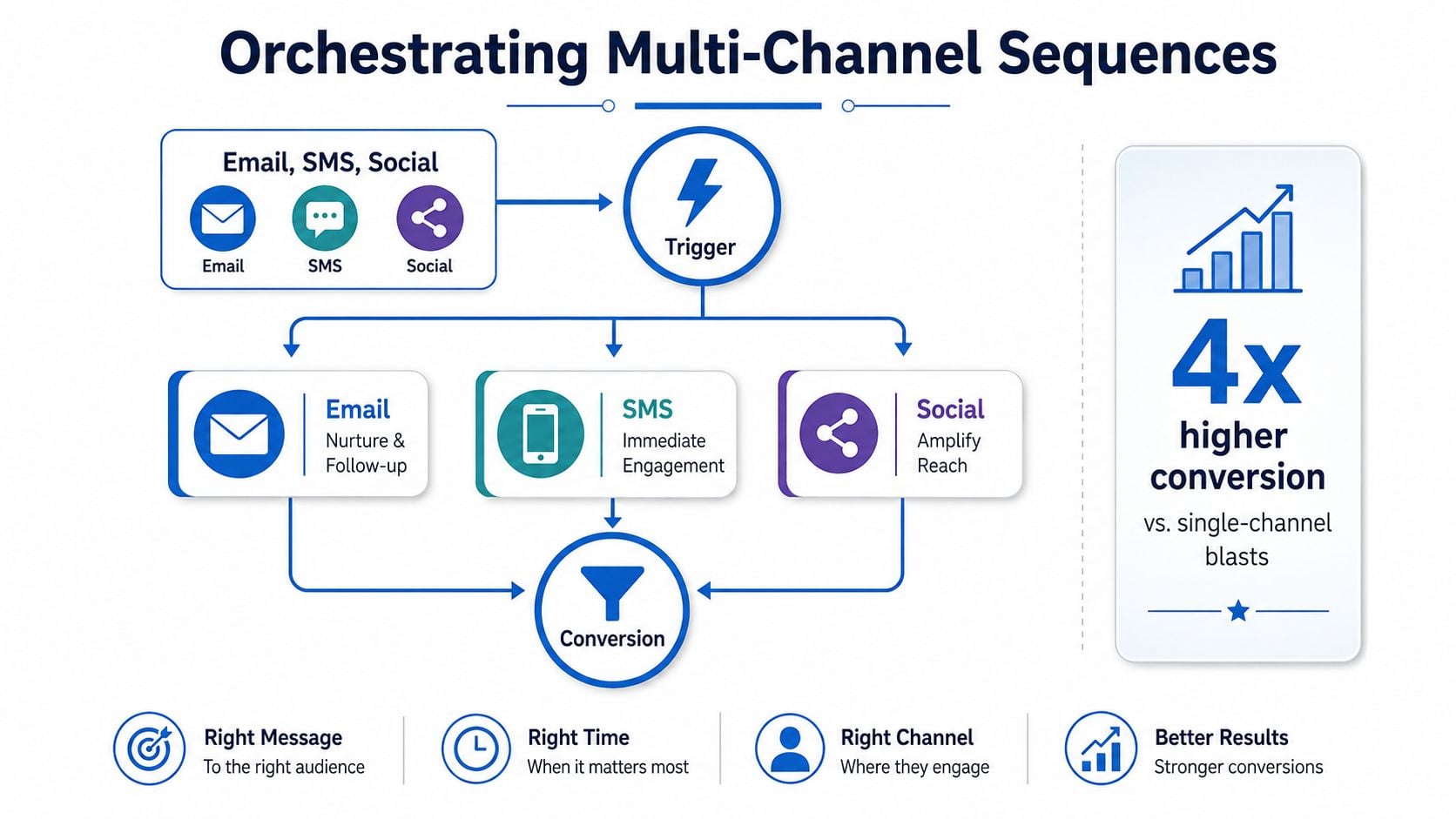
A batch campaign asks one audience to consume one message at one time. A triggered sequence responds to what an individual did. Treating those programs as interchangeable is one of the most expensive distribution mistakes because the recipient's context is different.
A benchmark cited in a comparison of SMS and email follow-up found that cross-channel batch sends produced a 49% higher open rate than single-channel batch sends. The same benchmark reported that triggered cross-channel campaigns produced a 35% higher open rate than triggered single-channel campaigns. Those figures don't mean every business should automatically add channels. They show why orchestration deserves separate measurement from isolated sending.
Build around a behavioral trigger
A useful sequence might begin when a prospect submits a lead form:
- The workflow creates or updates the contact and records the campaign source.
- An email delivers the promised guide, estimate, or next step.
- After a short wait, an SMS asks whether the prospect wants help choosing the right option.
- If the contact hasn't engaged, a social task or permitted DM sequence provides another route to reply.
- The contact enters a retargeting audience for Google and Facebook, unless they book or opt out.
- A booking, reply, or sales-stage change removes the person from irrelevant steps.
The exact timing should follow the buying context. A missed-call recovery flow needs speed. A high-consideration service may need more education before the sales request. The system should react to behavior rather than force every contact through an identical calendar.
Use smart lists to separate new leads, active conversations, booked appointments, no-shows, customers, and unsubscribed contacts. Add suppression logic at every stage. A booked prospect shouldn't keep receiving “book now” messages, and a customer shouldn't remain in a prospecting audience.
A unified CRM email SMS automation platform makes this easier because the sequence can use conversation activity, appointment status, and pipeline movement as conditions. The tool matters less than the discipline of defining entry, progression, and exit rules.
Measure the right comparison
Don't compare a triggered sequence with a batch send and call the result a channel test. Compare:
- Batch email against cross-channel batch.
- Triggered email against triggered cross-channel.
- New leads against comparable audience segments.
- Engagement against booked appointments and closed revenue.
Open rates can help diagnose delivery and message relevance, but they aren't the commercial finish line. A message that receives fewer opens but produces qualified conversations may deserve more budget than a popular message that creates no pipeline.
Designing the Automation Workflow Behind the Sequence
A reliable workflow can be sketched with five blocks: trigger, wait, condition, action, and exit. If the team can't draw those blocks clearly, the automation probably isn't ready to build.
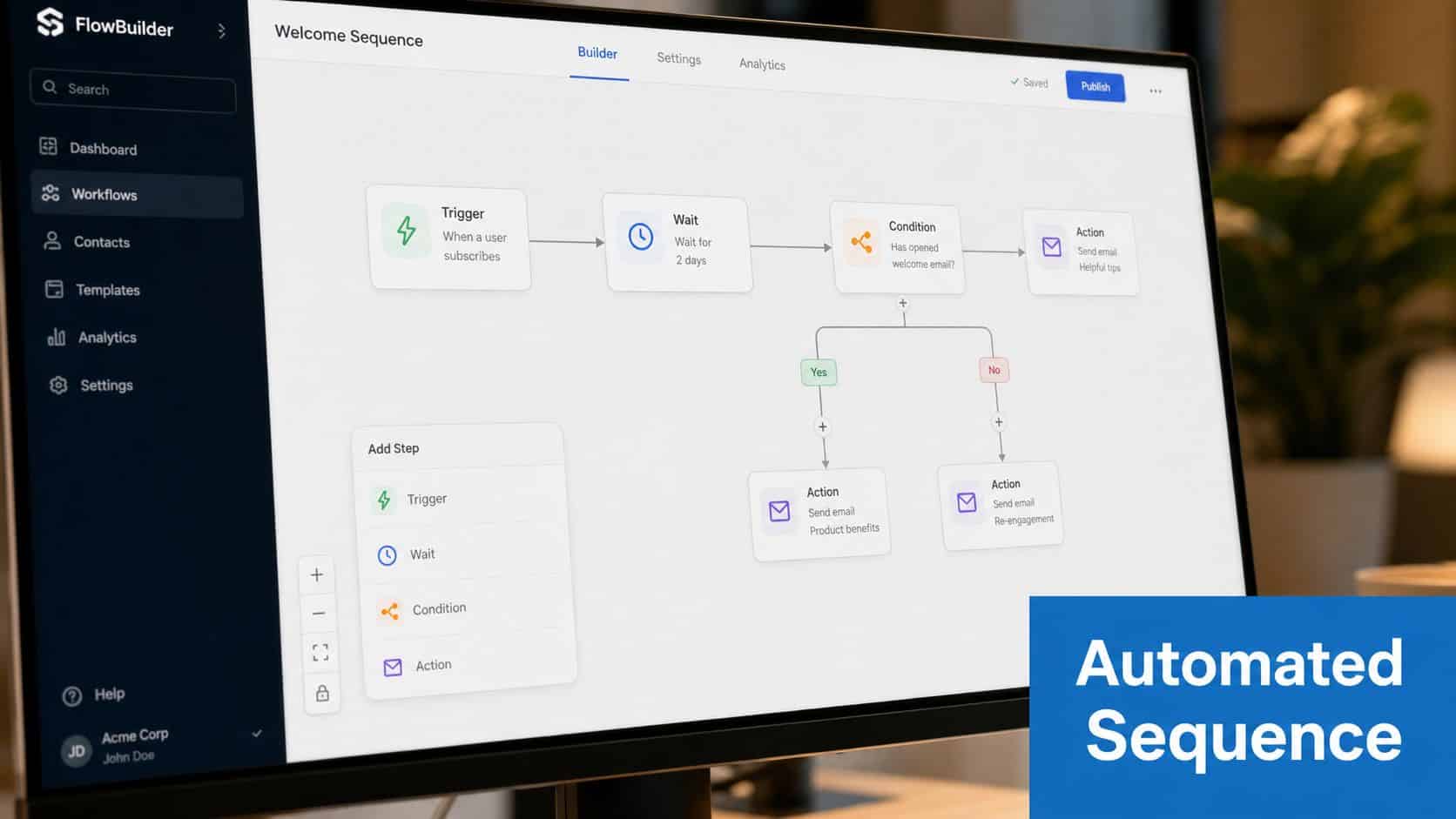
Start with the event that proves the workflow should run. That might be a form submission, inbound call, missed call, ad lead, appointment booking, payment, or pipeline-stage change. Avoid vague triggers such as “contact added” unless every possible contact should receive the same experience.
Map the workflow before building it
Trigger: A Facebook lead submits a request for a consultation.
Action: Create the contact, apply the source and campaign tags, assign an owner, and place the opportunity in the correct pipeline stage.
Condition: Check lead score, service area, requested offer, and whether the person already has an open conversation.
Wait: Pause before the next message only when the delay fits the buying situation. Don't make a high-intent lead wait just because a template says to.
Action: Send the relevant email, SMS, or task. A referral might go directly to a human call, while a colder ad lead may receive educational content first.
Exit: Remove the contact when they book, buy, opt out, become a customer, or reach a defined terminal stage.
A missed-call-text-back workflow shows why this structure matters. The missed call triggers an immediate text, the reply creates or updates a conversation, and the opportunity enters a pipeline where a team member owns the next action. A booked appointment then triggers reminders, while the completed appointment can trigger a review request and a reactivation path later.
Teams evaluating HighLevel automation benefits should focus on these operational mechanics, not on the number of workflow features. Automation only helps when the rules reflect the actual customer journey.
For agencies that need to streamline client follow-up workflows, naming conventions are a small investment with a large operational payoff. Name workflows by source, offer, audience, and lifecycle stage. Record the owner, entry condition, active dates, and exit criteria. Turn off seasonal promotions when they end, and audit every branch that can send a message.
Here's a practical review sequence:
- Test the trigger with a real submission.
- Confirm the contact receives the correct tags and owner.
- Check every wait and branch.
- Test replies, bookings, opt-outs, and duplicate entries.
- Confirm the exit condition removes the contact from all related workflows.
- Review the live workflow after launch for contacts stuck in unexpected branches.
The visual builder should make the logic easier to inspect, but it can't compensate for unclear decisions.
Knowing When to Skip a Channel Instead of Adding One
More channels don't automatically produce more revenue. They create more publishing requirements, more inboxes, more consent decisions, and more places for attribution to break.
Industry coverage often emphasizes familiar formats such as organic social, corporate blogs, email newsletters, webinars, and events. Newer options, including podcasts, microsites, branded communities, mobile apps, and separate content brands, receive less operational adoption. The Content Marketing Institute's B2B content marketing research points to a practical reason for that concentration. Teams tend to favor channels they can measure and run reliably.
Apply a pruning test
Keep a channel only if it passes these questions:
- Can you attribute it? You don't need perfect attribution, but you should know how contacts enter the system and what actions follow.
- Can one accountable person operate it? If nobody owns publishing, replies, moderation, and reporting, the channel is a liability.
- Does it perform a unique job? A second channel that repeats the same message without adding reach, context, or conversion value may not justify its overhead.
- Can you suppress and transfer contacts? The channel needs a way to stop messages after a booking, purchase, opt-out, or handoff.
A podcast may look attractive for a founder-led brand but fail if the business can't sustain production or connect listeners to a measurable next step. A private community can deepen relationships, but it requires moderation and ongoing value. A mobile app may be unnecessary when a responsive site, email, and SMS already serve the customer adequately.
The boring channels often win because they fit existing intent. A well-written email after a quote request, a fast text after a missed call, and a clear booking page may outperform a clever channel experiment that nobody maintains.
The best channel is the one your team can operate consistently, measure honestly, and connect to a commercial next step.
AI can reduce the cost of adapting one source asset into social posts, email drafts, or short-form variations. It doesn't decide whether the audience needs another channel, whether the message is compliant, or whether the workflow can support the resulting conversations. Use automation to reduce execution friction, not to justify channel sprawl.
Measuring What Closed the Deal
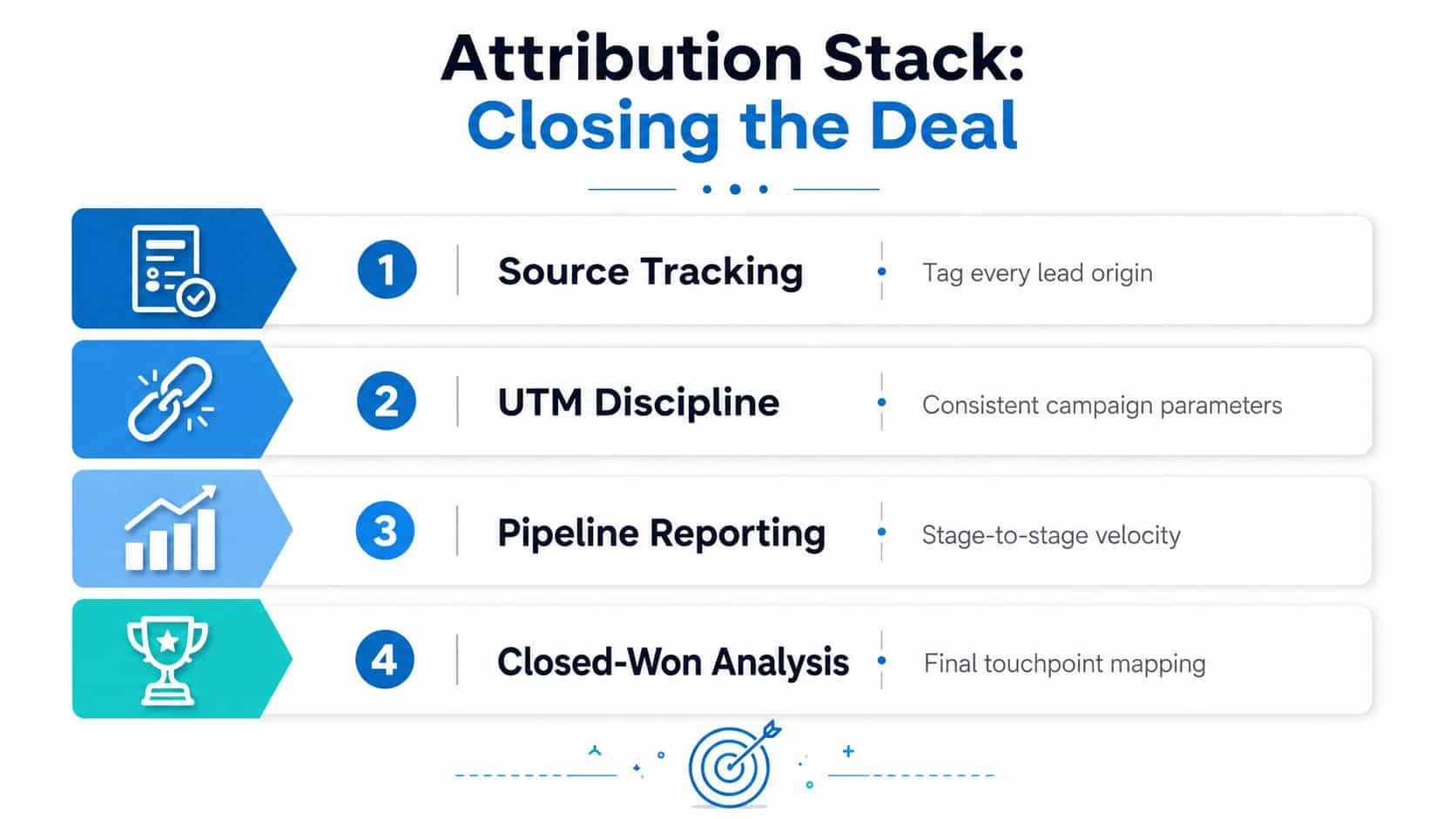
Attribution breaks when one report is expected to answer several questions. First touch shows where demand began. Assisted touch shows which interactions helped. Last click shows what happened immediately before conversion. Each view has a different job.
Track the source on every form, call, chat, and campaign entry. Use consistent UTM parameters, preserve the original source when a contact returns through another channel, and store the current campaign separately. Connect each contact to pipeline stages such as new lead, contacted, qualified, booked, proposal, won, and lost.
A worked multi-touch example
A fictional agency, Northstar Creative, runs a Facebook ad promoting a guide. A prospect downloads it, receives an email, replies to an SMS, and books through a calendar link. The opportunity then moves from qualified to booked, proposal, and won.
Last-click reporting may assign the conversion to the calendar or SMS link. That identifies the immediate action, but it hides the ad's role in creating demand and the email's role in explaining the offer. Northstar's attribution view keeps the original source, current campaign, conversation history, pipeline stage, and won opportunity on one record.
The team can now compare questions that separate activity from revenue: do Facebook leads reach qualification, do guide emails produce useful replies, does SMS recover undecided prospects, and does the booking page convert intent? A connected inbox and pipeline do not remove uncertainty. They show where it sits, inside one workspace rather than across disconnected dashboards.
For teams comparing tools, an agency analytics platform overview should be judged by whether it joins source, conversation, stage, and revenue data. Attractive engagement charts have limited value when sales cannot trace a closed opportunity to the interactions that shaped it.
Review the metrics that change decisions
Northstar reviews source quality, response speed, reply rate, stage movement, sequence-driven bookings, and closed revenue by source and campaign. It also checks suppression health, confirming that booked, purchased, and opted-out contacts leave the right campaigns.
The useful question is not which channel generated the most activity. It is which combination created qualified opportunities and helped them reach won status. If Facebook produces volume but few qualified leads, the team adjusts targeting or creative. If email creates replies but few bookings, it examines the offer and handoff. If SMS contributes late-stage recoveries, its operational cost has a clear reason to exist.
Follower growth, raw impressions, and open rates can diagnose distribution. They should influence budget only when they connect to pipeline movement or closed revenue.
A 30-Day Distribution Rollout Plan You Can Actually Ship
A manageable rollout starts with fewer moving parts. Don't rebuild every channel at once. Establish one measurable journey, make it reliable, then expand only when the operating evidence supports it.
Week one, audit and prune
List every lead source, message channel, automation, audience, and pipeline stage. Find duplicate workflows, inactive offers, missing source fields, and contacts who receive messages after booking. Keep the channels with clear audience fit and a defined commercial role.
Week two, build the core workflow
Choose one entry event, such as a form submission or missed call. Create the contact fields, tags, owner assignment, email, SMS, wait steps, conditions, task notifications, suppression rules, and exit criteria. Test the path with internal records before sending traffic.
Week three, activate distribution
Turn on the core nurture sequence, then add a retargeting audience and a controlled broadcast only after the workflow works. Keep creative variations tied to the same offer and source tags. Don't introduce a new channel just because the launch calendar has empty space.
Week four, review attribution
Inspect lead sources, replies, booked appointments, pipeline movement, lost reasons, and closed opportunities. Remove steps that create confusion, repair branches that misroute contacts, and promote the messages that generate useful conversations. A system designed to streamline lead capture and followup should make these reviews routine rather than dependent on a spreadsheet rescue.
Troubleshoot the problems that appear first
- Contacts don't enter workflows: Test the exact trigger, required fields, filters, and source mapping.
- Contacts receive double texts: Search for overlapping workflows and create one shared suppression rule.
- Ads target the wrong stage: Sync audience membership to pipeline status and remove booked or purchased contacts.
- Sales misses replies: Route every channel into the shared conversation view and assign ownership.
- The offer ends but messages continue: Add an end date, deactivate the campaign, and verify every branch.
Distribution works when fewer channels share one audience record, one sequence, one owner, and one revenue view.
How to distribute well in 2026 isn't about collecting more tools. It's about coordinating the channels you can operate, measuring the journey accurately, and removing everything that creates activity without a defensible path to revenue.
HighLevel brings lead capture, CRM records, conversations, workflows, calendars, payments, reputation tools, and campaign distribution into one workspace for agencies and small-to-medium businesses. If your team is losing context between email, SMS, social messages, bookings, and pipeline stages, visit HighLevel to see whether a connected operating system fits your distribution workflow.
