
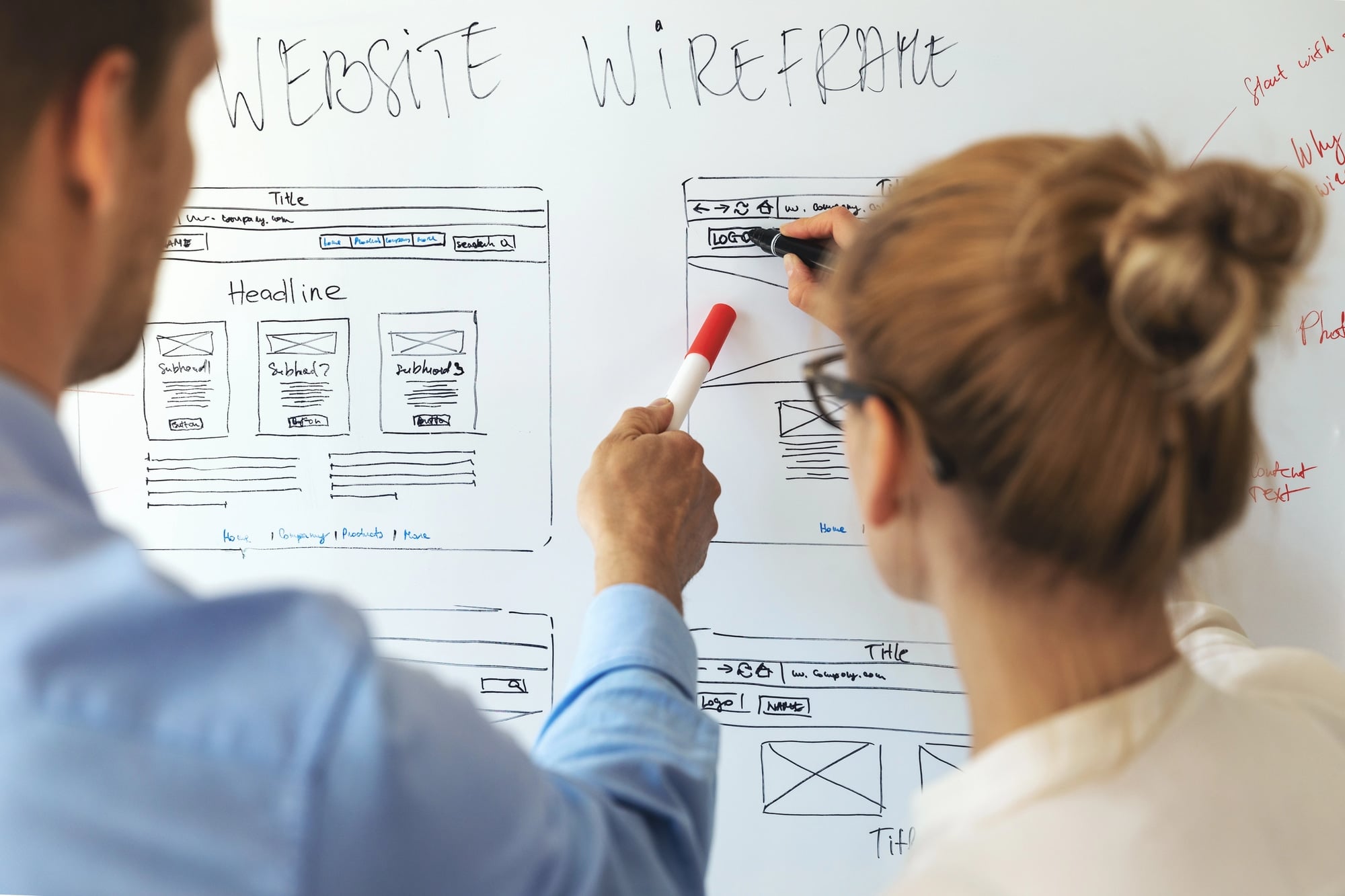

Conversion optimization, or conversion rate optimization (CRO), is the systematic process of increasing the percentage of website visitors who take a desired action. It's measured as conversions divided by total visitors, expressed as a percentage, and that makes it one of the most direct ways to improve marketing performance. In practical terms, global average eCommerce conversion rates sit around 3.76%, B2B conversion rates often land between 1% and 7.4%, and other industry-wide benchmarks in 2026 put average website conversion rates around 3.1% to 3.68% (WordStream).
You're probably looking at a site that gets traffic but still feels like it's leaving money on the table. The ads are running, the content is ranking, maybe the landing pages look polished, but leads are thin and the inbox is quiet. That's the classic CRO problem, and it usually isn't a traffic problem first, it's a conversion problem.
Table of Contents
- What Is Conversion Optimization Anyway
- Why CRO Is Your Highest ROI Marketing Activity
- The Core Components of a CRO Strategy
- A Repeatable 4-Step CRO Process for Agencies
- High-Impact Tactics for the Entire Funnel
- The Modern CRO Toolkit for Agencies and SMBs
- Your CRO Implementation Checklist
What Is Conversion Optimization Anyway
A lot of businesses have a site that looks fine in a design review and still doesn't produce enough revenue. Visitors click around, maybe they read a few pages, then they disappear without booking, buying, or filling out the form. Conversion optimization fixes that gap by making the journey from interest to action easier, clearer, and more trustworthy.
CRO is a structured, iterative process. You identify where people drop off, form a hypothesis about why they're dropping off, test a change, then keep what works. That is why the best definitions of CRO focus on the funnel, user behavior, and measured improvement, not just page aesthetics (Contentsquare).
CRO is bigger than the landing page
The term “conversion optimization” often brings to mind button colors, headline tweaks, or shorter forms. Those matter, but they're only part of the story. Real conversion work also includes follow-up speed, conversation quality, appointment booking, and post-lead nurture, which is where agencies and local-service businesses often lose the deal after they've already earned the lead.
That's why a practical CRO mindset looks beyond the website visit. If a visitor submits a form but never gets a timely response, the conversion hasn't really completed. For agencies, the core question isn't only “how do we get the form submit,” it's “how do we turn that submit into a booked call or closed sale?”
Practical rule: If the sale depends on a human conversation, your conversion journey doesn't end at the thank-you page.
That fuller view matters because CRO frameworks increasingly connect website analytics with sales data and customer feedback to understand the value of each touchpoint (PMC). It's a better fit for businesses that close through calls, chat, SMS, reviews, or appointment-setting, not just ecommerce checkout flows. If you already track traffic and funnels in HighLevel's analytics and reporting, you're closer to seeing CRO the way operators do, as a revenue process, not a design exercise.
Why CRO Is Your Highest ROI Marketing Activity
CRO gets attention from serious marketers because it makes the traffic you already paid for work harder. If you keep buying clicks while your site leaks leads, you pay twice, once for the visitor and again to replace the visitor who never converted. CRO cuts that waste by improving the value of traffic already in motion.
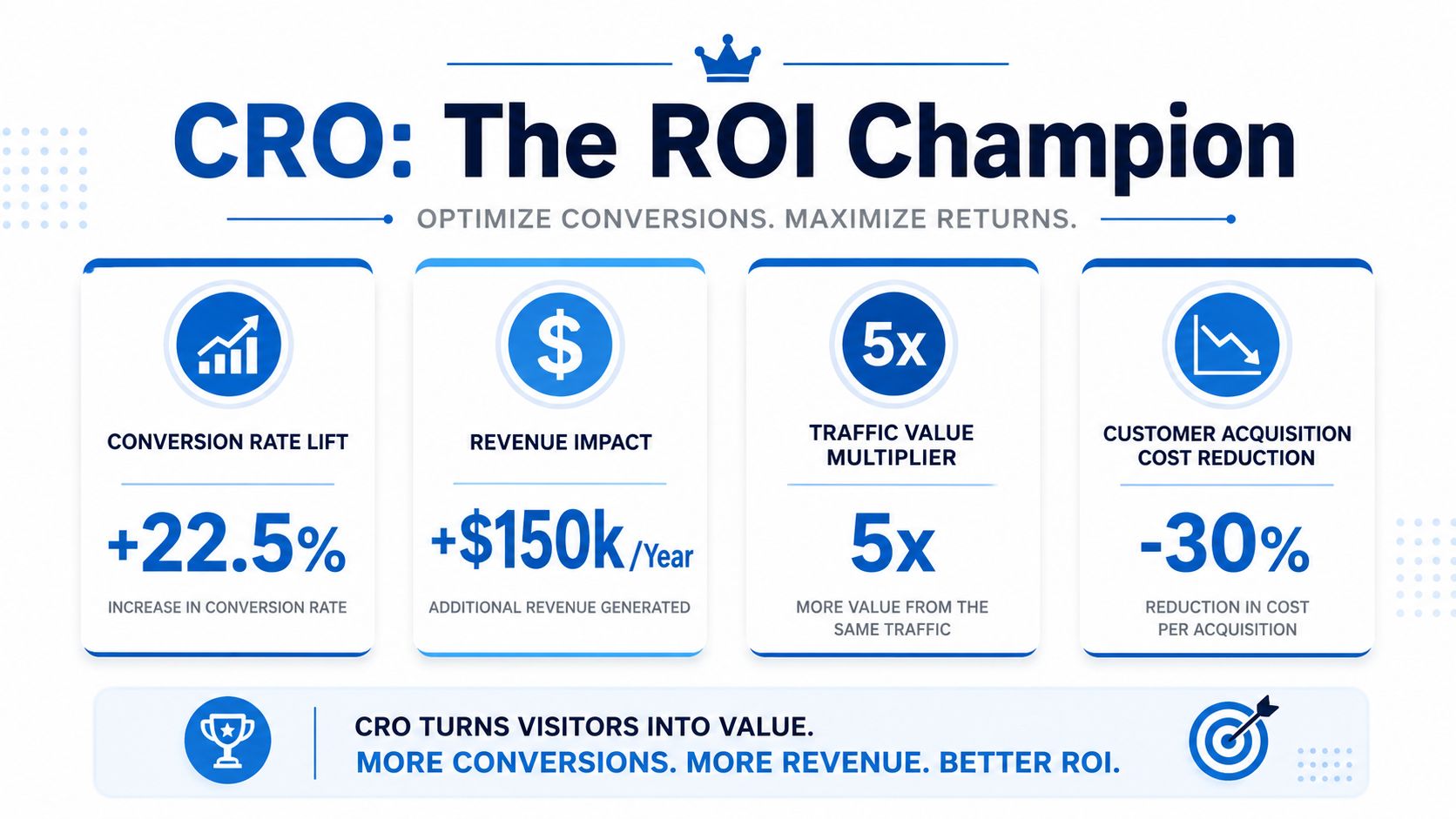
The benchmark data makes the case clearly. If the average eCommerce site converts around 3.76%, and many websites sit near 3.1% to 3.68%, small gains can change the revenue math quickly (WordStream). CRO matters because it improves the result of the same traffic, which is often more sustainable than scaling acquisition alone.
The economics are hard to ignore
In many businesses, the acquisition budget is already under pressure. Paid traffic is expensive, attribution is messier than it used to be, and weak pages in the funnel absorb real spend without creating revenue. CRO changes what happens after the click, so media spend, content spend, and sales effort all produce more output from the same input.
The upside is not abstract. Industry publications summarized in the verified data show that well-executed CRO tactics can raise sales by 30% to as much as 200% in some cases (WordStream). That does not mean every change produces a giant lift, it means the ceiling is high when you remove friction in the right place. Form simplification, landing-page testing, and mobile-speed improvements have all been recurring winners in CRO history, because they directly reduce effort for the buyer (Matomo).
A useful way to think about it is simple. Acquisition gets visitors in the door, CRO helps more of them say yes. Teams that pair conversion work with creative assets, such as personalized follow-up video, can turn a generic lead capture into a more human next step. Personalized follow-up video significantly increases relevance after a lead raises their hand, and boost engagement with personalized video shows why that matters.
CRO reduces dependency on constant traffic growth
Agencies should care for another reason. Not every business can keep buying more traffic forever, especially if the target keyword set is limited or the audience is niche. CRO gives you a way to grow without assuming traffic growth will always save the month.
That is also where platform choice matters. If your team already uses top CRM picks for agencies, you know the value of keeping pipeline data visible. CRO becomes much more valuable when you can see how a landing-page change affects booked calls, sales conversations, and closed revenue, not just form fills. HighLevel makes that kind of view practical because the follow-up path, the booking step, and the sales outcome stay connected instead of living in separate tools.
The Core Components of a CRO Strategy
A useful CRO strategy has three parts, measurement, diagnosis, and validation. If one of those is missing, the work turns into guesswork. The strongest programs define the conversion goal, map the funnel, and then use both quantitative and qualitative data to decide what to change (Contentsquare).
Macro conversions and micro conversions
Not every action has the same business value. A macro conversion is the outcome you care about, such as a purchase, booked appointment, demo request, or qualified lead. A micro conversion is a smaller signal that shows intent, such as clicking a pricing page, opening a form, or starting a chat.
That distinction matters because micro conversions tell you where the journey is healthy or broken before the final sale shows up. If people click the calendar but abandon the booking step, the problem is different from a page that gets no clicks at all. Good CRO teams track both because they show the shape of demand, not just the final outcome (Lucky Orange).
People rarely fail at the very end for one reason. They usually fail one or two steps earlier.
Funnel analysis shows where the leak lives
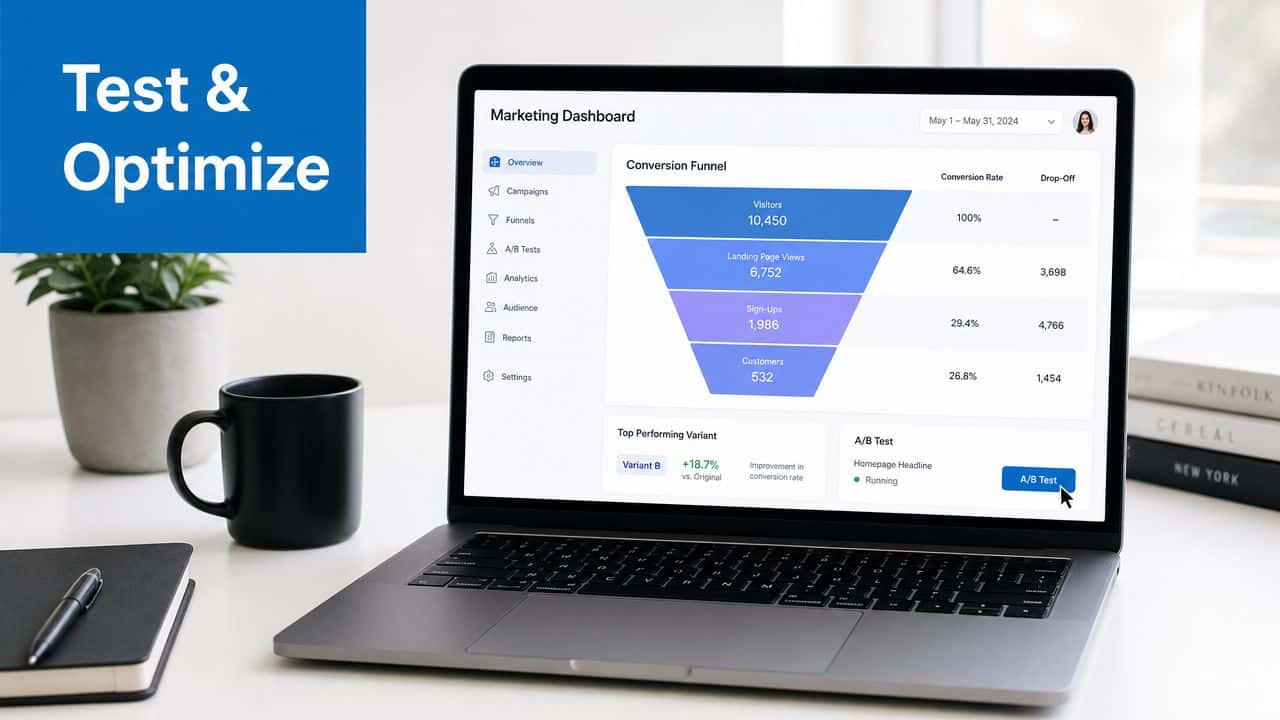
A conversion funnel gives you the path, and the path tells you where drop-off happens. That's why technical guidance stresses clean event tracking, destination goals, and form-completion measurement, since you can't fix what you can't see (Glassbox). For forms, a simple way to think about it is comparing form loads to completions, then checking whether the loss happens at the field level, the page level, or in the follow-up stage.
The problem is that dashboards alone don't explain why the leak exists. That's where session recordings, heatmaps, surveys, and sales-team feedback become useful. Behavioral data shows friction, while qualitative input tells you what people were trying to do when they got stuck.
Research, not redesign, should drive the work
Too many teams start with design opinions. A better CRO strategy starts with observation, then moves into testing. If the pricing page is underperforming, the first question isn't “what should it look like,” it's “what's blocking action, and what evidence do we have?” That mindset prevents random changes and keeps the work tied to revenue.
If you're centralizing operations already, Centralizing agency marketing and sales tools is the kind of systems thinking that makes CRO easier to execute. The cleaner the data flow, the faster you can move from insight to test to decision.
A Repeatable 4-Step CRO Process for Agencies
CRO works best when it becomes a loop instead of a one-off project. Agencies do this well when they standardize the work, because the process becomes repeatable across clients, offers, and landing pages. The cycle is simple enough to run every month, but disciplined enough to keep opinion from dominating the outcome.
1. Research the bottleneck
Start with the pages and steps that matter most. Look at traffic, drop-off, form starts, booking completions, and any place where leads disappear before sales can speak to them. Then combine the numbers with heatmaps, session recordings, and direct feedback so you're not assuming the cause from the chart alone.
Research also needs to include the sales side. If the lead quality is poor, the page may be attracting the wrong people. If the leads are strong but slow to respond, the issue may be operational, not promotional.
2. Form a testable hypothesis
A strong hypothesis names a change and predicts a measurable outcome. For example, a team might believe that changing a button from generic wording to a value-led message will increase form completions, or that removing an unnecessary field will reduce friction. The key is that the idea has to be testable, not just plausible.
Useful filter: If you can't define success in one sentence, the hypothesis isn't ready yet.
Good hypotheses come from observed behavior, not taste. If people keep stopping halfway through a form, the fix may be layout, reassurance copy, or fewer fields. If they click but don't book, the issue may be scheduling friction or missing trust signals.
3. Test the change
Use A/B or multivariate testing to compare the new version against the control. The goal is to isolate the effect of the change, not to redesign the page and hope the new experience works better. That discipline is what separates optimization from random iteration (Contentsquare).
For agencies, test the highest-friction step first. That usually gives you the fastest path to a meaningful lesson, even if the result isn't a win. A failed test still improves the next hypothesis because it tells you more about how people behave.
4. Iterate from the result
Winning tests should be implemented, documented, and monitored. Losing tests should be archived with the insight they produced. Then the cycle starts again on the next bottleneck.
Many teams stall at this point. They treat one test as proof that CRO “worked” or “didn't work,” yet its true value is cumulative. The point is to build a habit of measured improvement across the journey.
A simple reference video can help teams align on process and pacing. The embedded walkthrough below is useful for explaining the loop to clients or internal stakeholders before you roll out the next set of experiments.
If your team uses marketing automation insights from HighLevel, the workflow layer can make this loop easier to operationalize because research, follow-up, and measurement live closer together.
High-Impact Tactics for the Entire Funnel
The fastest CRO wins usually come from reducing effort at the obvious friction points. That starts on the page, but it doesn't end there. In agency work, the more expensive leak is often the one that happens after the form is submitted, when the lead waits too long, gets the wrong message, or never gets a human response at all.
Fix the obvious page-level friction first
Shorter forms usually outperform longer ones when the extra fields don't add real qualification value. Strong CTAs also matter, especially when they tell the visitor what happens next instead of using vague language. Page speed still matters too, because mobile delays can reduce conversions and one-second load improvements have been tied to conversion lifts in industry reporting (Matomo).
Many teams overcomplicate things. If the page is confusing, slow, or overloaded with choices, users hesitate. Simplify the path, remove unnecessary distractions, and make the next action obvious.
Optimize the post-submission moment
The lead doesn't become revenue when the form is submitted. It becomes revenue when someone responds, qualifies, books, and closes. That's why immediate follow-up is a CRO issue, not just a sales-process issue.
A practical example is sending an instant SMS after a form fill, then routing the lead into a booking flow before the prospect cools off. If a call is missed, a missed-call text-back can keep the conversation alive instead of losing the lead to voicemail. Conversation AI can also handle routine engagement when the team is offline, which helps keep response time tight across more hours of the day.
The fastest follow-up often wins the first conversation, and the first conversation often wins the deal.
This is also where text messaging, voicemail recovery, and live inbox management become conversion tools. If you need a reference point on that part of the stack, text back solutions for businesses is a useful way to think about closing the gap between intent and response.
Use creative and qualification assets that keep people moving
Not every visitor is ready to buy right away. Some need more reassurance, some need examples, and some need a second touch after the first click. That's where follow-up content, short videos, and answer-driven nurture sequences help maintain momentum.
For paid campaigns, this is also where creative quality matters. A prospect who saw the ad, clicked, and filled out the form still needs a relevant next step. If you're building that kind of ad-to-lead experience, how to create AI video ads is a relevant companion resource because it connects creative production to downstream response quality.
The Modern CRO Toolkit for Agencies and SMBs
Tools do not create optimization, but they decide how quickly a team can find a leak, test a fix, and put the winning change into daily use. The usual stack covers analytics, behavior tracking, experimentation, and CRM or automation. Each layer answers a different question, and the stack works best when those answers connect instead of sitting in separate dashboards.
Analytics tells you what happened
Google Analytics and similar platforms are the baseline. They show traffic sources, conversion rates, funnel steps, and device behavior. That gives you the quantitative map, which is necessary, but not enough on its own.
Many teams stop too early. They see a drop-off and guess at the reason. Good analytics setups define the key goals clearly, so the team can compare the conversion path against actual outcomes instead of vague engagement signals.
Behavior tools tell you why it happened
Heatmaps, session replay, and surveys fill in the missing layer. They show where people hesitate, what they ignore, and which parts of the page create confusion. That is the difference between knowing users left and understanding what they experienced before they left.
A/B testing tools then let you validate the hypothesis. If users are ignoring a CTA, you can test placement or copy. If they are dropping out of a form, you can test fewer fields or clearer microcopy. The point is to let observed behavior shape the experiment.
CRM and automation connect conversion to revenue
This layer is often underused by agencies. A lead that is not followed up quickly is a conversion problem in disguise. CRM and automation tools let you route the lead, trigger follow-up, log conversations, and keep the handoff visible.
HighLevel is one platform that combines CRM, a unified conversation inbox, funnel building, forms, surveys, automation, missed-call text-back, and conversation workflows in one place. That matters because it reduces the friction of stitching together separate tools, especially when the conversion journey continues after the page visit. Text messaging, voicemail recovery, and live inbox management become conversion tools at this stage.
Tool choice should follow workflow, not hype
You do not need the fanciest stack. You need the stack that helps you see the leak, test the fix, and close the loop with the fewest blind spots. For teams that rely on multi-touch follow-up, a unified system can be easier to manage than a patchwork of separate tools, especially when the buyer moves between SMS, chat, email, and phone.
If you are comparing software options, Discover AI web scraping with Scrapfly is a useful example of how teams are thinking about data capture and signal quality in adjacent workflows. The same principle applies here, better data inputs make better optimization decisions.
Your CRO Implementation Checklist
Start with one conversion goal, not five. If you can't define the main action you want users to take, you'll end up optimizing in circles. Then confirm that your tracking can measure the step that matters, whether that's a form submit, booked call, purchase, or appointment.
From there, identify the biggest drop-off point in the funnel. Use analytics to find the break, then use behavior data and feedback to understand why it's happening. Once you have that, form one clear hypothesis and test the smallest change that could realistically move the number.
A practical checklist looks like this.
- Define one macro conversion: Choose the revenue action that matters most right now.
- Track the micro steps: Capture page views, form starts, booking clicks, and other intent signals.
- Find the biggest leak: Look for the step where users disappear most frequently.
- Write one testable hypothesis: State the change and the expected result plainly.
- Run the test cleanly: Change one meaningful element, then measure the outcome.
- Fix the follow-up: Make sure leads get a fast, consistent response after submission.
- Document the lesson: Keep a record of what worked, what didn't, and what to try next.
The main thing to remember is that CRO isn't a single tactic. It's a habit of tightening the full journey, from first click to final sale, so more of the traffic you already earned turns into actual revenue.
If you want a single system for capturing leads, responding faster, and keeping the conversion journey visible from click to close, take a look at HighLevel. It combines CRM, funnels, automation, and conversation tools in one place, which makes it easier to measure and improve conversion across the whole path, not just the landing page.
