


You're probably staring at a stack of tools right now and wondering why your agency still feels messy. One client lives in a CRM, another lives in a project board, a missed-call text-back is buried somewhere else, and a renewal note slipped because nobody owned the follow-up. That's the core gohighlevel vs Podio for agencies decision, not a feature checklist.
A common mistake is treating this like a simple software preference. It isn't. One platform is built around agency revenue generation, the other is built around customizable internal work management. If your business runs on lead capture, speed-to-lead, follow-up, and client-facing automation, the wrong choice creates drag every week you keep it. If your business is mostly delivery ops and bespoke approvals, forcing a marketing OS into that role is just as bad.
Table of Contents
- The Agency Decision That Actually Matters in 2026
- Where Each Platform Actually Came From
- Feature-By-Feature Reality Check for Agencies
- How GoHighLevel Runs an Agency Day
- When Podio Is Actually the Better Choice
- The Hidden Cost Most Comparisons Ignore
- Three Questions That Pick the Right Platform
- A 30-Day Plan If You Go With GoHighLevel
The Agency Decision That Actually Matters in 2026
A 12-person agency owner usually does not wake up and say, “We need a new platform.” They wake up to five browser tabs, three half-finished client tasks, and a sales lead that went cold because the text-back lived in the wrong system. That is the moment the platform choice stops being theoretical and turns into an operating problem.
If you are running around 40 SMB clients, the question is simple. Do you need a marketing automation operating system that centralizes capture, follow-up, booking, invoicing, and client communication, or do you need a configurable work-management OS that your team can shape around custom delivery workflows? That difference decides whether your agency moves fast or spends half the week stitching tools together. Agencies do not survive on internal task tracking alone. They survive on speed, follow-up, and recurring revenue.
GoHighLevel wins where agencies need operational efficiency. It is built as an all-in-one marketing automation platform for agencies, with CRM, email, SMS, automation, and white-label tooling in one stack, and it is built for multi-client operations with unlimited sub-accounts on the Unlimited plan and unlimited contacts in published plans (consultevo.com comparison). Podio is the second job. It is a customizable work-management platform centered on tasks, projects, workflows, collaboration, file sharing, and integrations, which makes it flexible but not naturally revenue-facing (hexaclicks.com). If your agency sells retainers and needs client activity to move through a pipeline without constant manual cleanup, GoHighLevel fits the job. If your agency lives in delivery-heavy processes and custom internal coordination, Podio will feel more natural.
Practical rule: if your agency makes money by acquiring, nurturing, booking, and reactivating leads, build around the tool that was designed for that. If your money comes from custom delivery processes, build around the tool that bends to those processes.
The cleanest way to think about GoHighLevel vs Podio for agencies is direct. GoHighLevel is the platform you pick when the agency itself is the productized machine. Podio is the platform you pick when the agency is mainly a delivery engine that needs structure. If you are comparing the broader stack, the complete operating system for agencies only works when the core platform matches how you make money. PRWiz matters for the same reason, the wrong system adds friction to every handoff, every follow-up, and every client touchpoint.
Where Each Platform Actually Came From
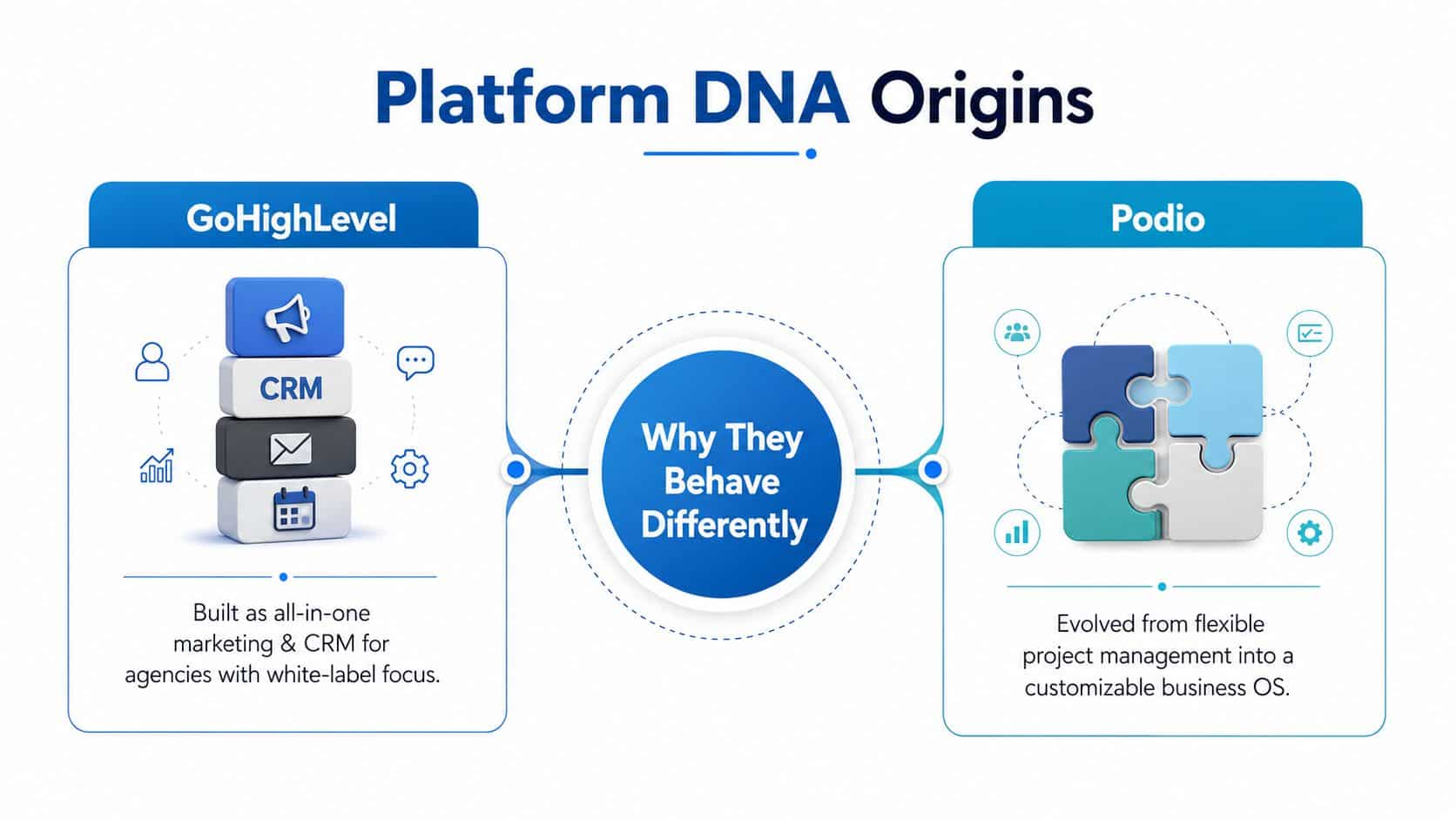
The origin story explains most of the gap. GoHighLevel was built for agencies that need to capture leads, move them through a pipeline, and manage follow-up from one place. White-label reselling, funnel building, SMS, email automation, and multi-account administration are part of its core identity, not add-ons (HighLevel white label capabilities). That is why it feels like a system designed to drive revenue activity, not just store contact records.
Podio came from a different direction. Its foundation is closer to a flexible operations hub, built around configurable workspaces, task handling, projects, file sharing, communication, and integrations. It can be adapted to many internal workflows, but it does not begin with agency acquisition or multi-channel nurture. That is the trade-off people miss when they compare it like a CRM and then act surprised by the result.
The contrast lies in the assumptions each product makes about your agency. GoHighLevel assumes you need to capture leads, route them into pipelines, push them through messaging, and manage them across multiple client sub-accounts. Podio assumes you need to define internal workflows, coordinate people, and customize process structure. One is a marketing automation OS that includes CRM functions. The other is a configurable work OS that can be shaped into a CRM-like system only if you build that layer yourself.
For agencies, that origin matters more than a feature checklist. I have seen teams try to force Podio into a front-end sales engine, and the result is usually a pile of integrations glued together just to match what GoHighLevel already ships natively. I have also seen agencies force delivery-heavy work into GoHighLevel and get irritated because it is not designed to be a deep operations workspace. The mistake is not picking the wrong tool in a vacuum, it is picking the wrong tool for the agency model.
If you want a cleaner read on the agency-facing structure, use the white-label question as the filter. Agencies that sell under their own brand should care about how HighLevel white label capabilities support reselling and sub-accounts from the start. Teams that are pressure-testing recurring client work versus one-off project flow should also compare their current setup against resources like PRWiz, because the wrong system adds friction to every handoff, every follow-up, and every client touchpoint.
Feature-By-Feature Reality Check for Agencies
GoHighLevel wins when the agency needs a system that sells, follows up, and keeps clients inside one operating layer. Podio wins when the agency needs process design and internal control. That is the fundamental split, and it matters more than any feature grid.
CRM, messaging, automation, and agency tooling
GoHighLevel ships with a native CRM, pipelines, workflows, calendars, invoices, payments, reputation tools, and a unified conversation stream across SMS, Messenger, Instagram DM, WhatsApp, and live chat. That matters because an agency can move a lead from ad click to booked call to review request without stitching together separate tools or asking account managers to re-enter data by hand. Podio can be built out to cover pieces of that flow, but it does not come with the same front-end marketing depth out of the box.
The same gap shows up in white-label and multi-client operations. GoHighLevel is built around agency account separation, sub-accounts, and reselling from the start. Podio is flexible and can be configured in many ways, but it is not native to agency SaaS packaging in the same way.
GoHighLevel fits agencies that sell speed, follow-up, and recurring client outcomes. Podio fits agencies that sell process control and internal coordination.
Where Podio stops competing
Podio does not naturally compete on native SMS marketing, reputation management, funnel building, or paid calendar flows. You can approximate those pieces through integrations, but that is still approximation, and approximation creates overhead. Agencies that need a marketing stack end up spending time maintaining connections instead of running campaigns.
A better way to judge agency software is to separate what the platform does on its own from what it only does after a pile of add-ons. Resources like SemDash competitive discovery tools help with the audit side of that decision, but the platform choice still comes down to fit. If your team wants to explore a unified marketing stack, GoHighLevel is the cleaner path.
| Capability | GoHighLevel | Podio |
|---|---|---|
| CRM and pipeline | Native, agency-oriented | Customizable through setup and integrations |
| Multi-channel messaging | Native unified inbox across SMS, Messenger, Instagram DM, WhatsApp, live chat | Not native in the same agency-marketing sense |
| Automations and workflows | Native workflow engine built for follow-up | Flexible automation rules for internal processes |
| Calendars and payments | Native scheduling and payment tools | Can be configured, but not the core focus |
| Reputation and reviews | Native reputation tools | Not a core strength |
| White-label agency tooling | Native agency structure and sub-accounts | Customizable, but not centered on reselling |
For agencies that sell lead generation, recurring retainers, and client communication at speed, GoHighLevel does the job with less setup and less friction. Podio still has a place for delivery-heavy teams that need highly specific task orchestration, but it is not the right front-end growth engine.
How GoHighLevel Runs an Agency Day
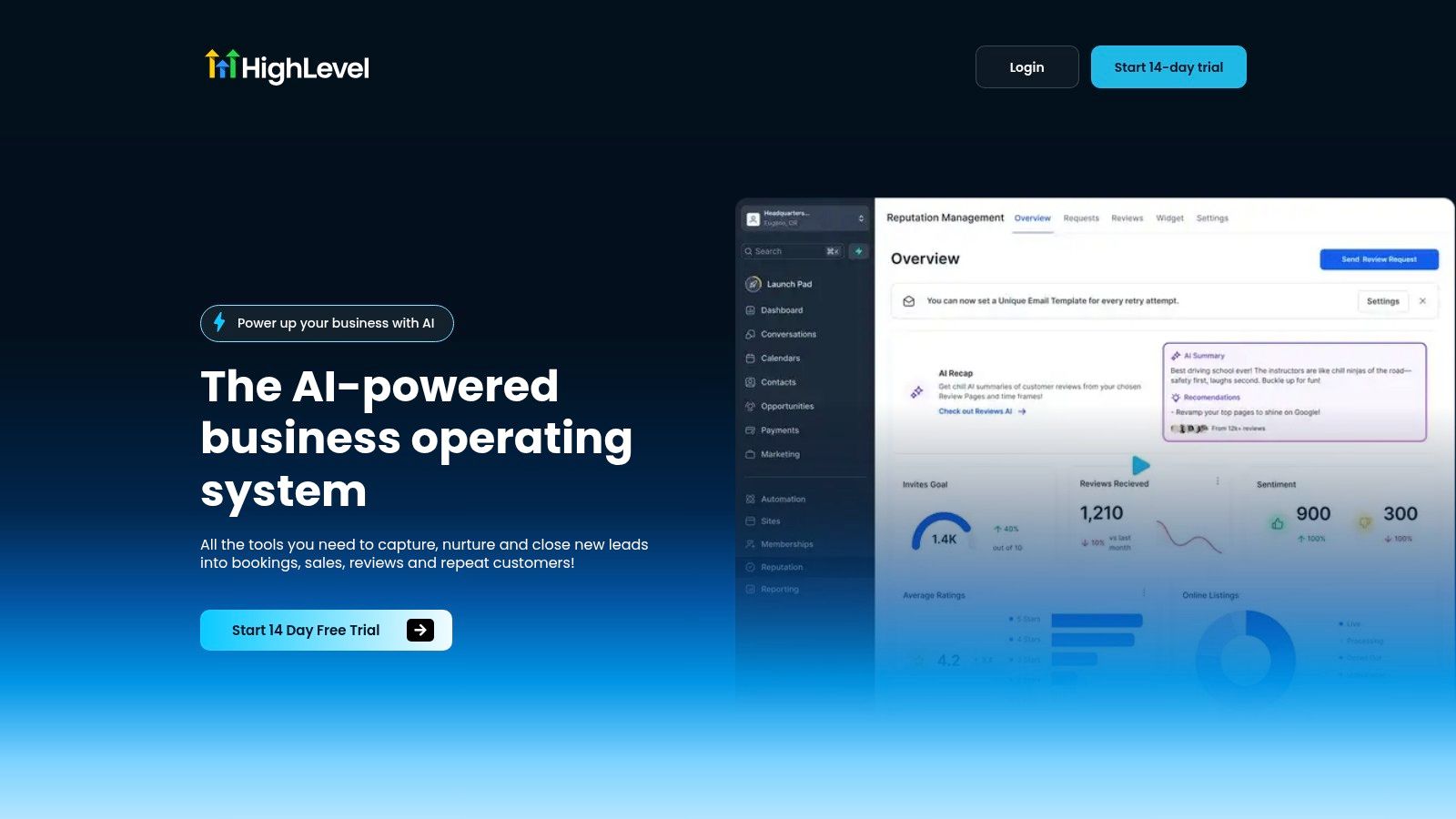
A client calls in before lunch, a form submission lands an hour later, and your team does not have to stitch the work together by hand. That is the core appeal of GoHighLevel for agencies that run lead generation and client communication inside one operating system. The platform gives each client its own sub-account, so the agency can keep campaigns, inboxes, and pipelines separated without building a maze of extra tools.
The practical win is speed. Your team opens a workspace, drops the lead source into the pipeline, and starts working inside the client's own environment instead of juggling shared folders and disconnected apps. For agencies that live on multi-client agency structure, that setup cuts down on the setup tax that usually slows onboarding.
The workflow that actually matters
A lead comes in from a form, and the unified inbox pulls the conversation into one thread. If the phone call is missed, the missed-call text-back workflow fires right away. If the lead replies on Instagram DM instead of text, it still lands in the same workspace. If they book, the calendar moves the process forward. If they buy, the review request goes out later.
That chain is the point. One event triggers the next without an account manager copying details between modules or hunting for context in another app. GoHighLevel's real strength is the connection between capture, nurture, close, review, and reactivation, not any single tool by itself.
For agencies serious about attribution and client reporting, multi-client analytics monitoring belongs in the same conversation. If you cannot see where leads entered, which workflow fired, and what got booked, you are flying blind inside a system that is supposed to reduce guesswork.
A normal day in GoHighLevel usually looks like this:
- Create the client workspace. Each client gets its own sub-account, which keeps data and communication separated.
- Map the pipeline. Leads move through stages like new, contacted, booked, sold, or follow-up.
- Turn on workflows. Missed calls, new leads, no-shows, and review requests all trigger automatically.
- Use the inbox. SMS, email, and social messages sit in one thread instead of scattered across apps.
- Close the loop. Reputation requests and reactivation campaigns keep the account active after the first sale.
The dashboard only works if your team treats it as the system of record. If people still keep side notes in spreadsheets, you have recreated the same mess in a different interface. The fastest proof point is usually the agency missed call text back workflow, because it shows whether the team is willing to let automation handle the first response instead of letting leads go cold.
When Podio Is Actually the Better Choice
Podio becomes the smarter choice the moment an agency makes most of its money from bespoke delivery, not lead-gen velocity. Most comparison posts miss that because they keep staring at pipeline stages and automation maps. If your team spends its days on approvals, handoffs, custom client requests, and internal service workflows, GoHighLevel can feel like too much marketing machinery for too little operational payoff.
The agency model where Podio wins
Take a six-person shop that runs on referrals and repeat business. There is no paid acquisition engine to manage, no high-volume nurture machine, and no white-label software resale to support. In that setup, the agency does not need a heavy front-end marketing stack. It needs clean internal coordination, custom status tracking, and enough flexibility to match how delivery happens.
Podio fits that model because you can shape workspaces around legal review, real estate transaction coordination, consulting deliverables, or multi-stage client approvals. You are not forcing a sales engine to act like an ops board. You build the ops board first, then wire the work around it.
For agencies that manage non-marketing client workflows, Podio's weaker native marketing feature set is a trade-off, not a flaw. That trade-off makes sense when the core bottleneck is service delivery, not lead handling. The mistake is assuming every agency needs the same system because they all invoice clients. They do not.
The hybrid case that's defensible
A hybrid setup is defensible when Podio owns delivery and another tool owns acquisition. That works if your agency already has a steady lead source and the internal process is the part slowing you down. It does not work if the business is still missing calls, delaying first responses, or failing to bring old leads back into the pipeline.
The cleanest proof point is the agency missed call text back workflow. If your team cannot trust automation to handle the first response, Podio will not fix that problem, because Podio is built to organize work, not to run the front end of demand capture.
Rule of thumb: if your team says, “We need better internal workflow control,” Podio may be the right fit. If they say, “We keep losing leads,” it is the wrong tool.
Solo and hybrid operators also need fewer tools, not more of them. The practical case for consoidating tools with HighLevel for solos only matters when the goal is to shrink the stack and centralize revenue work, not when the agency's real edge is custom delivery and internal coordination.
The Hidden Cost Most Comparisons Ignore
Sticker price is the wrong number to optimize around. The total cost shows up when a team has to rebuild pipelines, re-import contacts, recreate automations, retrain staff, and unwind old habits. That is the tax most side-by-side reviews leave out.
What actually drives total cost
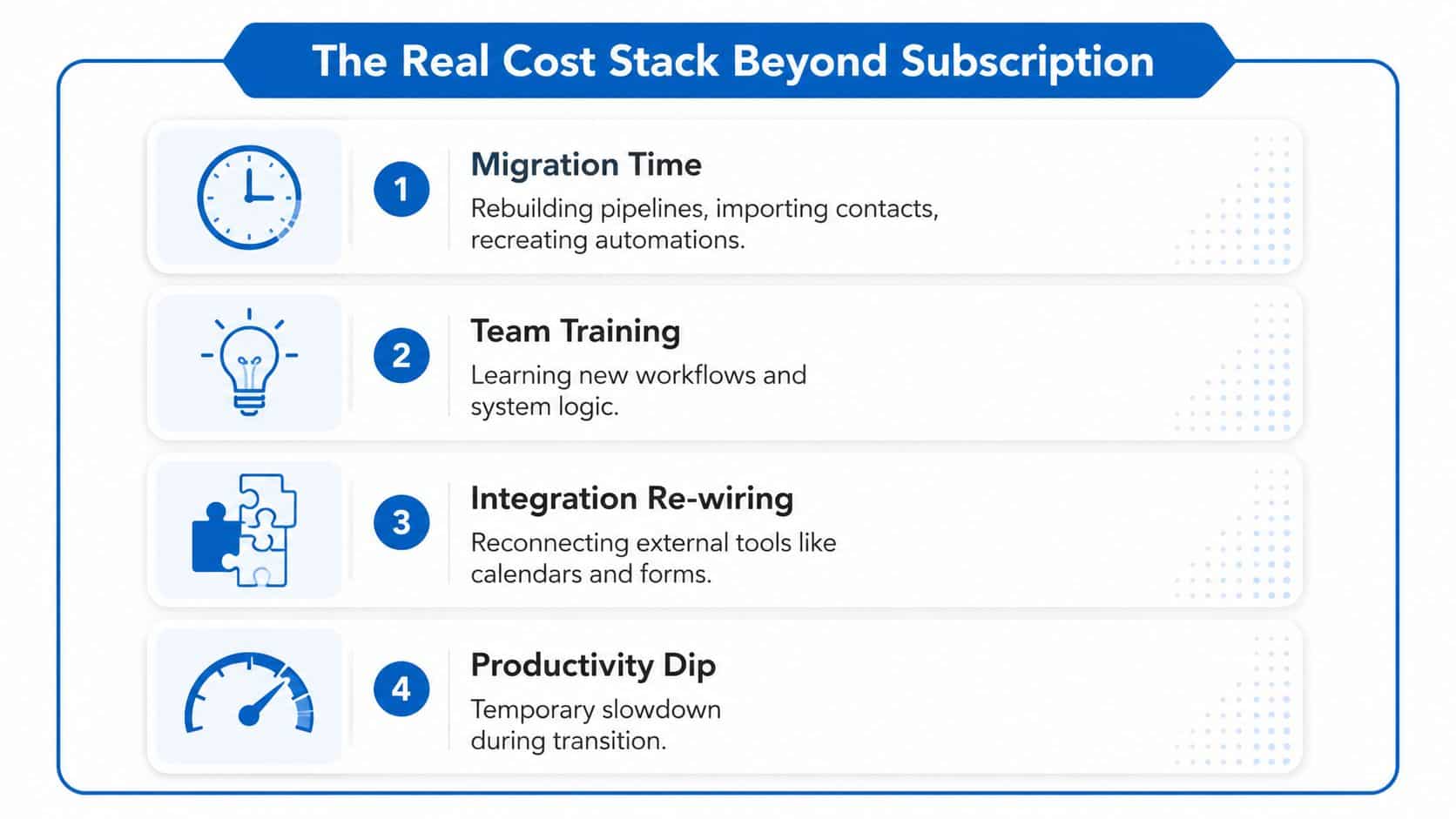
A bad platform fit creates four kinds of waste. First is migration time, because your team has to rebuild the working parts of the business in a new system. Second is training overhead, because non-technical account managers need time before they can use the platform without help. Third is integration re-wiring, because calendars, forms, inboxes, and external tools do not reconnect themselves. Fourth is the productivity dip that hits while everyone learns the new logic.
That cost lands harder with GoHighLevel because the platform is broad. Independent coverage says it works best for agencies that will use most of its capabilities, and it is a weaker fit for enterprise or highly specialized stacks (ustechautomations.com). If you only need one or two functions, you can end up paying for breadth you do not use.
| Hidden cost | What it looks like in practice |
|---|---|
| Migration time | Rebuilding pipelines, importing contacts, recreating automations |
| Team training | Account managers learning new workflows and system logic |
| Integration re-wiring | Reconnecting calendars, forms, messaging, and payment flows |
| Productivity dip | Temporary slowdown while the team adapts |
A practical ownership check is simple. Add platform subscription, migration work, training time, integration fixes, and the cost of underused features over 12 months. You do not need a spreadsheet to spot a bad decision. If the team only uses a slice of what it pays for, or the switch does not remove manual work, the platform is too expensive even when the sticker price looks fine.
For a narrow use case like agency missed call text back, GoHighLevel often pays for itself faster because the automation is obvious and immediate. For teams that will not use the messaging, calendar, reputation, and sub-account stack, the hidden cost is pure downside.
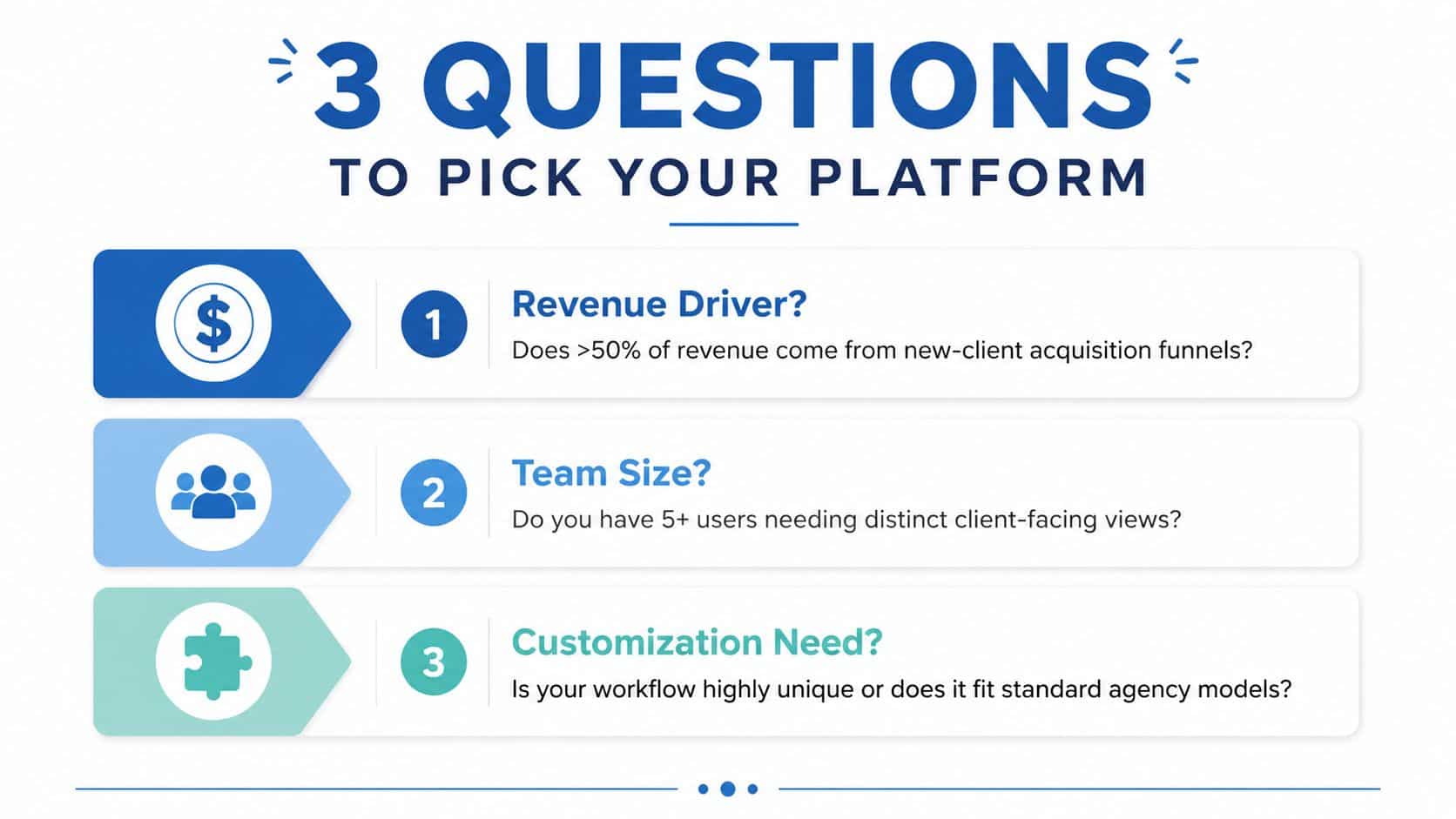
Three Questions That Pick the Right Platform
If you pick the wrong platform, the waste shows up fast. The team spends time rebuilding workflows, the handoff process gets messy, and the software starts shaping the agency instead of supporting it. Use three questions and the answer gets obvious.
Ask these three questions
- Does more than half of agency revenue come from new-client acquisition that needs multi-channel follow-up? GoHighLevel fits better because its core job is capture, nurture, and booking.
- Do you actively resell or white-label your tech stack to clients? GoHighLevel is built for that model, so this is a direct match.
- Are your client workflows standardized enough to live in one platform, or do they need deep customization? Standardized workflows favor GoHighLevel. Bespoke internal operations push you toward Podio.
Two or three yes answers point to GoHighLevel. Two or three no answers point to Podio. Mixed answers usually mean you are in hybrid territory, where the client-facing marketing stack and the back-office delivery stack should stay separate instead of being forced into one system.
The blunt recommendation
Choose GoHighLevel if your agency runs on revenue operations, follow-up, and client-facing automation. Choose Podio if your agency runs on delivery ops, custom workflow design, and internal process control. Do not compare feature counts and call it strategy. Compare what the team will use to make or save money.
The solo and small-agency case is even less forgiving. Consolidation matters more than perfect flexibility, which is why consoidating tools with HighLevel for solos is often the cleaner move than trying to stitch together a complex stack too early.
A 30-Day Plan If You Go With GoHighLevel
The first month should prove one thing: whether the platform reduces work. Not “is it powerful,” because it is. Not “does it have everything,” because that's the wrong test. The test is whether your team can run a client cleaner, faster, and with fewer handoffs.
Week 1 through week 4
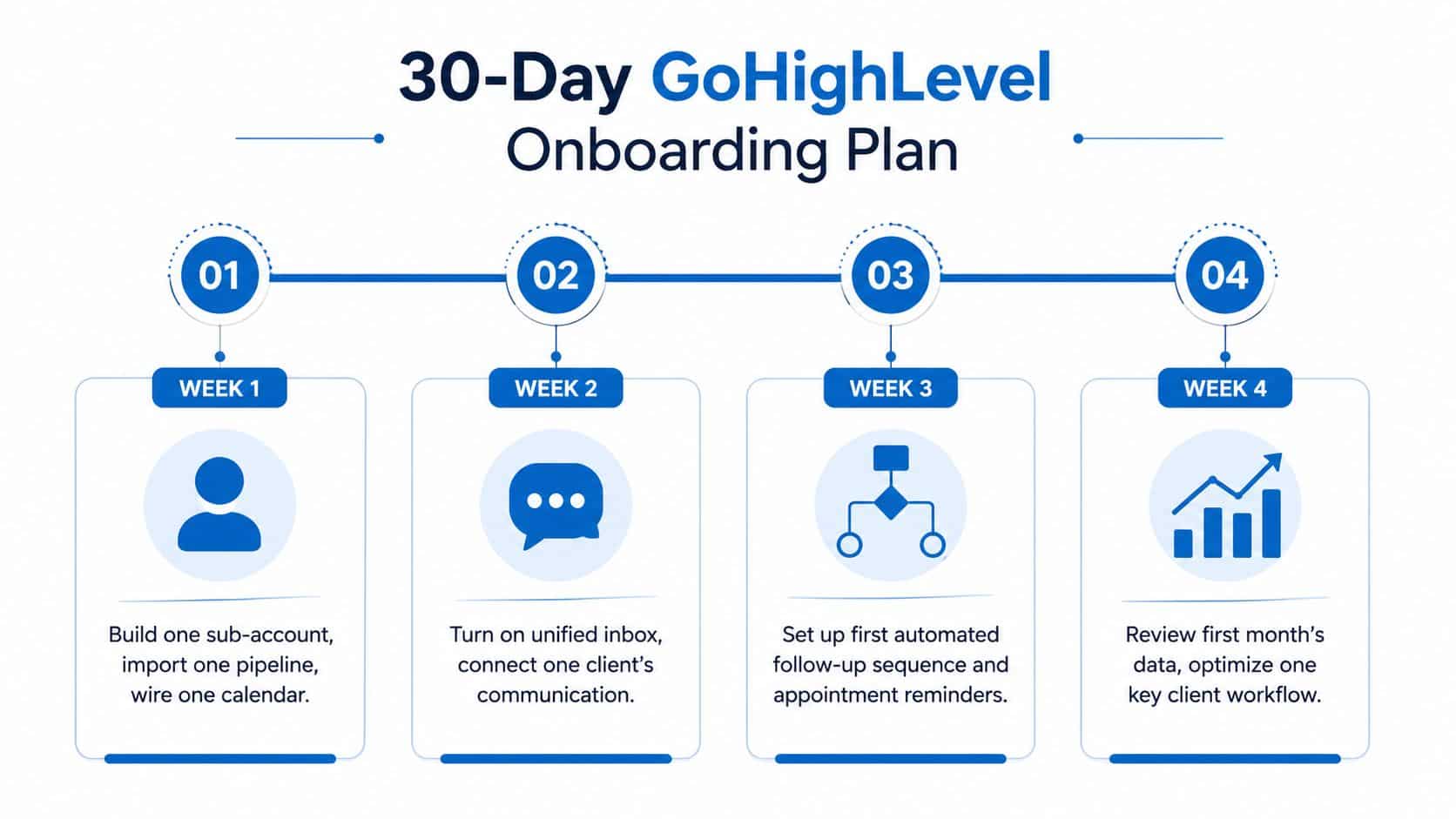
Week 1, build the shell. Create one sub-account, import one pipeline, and wire one calendar. Success looks like the team being able to see a lead move from entry to booked without admin help.
Week 2, turn on the conversation layer. Activate the unified inbox and missed-call text-back for one client. Success looks like missed calls turning into same-day replies instead of sitting untouched.
Week 3, automate the money moments. Build three workflows, new lead nurture, appointment no-show recovery, and post-service review request. Success looks like the agency replacing manual reminders with automated actions that fire on time.
Week 4, use the system in public. Launch one broadcast campaign and place one reputation widget on a client site. Success looks like the team using the platform to reactivate dormant contacts and collect reviews without manual chasing.
What to watch after day 30
If your account managers still jump between spreadsheets and inboxes, the implementation is failing. If the client's lead flow feels cleaner and your team can explain what triggered what, you're on the right track. That's the point where the platform stops being software and starts being infrastructure.
For smaller teams, especially solo operators, the question often becomes whether HighLevel for solos replaces enough tools to justify the switch. If you're using GoHighLevel, keep the first deployment narrow and measurable before you expand.
If you're still deciding between GoHighLevel vs Podio for agencies, stop comparing feature lists and map the platform to your revenue model. If you want a marketing-and-CRM operating system that handles capture, follow-up, booking, and white-label agency work, GoHighLevel is the right move. If you want a configurable internal work hub for bespoke delivery processes, Podio is the better fit. Start with one client, one workflow, and one month of real usage, then make the call with your own numbers. A CTA for HighLevel.
