


You are probably at the point where the stack is slowing the work instead of supporting it. One tool handles CRM, another books calls, another sends emails, another sends SMS, and none of them help much when a lead comes in at 9 p.m. For a solo agency owner, is GoHighLevel worth it for a solo agency usually comes down to a simple trade-off, whether replacing several tools with one system saves time and money, or whether it just gives you a larger dashboard to manage.
GoHighLevel exists because that all-in-one trade-off can work. It is most useful when the platform replaces several subscriptions or helps you build recurring revenue on top of services, not when you only need a basic contact list. A complete guide to HighLevel is useful if you want the broader platform view, but the solo-agency question is more practical. Can one person use it to handle delivery, sales, admin, and cash flow without turning setup into another project?
Table of Contents
- 1. HighLevel
- 2. HubSpot Marketing Hub and Optional Sales or Service Hubs
- 3. ActiveCampaign
- 4. Keap
- 6. Systeme.io
- 7. EngageBay
1. HighLevel
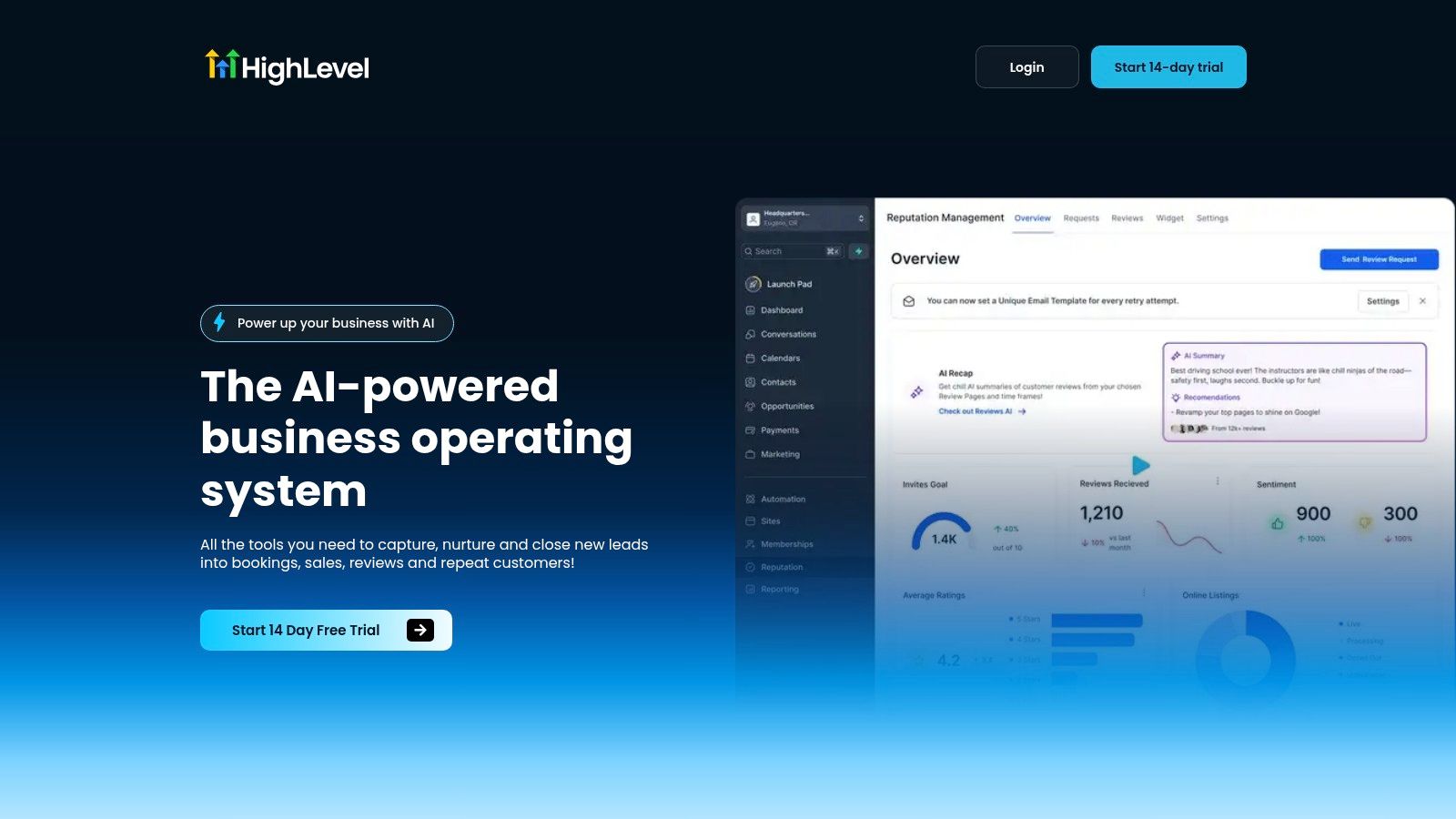
HighLevel makes the strongest practical case for a solo agency owner who is tired of stitching tools together. Independent coverage describes it as combining funnels, websites, email and SMS automation, scheduling, pipelines, memberships, and reputation management in one system, with a published $97/month Starter plan that can replace five to eight tools in some use cases. For a one-person shop, that matters because you are not only buying features, you are reducing logins, sync failures, and the number of places where a lead can fall through.
Its agency-first setup is a primary distinction. The Unlimited plan supports unlimited sub-accounts, and paid plans include unlimited contacts, which makes the platform far more relevant once you are handling multiple clients instead of only one pipeline. It also gives you a unified inbox for SMS, Messenger, Instagram DM, WhatsApp, and live chat, plus workflows, appointment calendars, paid booking flows, invoicing, memberships, reputation management, and AI-driven follow-up. That kind of setup helps a solo operator keep delivery, sales, and admin in one place instead of bouncing between separate apps.
The trade-off is setup time. HighLevel can replace several subscriptions, but it still asks you to configure workflows, templates, pipelines, and client-facing assets before it starts saving real time. If you only need a basic CRM and email tool, it is more platform than you need. If you sell retainers, handle inbound leads, book calls, and want to create recurring revenue through memberships or packaged offers, the extra complexity is easier to justify. For a broader look at the platform beyond this solo-agency lens, see a complete guide to HighLevel.
HighLevel also fits agencies that want to productize service delivery. Its sub-account model lets you separate client work without building a new stack for each account, and that keeps operations cleaner as your client list grows. The same structure can support white-label positioning, which matters if you want your tools to feel like part of your service instead of a bundle of third-party software. The downside is that this only pays off if you are ready to standardize your process. A solo agency with highly custom work may not use enough of the system to make the overhead worthwhile.
Why It Usually Wins For Solo Agencies
For a solo operator, the appeal is not just breadth. It’s the ability to turn one system into the operational hub for lead intake, follow-up, booking, and client communication, while also leaving room to package recurring software access later. That’s why HighLevel gets framed so often as an agency operating system rather than just a CRM.
The strongest practical advantages are easy to see:
- Tool consolidation: You can fold CRM, funnels, booking, messaging, and reputation management into one workspace instead of juggling separate apps (Ideal Online Business review).
- Recurring revenue potential: SaaS Pro at $497/month exists for white-labeling, which matters if you want to resell software access instead of only billing for services (Convology’s HighLevel breakdown).
- Automation across channels: Conversation AI, Voice AI, review replies, and content assistance reduce the manual back-and-forth that eats a solo owner’s day.
- Operational fit for client work: Sub-accounts let you keep client data separated, which is a real advantage once you’re handling more than a few accounts.
Practical rule: if you’re still manually chasing leads, booking calls by hand, and moving data between tools, HighLevel can remove a lot of friction. If you mostly need a polished CRM and nothing else, it can feel like too much platform.
Where The Solo-Owner Tradeoff Gets Real
The downside is implementation overhead. Recent coverage aimed at solo founders is blunt about the learning curve, because HighLevel’s surface area is large and the setup work determines whether you get ROI or just rent another complicated dashboard (ITSelectra review). That matters more to a solo agency than to a team with an ops person, because you are the ops person.
There’s also a pricing nuance that gets missed in quick takes. A 2026 review notes that AI add-ons such as Conversation AI, Voice AI, and Review AI can be charged pay-per-use or as a $97/month add-on per sub-account, which means the true cost can climb once you lean on the features that make the platform feel modern (GitHub-hosted review notes). That doesn’t make HighLevel bad. It just means the solo-agency math gets better only when you use the stack extensively enough to justify the extra spend.
Complete guide to HighLevel can help if you want a deeper implementation view before you commit.
2. HubSpot Marketing Hub and Optional Sales or Service Hubs
HubSpot is the cleaner choice when you want a great CRM first and an automation suite second. For a solo agency, that matters because you may not need white-label sub-accounts or SMS-heavy workflows, you may need a system you can trust immediately without wrestling it into shape. HubSpot’s biggest advantage is that it feels more polished, and that polish can save a solo owner time every single day.
The tradeoff is that HubSpot doesn’t optimize for agency economics the way HighLevel does. Independent 2026 coverage frames HubSpot as better for individual businesses that prioritize CRM depth, interface quality, and enterprise integration capability, while GoHighLevel wins for agencies and tool consolidation (Builts.ai comparison). That tells you who the product is really built for. If your agency is still primarily one client-facing business with a lean stack, HubSpot can fit better than people assume.
The practical edge is simplicity. You get a mature CRM, a large integration ecosystem, and a well-documented support and learning environment, which makes onboarding easier for a solo owner who doesn’t want to spend nights building the system from scratch. The downside is that the cost and complexity can rise quickly as you add seats, tiers, and more advanced features.
HubSpot is usually the better buy when you care more about user experience and less about turning software into a revenue line item.
For a solo agency owner, that means the decision often comes down to what kind of business you’re building. If you want a software stack that supports your service business, HubSpot is strong. If you want a platform that helps you productize your agency and manage multiple clients inside one operating model, HighLevel is usually the sharper fit.
Compare top agency CRM software if you’re deciding between CRM-led options.
3. ActiveCampaign
ActiveCampaign is the automation-first choice, and that makes it a serious contender for a solo agency that lives or dies on nurture sequences. If your biggest pain is follow-up, reactivation, and lead scoring, it can be a better fit than a broader all-in-one platform because it focuses on doing email and cross-channel automation well.
The strongest reason to choose it is workflow depth. The platform offers 950+ automation recipes and AI features like campaign building and conversation summaries, which gives a solo operator substantial capability without needing to build everything from a blank page. Its CRM capabilities are more modular, which is useful if you want automation first and sales pipeline features later through add-ons.
That modularity is also the limitation. Pricing becomes more customized, so it’s harder to forecast the actual monthly bill, especially once contacts and add-ons start stacking up. Two-way SMS is only available as an add-on in limited regions, which weakens it if SMS is a core communication channel for your clients.
For a solo agency, the fit is strongest when you sell email-heavy services, lifecycle campaigns, and reactivation systems. It’s weaker when your offer depends on booking, messaging, payments, and reputation management all living in the same place. That’s where HighLevel’s integrated model is usually more practical.
2026 marketing automation playbook is worth reviewing if automation is the center of your service offer.
4. Keap
Keap is the most hands-on option in this group, and that can be a good thing if you want structure more than flexibility. Solo agencies that don’t want to spend weeks architecting workflows sometimes do better with a platform that pushes them toward a usable setup instead of asking them to design one from scratch.
The appeal is the combination of built-in payments, invoices, SMS, and templated automations with implementation support that helps you get live faster. Keap includes 2 users on its main platform offering, with additional users billed separately, so it’s clearly not built around agency-scale account sprawl in the same way HighLevel is. That makes it more of a guided SMB system than an agency operating system.
For a solo owner, the upside is speed to launch. The downside is that the platform can feel more rigid, and the SMS side is more US-centric than a global agency may want. If your clients are local service businesses and you care about getting a basic system running without a heavy DIY phase, Keap has a place.
It’s also the kind of platform that can reduce shelf-ware. A lot of solo founders buy broad software and never wire it up properly. Keap’s implementation model can prevent that. But if your goal is to build a branded software layer or manage many client workspaces, HighLevel has a much clearer edge.
Recover missed calls for agencies if missed-call follow-up is a core part of your process.
6. Systeme.io
Systeme.io is the budget-first option, and it earns that position by keeping the stack simple. For a solo agency owner, that can be a real advantage, because the fastest way to waste money on software is to pay for features you do not have time to implement.
The platform covers funnels, email, automation, courses, memberships, and a basic CRM with a low-friction setup. It also offers free and lower-cost paid plans, which makes it appealing for MVPs, local offers, and the early stage of a solo agency that is still proving its service model. The white-label and agency sub-account options on higher tiers give it room to grow, although not with the same depth as HighLevel.
Its main limitation is breadth and depth. CRM functionality, integrations, and analytics are lighter than what you get from more mature platforms, so once your workflows get more complex, you can run into a ceiling. That is fine if you want to launch quickly and keep monthly overhead low. It is less useful if your agency is already managing multiple clients and needs strong operational separation.
For solo founders, Systeme.io works best when speed matters more than sophistication. If your priority is to sell a simple funnel, host a membership, and keep recurring software costs under control, it can be a smart choice. If your business model depends on multi-channel follow-up and recurring client management, the GoHighLevel white label solution is the stronger long-term operating system.
7. EngageBay
EngageBay is the value play for solo operators who want the basics covered without paying for an enterprise-style stack. It combines marketing, CRM, sales, and service in one suite, and the positioning is clear, affordable all-in-one coverage for small businesses and agencies.
The strongest part is price-to-feature ratio. You get visual pipelines, quotes, invoices, appointment scheduling, live chat, and helpdesk features in one place, plus a free plan for light use or testing. That makes it practical for a solo agency that needs core client communication and pipeline management without a heavy implementation burden.
The limit shows up when you ask it to behave like a serious agency operating system. The UI and integrations are thinner than the larger ecosystems, and enterprise-grade reporting and governance are limited. If you’re running a lean operation, that may be enough. If you’re trying to build a repeatable delivery machine or resell software access, you’ll probably outgrow it.
EngageBay is a good answer when the question is “what is the cheapest all-in-one that still feels usable?” It’s not the best answer when the question is “which platform provides the means to scale client work and recurring revenue?” That’s where HighLevel stays ahead.
Compare white-label CRM options for agencies if white-labeling matters more than simple affordability.
Is GoHighLevel Worth It? 7-Tool Solo Agency Comparison
| Solution | Implementation Complexity 🔄 | Resource Requirements ⚡ | Expected Outcomes 📊 | Ideal Use Cases 💡 | Key Advantages ⭐ |
|---|---|---|---|---|---|
| HighLevel | High 🔄🔄🔄, deep setup & customization required | Moderate–High ⚡, $97–$297/mo + configuration time | Strong lifecycle automation, faster follow‑up, higher bookings/reviews 📊 | Agencies, local services, multi‑location businesses needing one control center 💡 | True all‑in‑one stack, agency features, AI across messaging/voice, 24/7 support ⭐ |
| HubSpot (Marketing Hub + optional Sales/Service Hubs) | Moderate–High 🔄🔄, well‑documented but complex at scale | Variable ⚡, per‑seat/contact pricing can increase with growth | Scalable CRM-driven growth, robust reporting & integrations 📊 | Growing agencies and clients needing enterprise features & integrations 💡 | Unified CRM, large ecosystem, extensive academy & support ⭐ |
| ActiveCampaign | Moderate 🔄🔄, powerful automation with optional CRM add‑ons | Low–Moderate ⚡, contact‑based pricing; add‑ons affect cost | Excellent lead nurture and reactivation via advanced workflows 📊 | Agencies focused on email automation and multi‑step campaigns 💡 | Rich automation recipes, AI features, modular CRM add‑ons ⭐ |
| Keap | Low–Moderate 🔄, prescriptive templates + white‑glove onboarding | Moderate ⚡, higher entry price; implementation often recommended | Fast time‑to‑live with guided setup; reliable payments & invoicing 📊 | Solo owners wanting hands‑on onboarding and done‑for‑you workflows 💡 | Built‑in payments/invoices, SMS, strong onboarding & SMB automations ⭐ |
| Kartra | Moderate 🔄🔄, feature‑rich funnel/builder with some builder complexity | Low–Moderate ⚡, bundled commerce/features reduce tool needs | Integrated commerce, membership delivery and affiliate workflows 📊 | Creators/agencies building/selling funnels, courses and memberships 💡 | Native checkout, memberships, helpdesk and affiliate management in one platform ⭐ |
| Systeme.io | Low 🔄, simple builder, low friction to deploy | Low ⚡, free + low‑cost predictable plans | Fast deployment of funnels, courses and basic CRM for MVPs 📊 | Budget‑conscious solo founders and local offers needing quick launches 💡 | Very affordable, minimal setup, white‑label/agency options on higher tiers ⭐ |
| EngageBay | Low–Moderate 🔄, straightforward all‑in‑one suite | Low–Moderate ⚡, value pricing with free tier available | Solid core marketing, sales and support capabilities for SMBs 📊 | Small agencies and businesses seeking a Hub‑style affordable alternative 💡 | Good price‑to‑feature ratio; includes live chat, helpdesk and pipelines ⭐ |
The Verdict Which Platform Best Powers a Solo Agency
The right choice isn’t about feature count, it’s about maximizing your impact. For a solo agency, GoHighLevel is usually worth it when you want one system that can handle client management, automation, booking, payments, reviews, and, eventually, recurring software revenue. Its biggest advantage is not that it does everything perfectly. It’s that it compresses a lot of agency infrastructure into one place, which matters when you’re the only person doing the work.
That said, it isn’t the universal winner. If your business is mostly email-driven and you want a cleaner automation experience, ActiveCampaign can be the smarter fit. If you want a polished CRM and a gentler onboarding path, HubSpot makes more sense. If you’re building funnels, memberships, or creator-style offers, Kartra or Systeme.io can be more efficient. If you want structure and hands-on setup, Keap deserves a look. If your budget is tight and you need a workable all-in-one without much fuss, EngageBay is a practical alternative.
The solo-agency test is simple. Pick the platform that reduces admin time, not the one that adds more configuration work in exchange for features you won’t use. HighLevel wins that test when you need sub-accounts, multi-channel follow-up, and a path to recurring revenue. It loses that test when you only need a clean CRM and a light automation layer.
If you’re building a solo agency that wants to look and operate like a bigger shop, start with HighLevel, test it against your real delivery process, and see whether the consolidation makes your week easier. If you want the deepest CRM or the easiest learning curve, choose the platform that matches that priority instead of forcing the wrong tool into your workflow.
