


You can post every day, publish clean graphics, and still wonder why the calendar stays empty. That's usually not a content problem. It's a system problem, where attention gets captured in one place, then leaks out before anyone books, pays, or gets followed up with in a way that feels personal.
A coaching business can't be treated like a generic content brand. The market is already large enough to support systemized marketing, with the global coaching industry valued at $5.34 billion in 2025 and projected to reach $9.5 billion by 2032 at an estimated 8.53% CAGR. The same benchmark also cites about 122,974 professional coaches worldwide and an average coaching session rate of $234 per hour (coaching industry statistics), which is exactly why the job is to build a revenue path, not just visibility.
Table of Contents
- Why Most Coaching Marketing Leaks Revenue Before It Starts
- Lead Magnets, Landing Pages, and the First Funnel
- Traffic That Fills the Funnel
- Multi-Channel Capture and Automated Nurture
- Paid Calendars and Frictionless Payment Collection
- Reputation and Referrals as a Performance Channel
- KPIs and Quarterly Optimization
Why Most Coaching Marketing Leaks Revenue Before It Starts
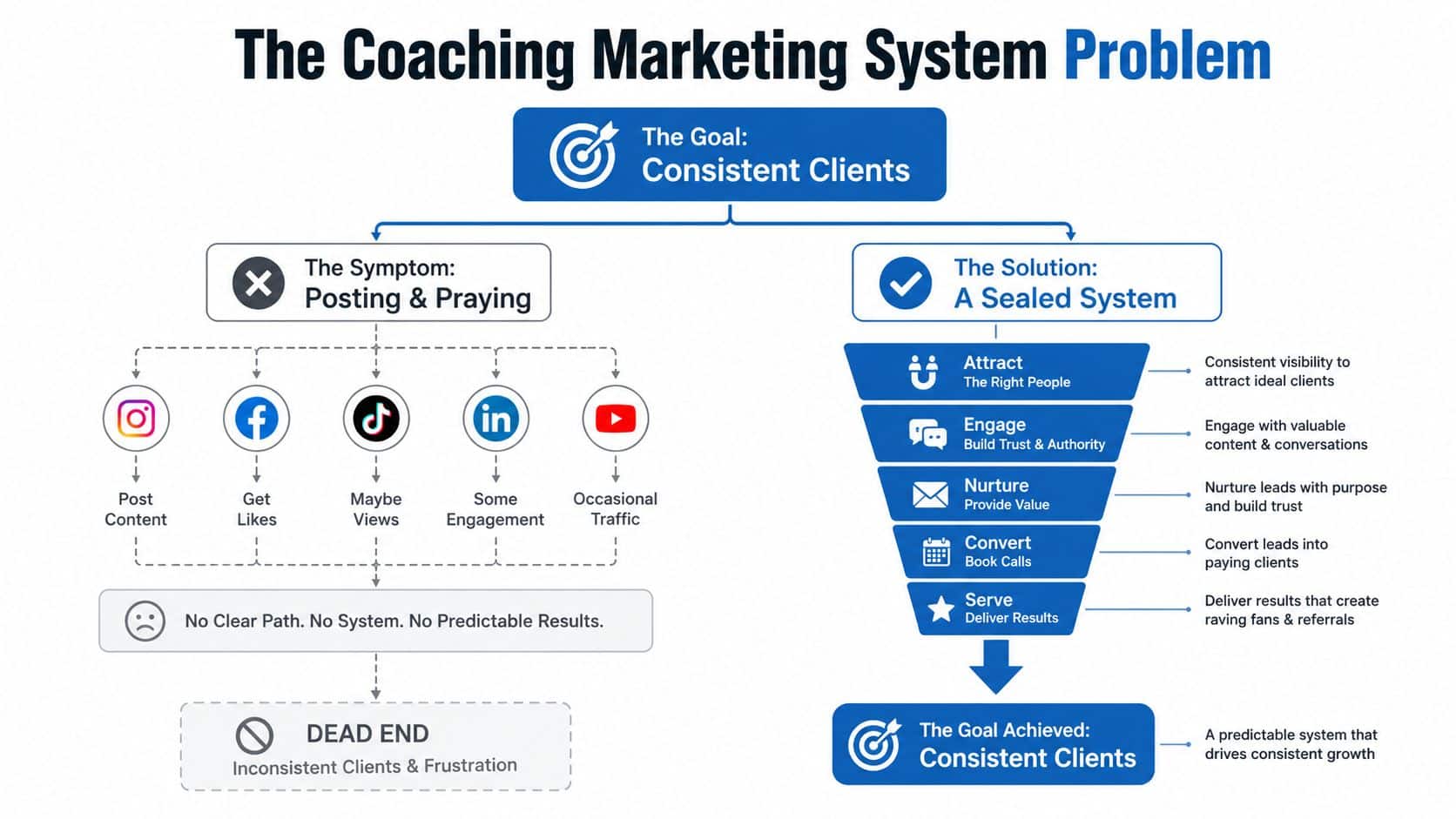
The most common failure in marketing for coaching business is treating it like a posting habit. A coach publishes on LinkedIn, shares a reel, gets a DM, sends a free PDF, and then nothing happens because the lead drops into a spreadsheet, a personal inbox, or a memory that's already overloaded. The problem isn't demand. It's the missing handoff between interest and revenue.
Narrow the offer before you widen the traffic
A broad offer sounds flexible, but it usually underperforms because the message has nowhere to land. A generic life coach can move into something like career transition coaching for senior engineers moving into management, and suddenly the headline, the lead magnet, the audience targeting, and the follow-up all become sharper. That kind of repositioning is the difference between “I help people grow” and “I help this person solve this specific problem now.”
The three positioning questions are simple, but they have to be answered cleanly. Who specifically is this for, what outcome do they want, and why should they trust this coach? If those answers are fuzzy, every downstream asset gets weaker, including your landing page and email sequence.
Treat the CRM like the memory of the business
A CRM stops being a database and becomes a control center when every new lead gets tagged by niche, source, and intent from the first touch. Then, later automation can sound relevant instead of generic. A senior engineer thinking about management doesn't need the same follow-up as a founder exploring confidence coaching, and the CRM should reflect that difference immediately.
That's also why a “content-first” mindset usually underperforms a revenue-system-first mindset. Content can start the conversation, but it doesn't book the call, qualify the lead, collect the payment, or reactivate the prospect who went quiet for two weeks. The business wins when those pieces are wired together, not when they're spread across different tools and half-managed manually.
A strong outside example of relationship-led service marketing is explore Impact Marketer, which is useful because it pushes the same core idea from another angle, strategy beats random posting. For a coaching business, that means the funnel matters more than the feed.
Practical rule: If a lead can download something, disappear, and never be touched again, your marketing is generating activity, not clients.
The same logic shows up in this this playbook for local businesses, where capture and follow-up matter more than isolated tactics. Coaches don't need more channels first. They need a sealed path from attention to appointment.
Lead Magnets, Landing Pages, and the First Funnel
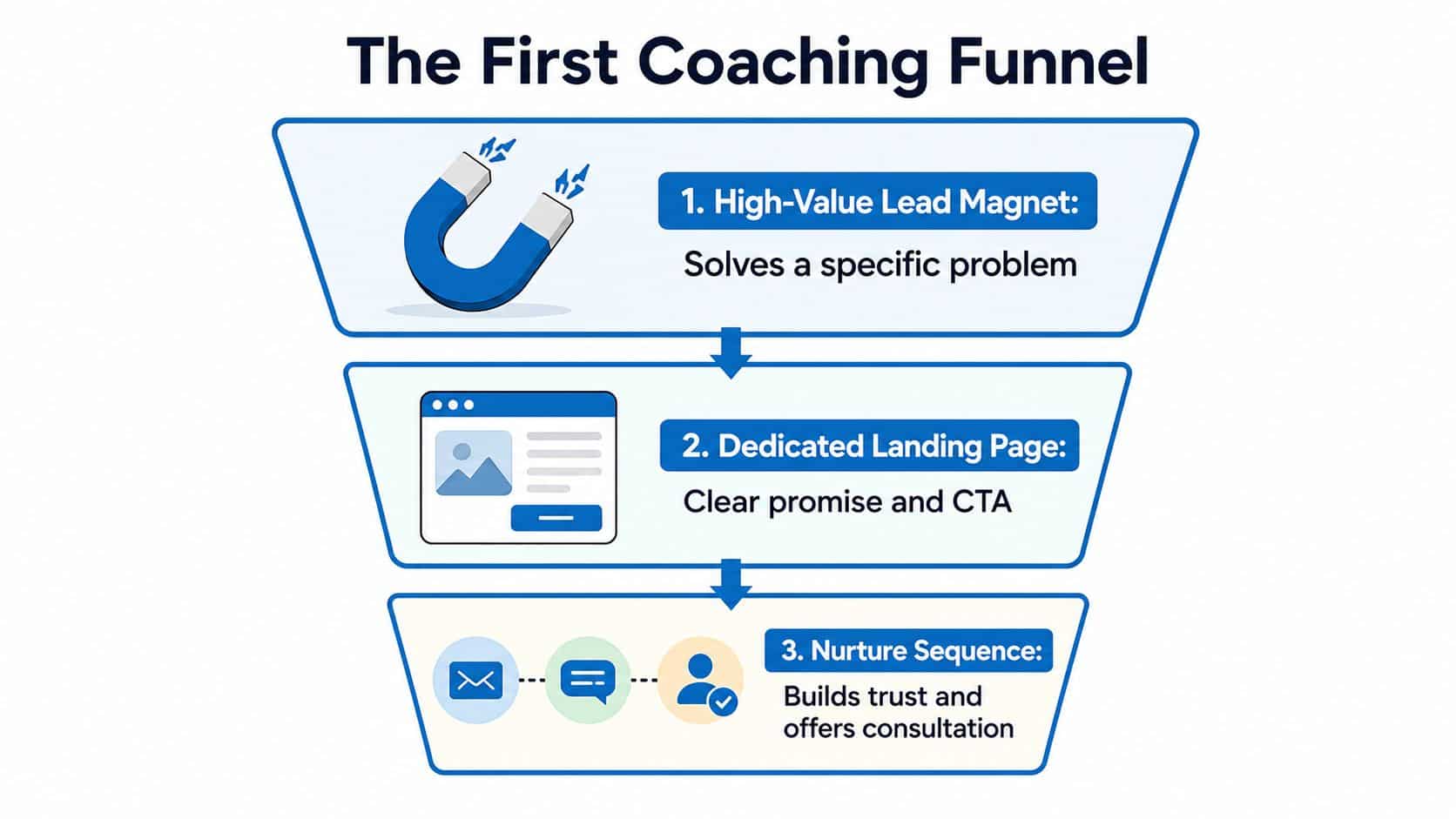
The first coaching funnel should be small enough to finish, but specific enough to convert. Thinkific's organic marketing guidance centers on a high-value lead magnet, a landing page, and automated email follow-up as the core acquisition flow, and that structure makes sense because it turns anonymous interest into an owned lead list and then into sales conversations (organic marketing to get new coaching clients). For coaches, the lead magnet isn't the prize, it's the filter.
Build the lead magnet around a decision, not a download
The best coaching lead magnets usually help someone decide what to do next. A diagnostic quiz, a 5-day email challenge, a workshop replay, a scorecard, or a swipe file all work because they create motion, not just consumption. A coach selling confidence work might use a self-assessment. A business coach might use a readiness scorecard. A career coach might offer a “should I stay or switch?” decision guide.
The landing page should do one job only, which is to make the trade feel obvious. That means a clear promise, a visible call to action, and a single next step. If the page tries to sell the whole coaching program before the lead has even opted in, it usually kills conversion instead of improving it.
Put the asset in the right place inside the system
In practice, each asset should live in a distinct part of the stack. Forms and quizzes collect the data, the landing page carries the promise, and the workflow trigger starts the follow-up sequence. That separation matters because it gives you something real to test. A poor opt-in rate is a landing page issue, not an email issue. A weak booking rate after opt-in is a nurture issue, not a traffic issue.
The simplest way to think about it is this.
- Lead Magnet: Solves one painful, immediate problem.
- Landing Page: Makes the promise and captures the lead.
- Email Sequence: Builds trust and moves the person toward a consult.
A coaching funnel doesn't fail because one email was weak. It fails because the handoff between steps was never designed.
If you want a practical companion reference, the conversion rate optimization tips resource is a good reminder that each step needs its own measurement. The three rates that matter most are page-view-to-opt-in, opt-in-to-email-open, and email-to-call-booked.
Traffic That Fills the Funnel
Traffic only matters if the funnel is ready to receive it. A lot of coaches begin with social posting, but that often creates visibility without capture. The better frame is to match the traffic source to the maturity of the offer, because a new coach, a mid-ticket coach, and a well-positioned niche coach should not all buy attention the same way.
Organic and paid traffic solve different problems
Organic channels work best when the business needs trust and time. SEO blog content, YouTube, short-form video, LinkedIn thought leadership, podcast guesting, and partnerships can all work, but they do so at different speeds. A coach with a clearly defined niche can get useful traction from content and relationships, while a coach still refining the offer often wastes time producing polished content that never reaches the right person.
Paid traffic can work sooner, especially when the offer has enough value to support acquisition costs. A session rate benchmark of $234 per hour (coaching industry statistics) gives coaches more room to justify paid lead generation than many service businesses. Still, paid traffic only works when the landing page and follow-up sequence are already doing their job.
Choose the channel based on the stage you're in
If the niche is still broad, start with one organic channel and one capture asset. If the offer is mature and the calendar already converts, add paid traffic for lead magnet downloads or retargeting. If the audience is warmed up through partnerships, webinars, or direct referrals, paid traffic can be used more surgically to accelerate booking rather than invent awareness from scratch.
For the budgeting side, small business social media budget tips is a useful companion read because it forces the same discipline. The point is not to spend more on marketing, it is to spend where you can measure a return.
| Channel | Time to First Lead | Typical Cost | Best Fit Stage |
|---|---|---|---|
| SEO blog content | Slower | Low cash, high time | Early niche building |
| LinkedIn content | Moderate | Low cash, consistent effort | Niche validation |
| Podcast guesting | Moderate | Mostly time | Trust building |
| Partnerships | Often faster | Low cash | High-trust offers |
| Google ads | Faster for intent | Paid media budget | Mature offers |
| Meta ads | Can be fast for opt-ins | Paid media budget | Strong lead magnet |
| Retargeting | Faster with warm traffic | Lower than cold acquisition | Post-opt-in recovery |
If you are deciding where to start, use one rule. If your offer is not converting organically, do not buy more traffic yet. Fix the page, the message, and the follow-up first.
For paid social execution, the guide to automating DMs is relevant because many coaching conversations now start inside the inbox, not on a web form. That is especially true when the first touch comes from video, comments, or Instagram interest.
Multi-Channel Capture and Automated Nurture
Once the opt-in happens, the work starts. The lead is usually not ready to buy immediately, which means the next touches have to be timely, relevant, and easy to manage. A unified inbox across SMS, Messenger, Instagram DM, WhatsApp, and live chat keeps those conversations from scattering across different apps and personal devices.
The difference is operational, not cosmetic. A coach can answer faster, keep context intact, and avoid the common problem of forgetting who said what where. That matters because buyers don't move in a straight line, and the follow-up has to adapt to that reality.
Use the inbox to centralize the messy middle
A practical workflow looks like this. Someone completes a quiz, gets a personalized SMS within a minute or so, enters a short email sequence, and then gets routed to a calendar link once engagement shows clear intent. The system decides the next touch based on behavior, not on whether the coach remembered to check the phone after dinner.
That's also where missed-call text-back earns its keep. Coaches who still close conversations by phone can recover lost leads automatically instead of letting every unanswered call become a silent dropout. Conversation AI can also handle the first layer of DM replies, which keeps evenings from disappearing into repetitive “what do you charge?” messages.
Operational rule: If a lead is warm enough to ask a question, they're warm enough to get an immediate response, even if that response is automated first.
Let the score determine the next step
The smartest systems don't treat every lead the same. They score engagement, segment by source, and trigger different follow-up based on behavior. Someone who opened every email and clicked the booking link should not get the same message as someone who downloaded the freebie and vanished.
For a deeper platform-oriented lens, HighLevel's 2026 automation tips is useful because it reflects the same operating principle. Automation isn't about replacing the coach. It's about making sure the coach's time goes to the highest-intent conversations.
A CRM-driven nurture system works because it preserves context across the whole journey. That means fewer dropped leads, cleaner handoffs, and a much better shot at converting the people who weren't ready on day one.
Paid Calendars and Frictionless Payment Collection
Booking a call and collecting money are two different obstacles, and many coaching businesses lose deals at both points. The cleanest fix is a paid calendar, where scheduling, payment, and confirmation happen together. That way the prospect chooses a slot, pays a deposit or full fee, and receives reminders without another manual handoff.
Make the booking step pay for itself
A paid calendar raises commitment before the call even starts. That doesn't mean every discovery call needs a big upfront fee, but it does mean the booking experience should reflect the seriousness of the offer. When the calendar, payment, and reminders sit in the same workflow, no-shows usually stop feeling random and start feeling preventable.
For higher-ticket work, estimates, proposals, and invoices should live in the same environment as the booking pipeline. That keeps the next action visible, whether the prospect is waiting on a proposal, a follow-up note, or a payment link. If you're comparing tools for that stage, best proposal software 2026 is a good benchmark for what a structured sales handoff should include.
Reduce no-shows before they happen
Many coaches still tolerate no-shows as part of the job, but that's just a workflow problem wearing a familiar face. A refundable deposit, automated reminders, and clear confirmation copy can reduce friction without making the experience feel pushy. The key is to set the expectation at booking, not after the time slot has already been missed.
HighLevel's calendar and payment stack can also support Text-2-Pay and Tap-2-Pay for coaches who close by phone or in person. That's useful when the client is ready to move quickly and doesn't want to wait for a separate invoice thread. One place for booking, payment, and reminders creates fewer escape points in the sales process.
Reputation and Referrals as a Performance Channel
Reviews and referrals are not just the bonus that happens after good work. They're a channel, and they can be engineered like one. That starts with asking for proof at the moment of client success, not weeks later when the emotional intensity has faded and the testimonial sounds generic.
Capture social proof while the outcome is fresh
Automated review requests should trigger when the client has just hit a milestone, completed a phase, or shared a visible win. That timing matters because the result is still concrete in the client's mind. Video testimonials can then be embedded directly on landing pages, inside nurture sequences, and in follow-up messages so social proof travels with the offer instead of sitting in a forgotten folder.
AI-assisted review replies also matter more than most coaches think. They keep the response timely and personal without forcing the coach to draft the same appreciation message ten times a month. If reputation is part of the acquisition engine, then reply speed and tone are part of the brand.
For a broader reputation strategy angle, TheBestReputation media relations playbook is a helpful external reference because it reinforces the idea that trust has to be managed, not assumed. The same principle applies here, even if the channel is smaller and more personal.
Build referral partnerships on purpose
The referral side works best when it is engineered, not hoped for. Identify adjacent providers with the same audience, build a simple co-marketing or referral offer, and track referred leads separately in the CRM. That source tracking matters because a referral lead with high trust usually behaves differently from a cold lead who found you through search.
A practical habit helps here. Ask one happy client per month if there's anyone in their network you should meet, then record the answer. It sounds small, but it creates a repeatable motion instead of relying on vague word-of-mouth.
KPIs and Quarterly Optimization
If you don't measure the system, you're just staying busy. A coaching dashboard should be simple enough to review every week and serious enough to guide actual decisions. The weekly numbers that matter are new leads, cost per lead, opt-in rate, email open rate, calls booked, show rate, and revenue collected.
Review the weekly dashboard without overcomplicating it
Weekly reporting should answer one question, which is whether the system is moving people forward. If leads are up but bookings are flat, the issue is usually the follow-up or the offer. If bookings are happening but revenue is weak, the calendar or payment step is leaking.
A good CRM makes this easier because it ties traffic, messages, appointments, and payments to the same lead record. That's especially useful when leads come from several places, since one system can show what happened after the opt-in instead of forcing you to stitch the story together manually.
Decision rule: Pause the channel when lead quality drops, rewrite the sequence when opens or replies soften, and raise prices only after the conversion path is stable.
Run the quarterly review like a business owner
Quarterly reviews should answer different questions. Which traffic sources produced the highest-close-rate leads? Which email sequence moved people to booking? Which lead magnet still attracts the right audience, and which automation leaks the most prospects? A coaching-marketing guide recommends quarterly reviews of website traffic, content engagement, and lead quality, then adjusting strategy based on those findings (executive coaching and marketing mastery).
That kind of review only works if the data is already clean. Lead scoring, workflow triggers, and segment tags make the patterns visible without manual guesswork. If the highest-quality leads all come from one partner channel, that's a signal to deepen that relationship. If one email sequence repeatedly drives call bookings, that sequence deserves more traffic and tighter testing.
A simple 90-day rollout keeps the business from trying to do everything at once. Days 1 to 30 should lock positioning, build the lead magnet, landing page, first email sequence, and CRM pipeline. Days 31 to 60 should launch one organic channel and one paid channel, activate missed-call text-back, and turn on paid calendar booking. Days 61 to 90 should add review requests, launch the referral partner motion, and run the first quarterly KPI review so the next cycle starts from evidence, not guesses.
For a central workspace that ties capture, nurture, booking, payment, reputation, and reactivation together, HighLevel gives coaches the operational layer to manage it without bouncing between disconnected tools. If you're serious about turning marketing into a revenue system, go look at how it handles CRM, automation, booking, and reviews in one place, then map your current funnel against it and fix the weakest handoff first.
