


You're probably staring at a client's inbox right now, or at least thinking about one, and realizing the actual problem isn't writing email. It's the messy stack around it. One tool holds contacts, another sends campaigns, a third builds forms, and a fourth schedules follow-up, so every client request turns into another round of logins, fixes, and handoffs.
That's where GoHighLevel for marketing agencies starts to make sense. It's built for agencies that need to manage client communication, automate follow-up, and keep everything tied to one account structure instead of stitching together disconnected apps. If you're trying to turn email marketing into a service that's reliable, repeatable, and profitable, the platform matters as much as the strategy.
Table of Contents
- Why Agencies Are Ditching Their Fragmented Toolkits
- Email Marketing Fundamentals for Client Success
- How GoHighLevel Consolidates Your Agency's Stack
- Building and Segmenting Lists The Smart Way
- Crafting High-Impact Email Campaigns in GoHighLevel
- Measuring Performance and Protecting Deliverability
- Your 30-Day GoHighLevel Email Marketing Launch Plan
Why Agencies Are Ditching Their Fragmented Toolkits
An agency owner can lose half a day to a simple campaign update. A contact comes in through a form, the record has to move into a CRM, the lead needs a tag, the email platform needs a segment, and the scheduler has to know about the appointment request. If one integration breaks, the workflow slows down and the client just sees a missed follow-up.
That is why all-in-one platforms get so much attention. GoHighLevel's agency model was built to pull point tools into one workspace, and agencies can structure their setup around that model with Starter at $97 per month, Unlimited at $297 per month with unlimited sub-accounts and white-labeling, and SaaS Pro at $497 per month for agencies reselling rebranded access. For teams managing recurring client work, one system is often easier to run than separate logins, separate billing, and separate data trails (US Tech Automations, Builts review).

Why email service becomes profitable only when the stack is lean
Email marketing is often one of the first recurring services an agency can package, because it touches lead capture, nurture, booking, and retention. It becomes profitable only when the process is tight. If every list update and automation change requires switching between five tools, labor costs rise fast and margins shrink.
Agencies do not need more software for the sake of software. They need fewer handoffs, fewer breaks in data flow, and fewer places where a client's lead can get lost.
If you're comparing platform options, it helps to compare agency CRM systems before you commit to another disconnected setup. For agencies that also manage offline outreach, Sendvo's direct mail campaign management strategies show the same principle from another angle, the campaign system only works when capture and follow-up stay connected.
GoHighLevel fits that recurring-service model. It is described as a white-labeled CRM, calendar, funnel-builder, and SMS/email platform for agencies serving multiple SMB clients. For agencies that sell retainers and manage client relationships over time, workflow reliability matters more than flashy features.
Email Marketing Fundamentals for Client Success
Email marketing works because the agency, and the client, own the audience. A social following is rented attention, but an email list is an asset you can segment, nurture, and re-engage directly. When a client understands that distinction, it becomes easier to justify list-building, automation, and ongoing optimization as part of a real growth system.
The basics every client needs before the first send
A list starts with an offer. That might be a lead magnet, a discount, a guide, a booking incentive, or a simple newsletter signup tied to a useful reason to subscribe. The form has to be clear, the promise has to be specific, and the follow-up has to match the intent that brought the lead in.
Compliance matters just as much as the offer. Agencies need to treat CAN-SPAM, GDPR, and consent rules as part of the service, not as an afterthought. That protects the client's brand, but it also protects the agency from building a system that sends to people who never wanted to hear from the business in the first place.
Practical rule: if the form promise and the first email don't match, list quality drops before the campaign even has a chance.
What agencies should explain in plain language
Clients usually don't need a lecture on email architecture. They need a simple story about how a stranger becomes a subscriber, how a subscriber becomes a lead, and how a lead becomes a customer through timed follow-up. That story gets stronger when the platform keeps every interaction in one place, because the agency can point to the same contact record, the same journey, and the same outcome.
GoHighLevel fits that teaching model because it brings capture, follow-up, and pipeline movement into one environment. That makes it easier to explain why the email list isn't just a contact dump. It's the starting point of a revenue process, and every good campaign should move people one step closer to a call, a quote, a purchase, or a reply.
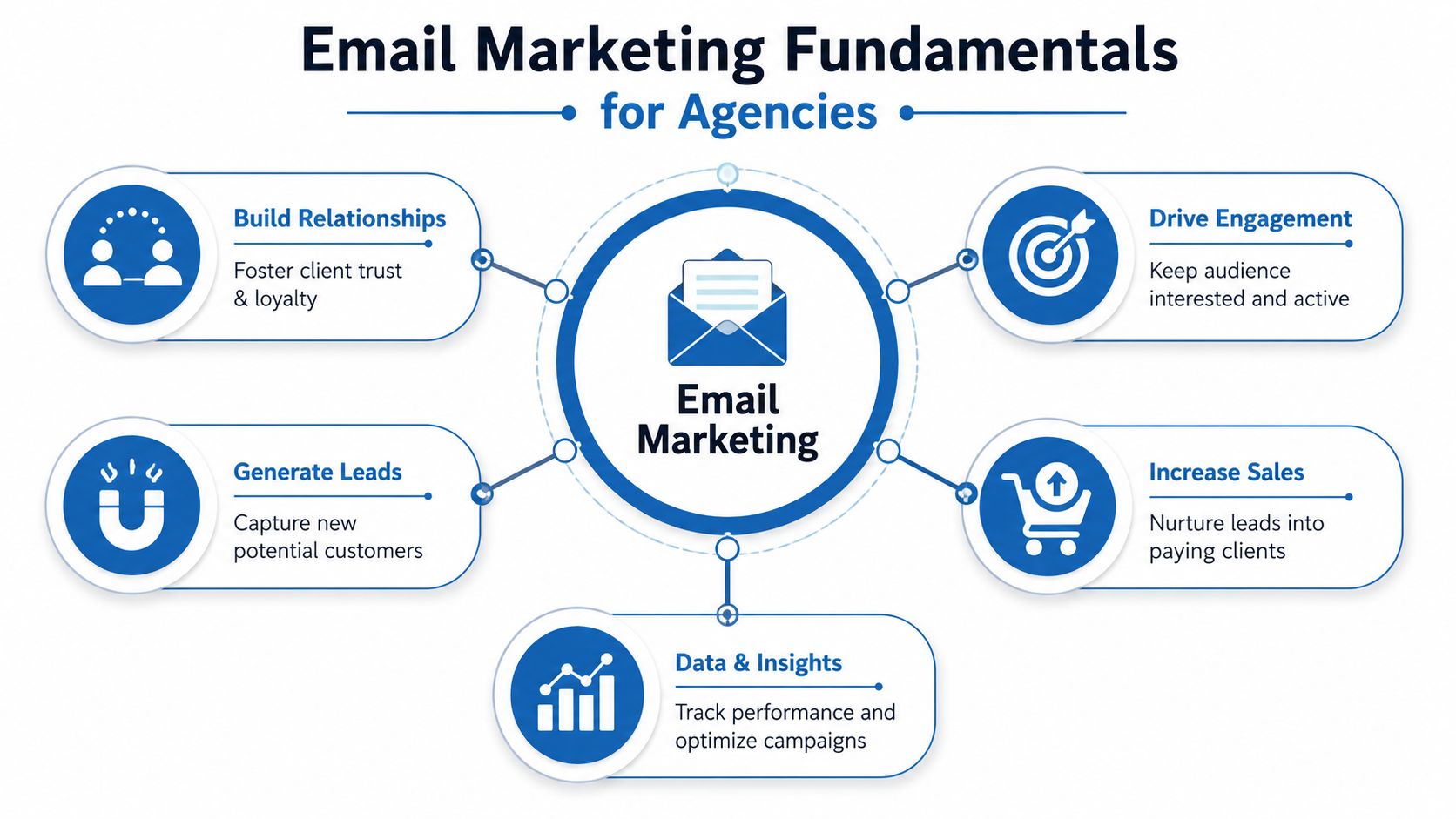
A smart agency also teaches the client what not to expect. Email isn't magic, and it won't rescue a weak offer. But when the list is built on permission, the message is relevant, and the follow-up system is consistent, email becomes one of the cleanest ways to create recurring communication with people who already showed interest.
How GoHighLevel Consolidates Your Agency's Stack
An agency can know how to write a good email and still lose time inside a messy tool stack. The problem is usually not strategy. It is the handoff between tools, where leads get exported, reimported, tagged in one system, and finally queued in another. GoHighLevel reduces that back-and-forth by keeping the main campaign pieces in one place, so the contact path stays visible from capture to follow-up.
The sub-account model keeps clients separated
GoHighLevel organizes agency work around isolated sub-account/location spaces, so each client can keep its own contacts, pipelines, automations, branding, and reporting separate from every other account (ClonePartner). For an agency, that separation is not a nice extra. It is the guardrail that keeps one client's list, offers, and reporting from bleeding into another client's work.
That structure also makes service delivery repeatable. Once an agency builds a nurture sequence, a follow-up path, or a campaign framework that works, it can be deployed again through snapshots instead of rebuilt from scratch each time. The result is less setup work, fewer handoff mistakes, and a clearer way to standardize what the agency sells.
The workflow engine connects the whole follow-up chain
The workflow engine ties CRM activity, funnels, SMS, and email into one automation layer, which reduces the need for third-party glue tools and the weak points that come with them (YouTube walkthrough). For a new agency owner, that matters because the follow-up path starts to behave like one continuous system instead of a set of disconnected tasks.
A contact can enter through a form, move into an email sequence, trigger a text reminder, and advance in the pipeline without the team stitching those steps together by hand. That is the primary operational benefit. The platform handles the handoff, while the agency focuses on the message, timing, and offer.
Agency takeaway: fewer connectors mean fewer places to troubleshoot when a lead does not move the way you expected.
A single system also makes training easier. New team members can learn one workflow instead of five tools, and clients can see how the email plan fits into the larger nurture process. If you want a broader framework for building that system, the guide for agency marketing automation is a useful companion.
Why the SaaS angle changes the economics
The SaaS side of GoHighLevel matters because it gives agencies a way to turn software access into recurring revenue instead of treating the platform as overhead. The agency resale model is built for teams that manage several client environments and want one system that can support both delivery and packaging. That changes how the business thinks about email service, since the agency is no longer just sending campaigns, it is building a repeatable service offer.
That does not mean every agency needs to resell software immediately. It does mean the platform is set up for agencies that want recurring client work to behave more like a product, with a repeatable setup, a clear process, and a cleaner path from service delivery to profit.
Building and Segmenting Lists The Smart Way
List building breaks down when agencies treat every lead like the same lead. A webinar attendee, a past customer, and a quote request each signal a different level of interest, so they should not receive the same follow-up. If they all land in one generic list, the message feels generic too, and replies usually follow that pattern.
Capture points should match the intent behind the lead
GoHighLevel gives agencies several ways to collect contacts, including forms, surveys, and landing pages. The goal is not only to collect an email address. The goal is to capture enough context that the next message feels like a continuation of the conversation rather than a random broadcast.
A short form works well when the offer is simple and the next step is obvious. A survey makes more sense when the agency needs to segment by service need, budget, location, or timing. Landing pages help when the client needs a dedicated place to turn ad traffic or organic traffic into a specific action.
Smart Lists make follow-up more precise
A single database gives agencies room to segment based on real behavior instead of static exports. Instead of pulling contacts into spreadsheets and rebuilding lists by hand, the team can use tags, custom fields, and activity data to group people by what they did and what they skipped. That is the difference between a broad blast and a follow-up that fits the person reading it.
One segment can hold people who asked for a consultation but never booked. Another can hold existing clients who clicked a cross-sell offer but did not buy. The agency does not need to guess who belongs where if the contact record already shows the path they took.
GoHighLevel keeps email, CRM, and funnel activity in the same system, so the workflow stays connected from capture to follow-up. That matters because the agency can see how a lead moved, then send the next email based on that movement instead of waiting for separate tools to sync. As the YouTube walkthrough shows, that kind of closed-loop setup is easier to manage than passing data back and forth between disconnected platforms.
A simple agency segmentation pattern
- New leads: people who just opted in and need immediate context, reassurance, and a clear next step.
- Warm prospects: contacts who engaged but have not booked, bought, or replied, so the email should reduce friction.
- Existing customers: people who already trust the brand and may be open to upsells, referrals, or reactivation.
- Inactive contacts: subscribers who stopped engaging and need a different message before they are removed or suppressed.
This structure keeps campaigns easy for the agency to manage and easy for the client to understand. It also makes reporting clearer later, because you can explain not just what was sent, but who received it and why.
Crafting High-Impact Email Campaigns in GoHighLevel
A good agency email campaign has a job. A welcome sequence introduces the brand, a promotional sequence drives an action, and a nurture sequence builds trust over time. If a campaign tries to do all three at once, it usually does none of them well.
Start with the three campaign types every agency should have
A welcome automation is the first thing to build. It should send immediately after signup, confirm what the subscriber asked for, and set expectations for what happens next. If the lead came in through a lead magnet, the first message should deliver the asset and then point toward the next logical step.
Promotional campaigns are different because timing matters more. A sale, event, or limited offer needs cleaner copy and a stronger call to action. The job here is to create urgency without sounding sloppy or overhyped.
Nurture sequences sit in the middle. They're not trying to force a sale on the first email, but they do need to teach something useful. A useful nurture sequence can answer common objections, share proof points, and keep the client's brand in the subscriber's mind until they're ready to act.
How the builder helps speed up production
GoHighLevel's email builder, templates, and Content AI features can shorten the setup process because the agency doesn't have to start from a blank page every time. That matters when you're building email systems for multiple clients and each one needs a slightly different tone, structure, and offer.
A practical workflow looks like this. Pick the campaign type, choose a template that matches the goal, customize the branding, then draft subject lines and body copy that fit the client's voice. The platform helps with execution, but the agency still has to supply the strategy and the offer.
Good email systems feel boring in the best way. They repeat the right message to the right people without making the team rebuild the same logic every week.
If you're choosing tools for delivery and attribution, HighLevel can sit alongside other software in your stack, but the value comes from reducing the amount of tool-switching inside the campaign itself. That's what makes a client service easier to maintain as the list grows and the campaign calendar gets crowded.
Measuring Performance and Protecting Deliverability
Sending email without measurement is just guessing. Agencies need a reporting habit that shows whether emails are getting attention, clicks, and action, and they also need a deliverability routine that keeps the client out of the spam folder.
Track what affects revenue, not just vanity metrics
Open rates can help with a quick read, but they do not show the full picture. Click behavior, conversions, unsubscribe trends, and reply quality tell you whether the campaign is moving the client toward revenue. If a message gets attention but no action, the offer may be off, the call to action may be unclear, or the list may need tighter segmentation.
GoHighLevel helps agencies review those signals in the same place where the campaign was built and sent. That saves time during client reporting because you are not stitching together data from separate tools just to explain a simple outcome. You can follow one contact trail, one workflow, and one campaign history, which makes the story behind the numbers easier to see.
Protect the inbox before it becomes a problem
Deliverability starts with the list. Clean up stale contacts, remove obvious dead ends, and avoid sending to people who never asked for the content. It also depends on the technical basics, like proper sender authentication, plus message content that does not look spammy or misleading.
A healthy inbox strategy works like a maintenance checklist. If you skip the basics, even a strong offer can land in the wrong place. Agencies should treat list quality, sender setup, and message relevance as part of the same system, because one weak link can drag down the rest.
If attribution matters to your client, Cometly's Highlevel integration can help connect campaign activity to performance analysis in a more complete way. That is useful when the client wants to understand not just that email was sent, but what it contributed to the broader funnel.
For agencies thinking in dollars, the platform's economics are part of the story too. A review focused on agency use says replacing a multi-tool stack can be expensive over time, and notes that SaaS Pro at $497 per month can support a software-resale model instead of pure overhead (Builts review). That kind of consolidation only matters if the emails are reaching inboxes and producing action, so delivery hygiene is a top priority.
If the client also relies on missed-call follow-up, connect that workflow to reduce agency missed call revenue loss so the email system and the response system support each other.
Your 30-Day GoHighLevel Email Marketing Launch Plan
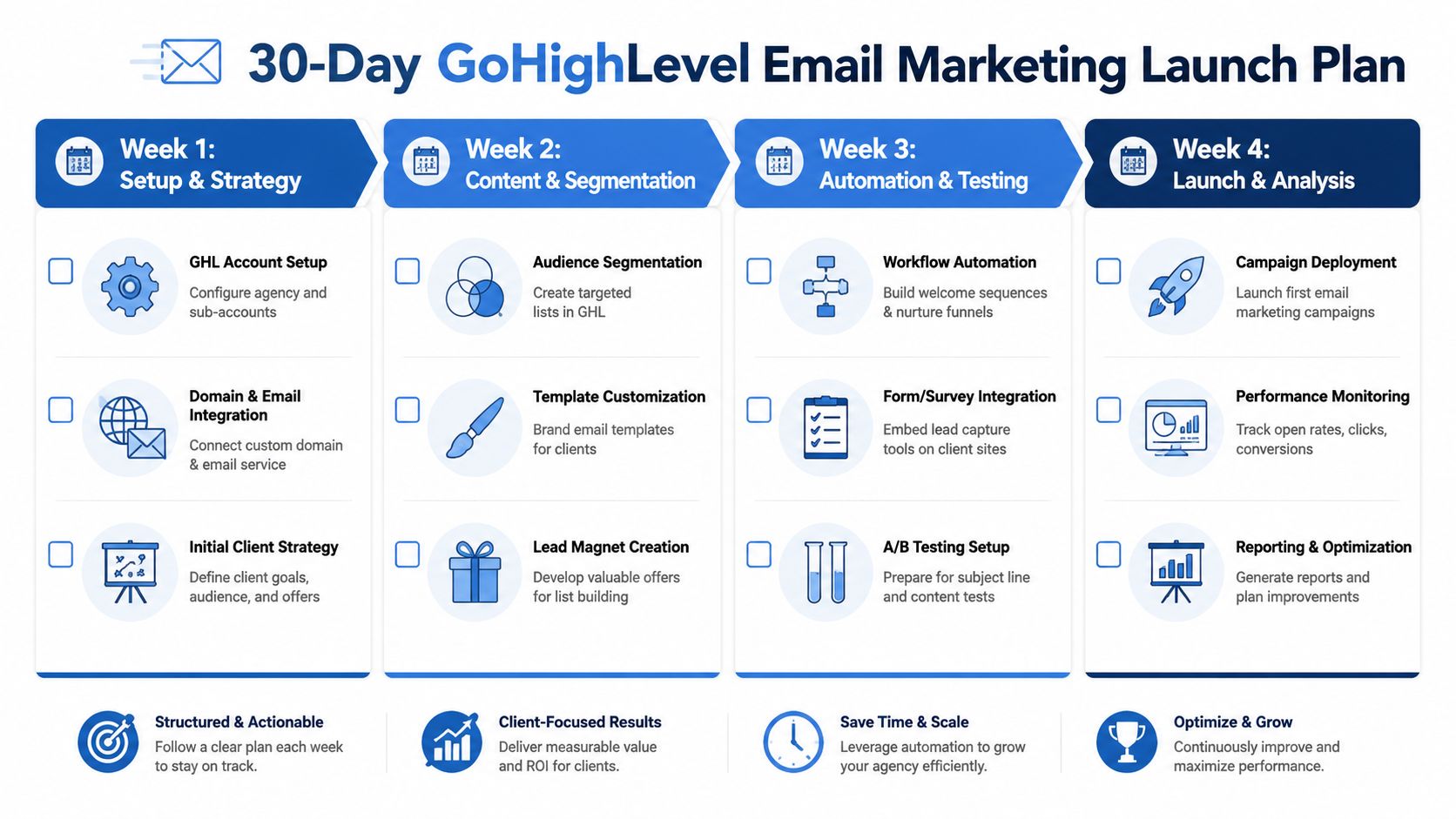
A first client launch goes smoother when the work is staged. Week one should be about setup and strategy, week two about list capture and segmentation, week three about automation and testing, and week four about launch and reporting. That sequence keeps the agency from building emails before it knows who they're for.
Week 1 setup and strategy
Set up the agency workspace, create the client sub-account, and define the primary goal of the email program. Decide whether the first campaign is meant to drive bookings, purchases, replies, or reactivation, because the rest of the build depends on that choice.
Connect the client's domain and email service, then document the audience segments the client cares about most. If the offer isn't clear, the emails will feel generic before they even go out.
Week 2 content and segmentation
Build the lead magnet or signup offer, then create the opt-in form or landing page that matches it. Once contacts start coming in, map the fields, tags, and segments you'll use for follow-up.
If the client is also trying to capture missed calls, a reduce agency missed call revenue loss workflow can sit beside email as a parallel recovery path. That's especially useful when the same lead might convert through either channel.
Week 3 automation and testing
Write the welcome sequence, the nurture sequence, and any promotional emails you know the client will need soon. Then test the workflow from end to end, including the triggers, tags, and inbox visibility.
A small test list is better than a confident launch with broken logic. One missed step in the workflow can make the whole system look unreliable to the client.
Week 4 launch and analysis
Launch the campaign, watch the early responses, and document what got clicks, replies, or bookings. Build the first client report around actions that matter, then use those results to decide what gets improved next.
The point of this plan is repeatability. Once the agency has one working email system in GoHighLevel, the next client doesn't need a custom invention, just a cleaner version of a proven process.
If you're ready to stop piecing together email tools and start offering a service you can scale, build your next client workflow in HighLevel and launch it this week. Start with one account, one list, and one automation, then turn that system into the template you use for every new client you bring on.
