


You're probably staring at a half-finished Google Doc right now, trying to turn “we do marketing” into something a buyer will sign. The problem usually isn't the design, it's that the proposal has no spine. It reads like a brochure when the prospect needs a decision document that answers trust, fit, and risk fast.
A strong marketing proposal template has to do more than list services. It has to help a buyer decide whether your team understands the problem, can deliver the outcome, and won't create a mess after the signature. The best templates are built around a commercial structure, with cover page, executive summary, problem statement, scope of work, measurement metrics, estimated timeframes, costs, and terms and conditions (Indeed's proposal structure guide).
Table of Contents
- The Decision Moment Your Template Has to Win
- The Eight Sections Every Proposal Needs in Order
- Pricing Models With Real Dollar Examples
- How to Make Your Template AI-Proof and Defensible
- Build the Template Once Inside HighLevel
- Automate Send Sign Invoice and Onboarding
- Field-Tested Checklist Before You Send
The Decision Moment Your Template Has to Win
A buyer usually does not read a proposal from top to bottom. A senior decision-maker skims the first screen, looks for proof, checks whether the scope matches the pain, and looks for the downside if the work underperforms. If that first pass feels generic, the document gets archived, even when the strategy is sound.
A proposal has to work like a decision tool. It should let someone answer three private questions quickly, Can I trust this team, does this scope solve my issue, and what happens if it misses? Proposal guides across the market keep returning to the same commercial elements, objective, deliverables, timeline, pricing, and proof, because buyers need those pieces to judge fit without reading every line. That is why the structure matters, as noted in Indeed.
Practical rule: write for the buyer who has five minutes and an approval stamp, not the account manager who loves detail.
Different people within the same company read the document for different reasons. The founder usually skips to the case study or proof section to see whether you have solved a similar problem before. The marketing lead reads the scope line by line to check whether the work covers the channels, assets, and handoffs they need. Finance goes straight to the pricing table and payment terms, because that is where budget risk, billing cadence, and approval friction show up.
The rest of the document should be built around that behavior, not around how agencies like to write. If your pipeline is unclear, the proposal usually is too. Close probability changes how you frame the risk section, how hard you push the offer, and how much certainty you can put around the timeline and investment. Tying that back to revenue forecasting with pipeline stages keeps the proposal aligned with how likely the deal is to close, instead of treating every prospect like a sure thing.
The Eight Sections Every Proposal Needs in Order
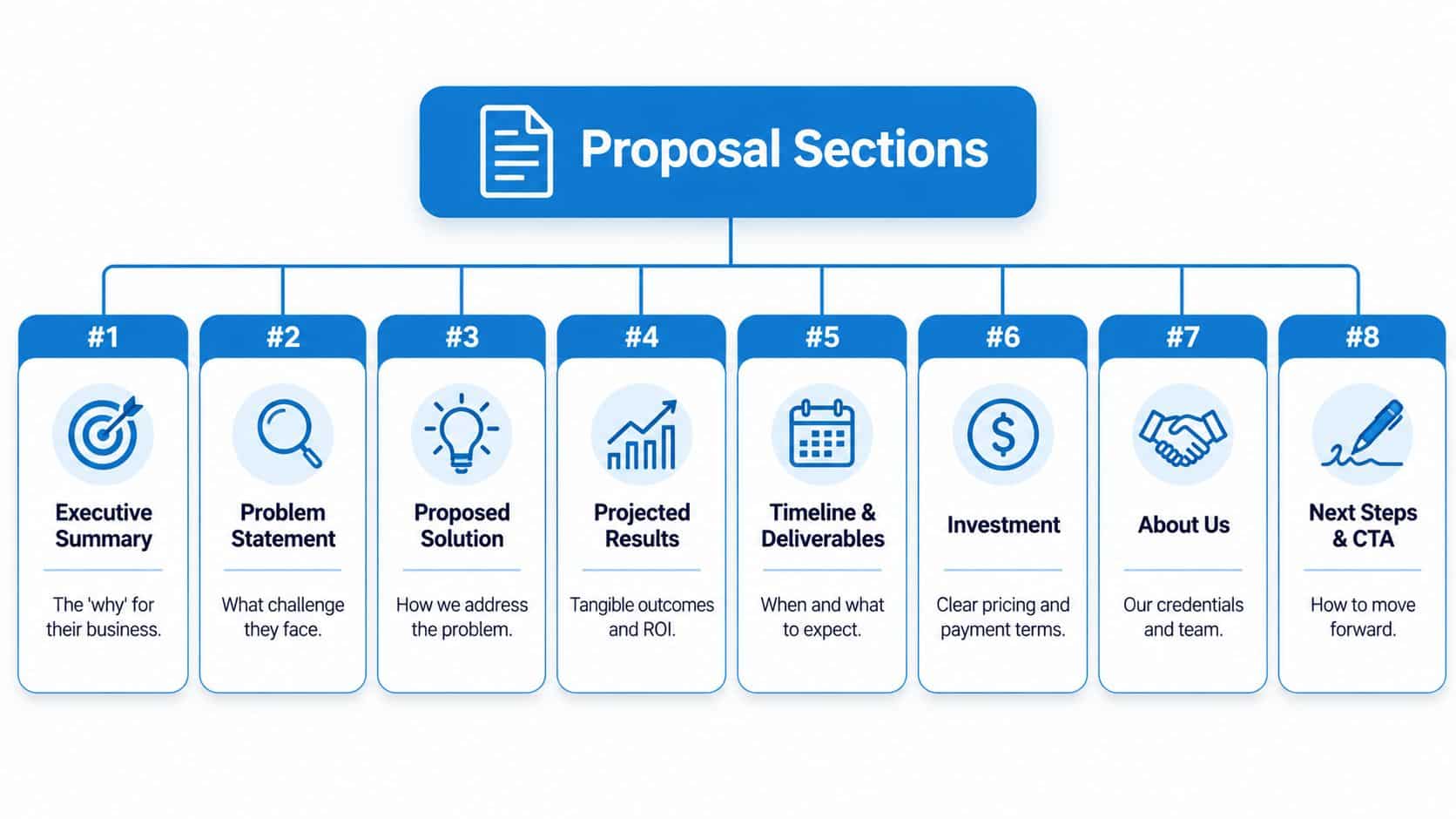
The order matters more than the polish. Senior buyers usually want the answer first, the proof second, and the mechanics last, so the proposal should read like a fast commercial brief, not a long-form case study.
1. Cover page and title framing
Use the client name, your agency name, the proposal date, and a clear project title. A line like “Marketing Growth Proposal for Northstar Dental” beats a clever title every time because it tells the reader they're in the right place.
2. Executive summary
Open with the business outcome in one short block. Example, “We'll fix stalled lead flow by tightening acquisition, improving landing-page conversion, and adding follow-up automation.” That's cleaner than a self-introduction.
3. Problem statement
Tie this to discovery data, not generic pain. If the client said leads are inconsistent or close rates are weak, repeat that in their language and show that you listened.
4. Proposed approach
Describe the strategy in plain terms. Keep it outcome-led, and connect each channel to a business goal, which is stronger than saying you'll “do SEO, content, and ads.”
5. Scope of work
List deliverables, not intentions. If you're including audits, landing pages, ads, reporting, or automation, name them directly so nobody can reinterpret the offer later.
6. Timeline and milestones
Break the work into phases with visible checkpoints. Buyers relax when they can see what happens first, what ships next, and when the review points happen.
7. Investment and terms
State pricing clearly, separate setup from ongoing management, and define what's included versus pass-through.
8. Signature block and single CTA
End with one action, sign, approve, or book a kickoff. Don't give three different next steps, because indecision spreads fast.
If you want to tailor messaging for paid acquisition inside the proposal, keep the framing tight and practical, the same way you would for your HighLevel campaigns. The goal is the same, clear offer, clear response, no fluff.
Pricing Models With Real Dollar Examples
Pricing is where strong proposals either protect margin or give it away. A prospect can accept the strategy and still balk if the numbers feel fuzzy, so the structure has to show exactly what is a setup cost, what is recurring, and what is passed through.
| Line Item | Retainer SEO | Project Launch | Hybrid Growth |
|---|---|---|---|
| Strategy / Discovery | $750–$1,500 one-time setup fee | Included in the project fee | $750–$1,500 one-time setup fee |
| Core Delivery | $1,500–$3,000 monthly management fee | $4,000–$12,000 fixed project fee | $2,000–$5,000 monthly retainer |
| Reporting / Reviews | Monthly reporting included | Milestone review included | Monthly reporting included |
| Tools / Pass-through | Billed separately | Billed separately | Billed separately |
| Total Structure | Monthly recurring | Fixed price | Retainer plus variable component |
For a retainer SEO engagement, keep the setup fee separate from the monthly fee. That protects margin when onboarding takes longer than expected and makes it clear that initial strategy is different from ongoing optimization. Buyers also understand why the first month costs more without asking you to justify every line item.
For a project launch, bundle only the work that belongs together. A site launch, campaign build, or repositioning project should have one clear fee, one kickoff payment, and one final payment tied to delivery, not to the calendar. I've seen date-based billing go sideways when a client delayed approvals for two weeks, then expected the final invoice to wait with the delay instead of the completed milestone.
For a hybrid growth deal, split the recurring base from the performance or variable component. That keeps the client from assuming everything is fixed while leaving room for expansion once early results justify more work. A common margin leak shows up when a $4,000 project includes three revision rounds on a landing page and ad set, then turns into six weeks of unpaid edits because nobody defined what counts as a new request.
Tie payment to milestones when you can. Dates are convenient, milestones are safer because they follow completed work, not assumptions. I've watched date-based billing create arguments when the client's internal review slipped, the work was done, and the invoice still had to wait for a calendar date that no longer matched reality.
If billing has ever turned into cleanup work, the problem is usually the structure. A quick review of consulting pitfalls to dodge helps you spot where bundled pricing turns into unpaid work without being noticed.
How to Make Your Template AI-Proof and Defensible
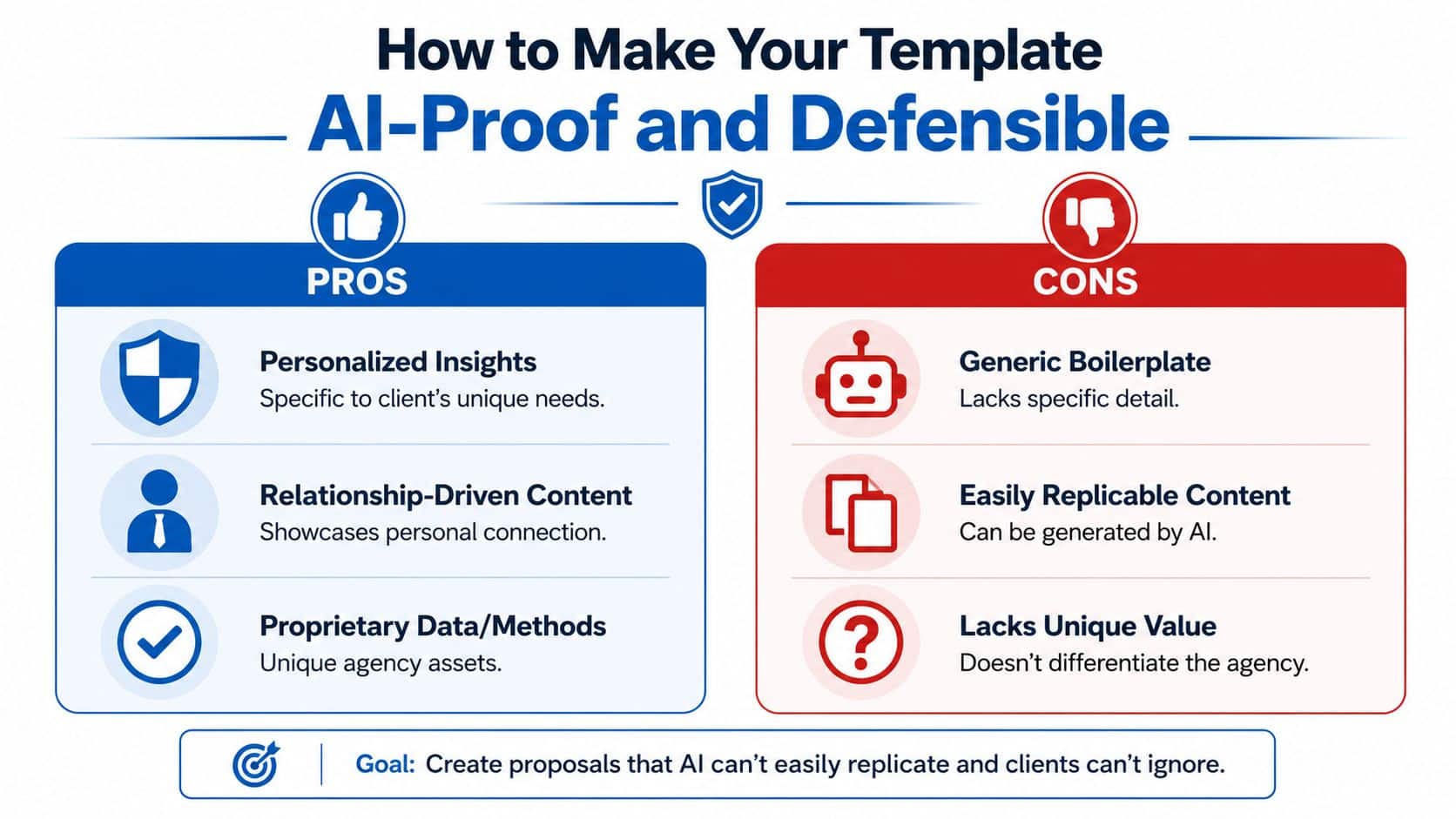
A generic proposal can be generated in minutes now, which means the document itself isn't the differentiator anymore. The differentiator is the proof inside it, and the parts that can't be copied without real work.
What makes a proposal defensible
Original discovery notes matter because they show the proposal was built around this client, not a template library. Named case studies help too, but only if they connect to the problem the prospect cares about. If your scope includes a content process, an audit trail of how the deliverables were defined is stronger than broad language like “ongoing support.”
The market has already moved toward AI in day-to-day marketing work. McKinsey reported in 2024 that 65% of organizations were regularly using generative AI, up sharply from the year before, and Adobe's 2024 survey found nearly two-thirds of small business owners were already using AI tools for marketing-related tasks (Bidsketch on AI and marketing proposals). That makes trust signals even more important, because a buyer can sense when a proposal was assembled from the same sections everyone else uses.
What weakens trust
Generic boilerplate is the fastest way to look replaceable. So is a proposal that never explains where the data came from, who owns the deliverables, or how the work will be measured. If the buyer can paste your sections into another agency's draft without changing anything meaningful, your template is too thin.
For teams that want a cleaner editing workflow, an on-brand AI humanizer workflow can help rough copy sound less machine-generated before it goes to a client. That only helps if the underlying offer is already specific, though, because polishing generic text still leaves you with generic text.
If you're choosing where to sharpen the proposal, start with the sections that create belief, not the sections that decorate the page. A useful comparison is whether your proposal proves value, or just describes services. For teams building around HighLevel's AI content tool picks, the lesson is the same, use AI to speed up drafting, not to replace the client-specific thinking that closes the deal.
Build the Template Once Inside HighLevel
The cleanest setup is to build the proposal where the rest of the sales motion already lives. A document in a folder is static. A proposal inside your operating system can pull client data, reuse approved language, and trigger the next step without manual copying.
Start with the template shell
Inside HighLevel, create a proposal template and map the eight sections in the same order senior buyers skim them. Use the cover page for the client name and offer title, then place the executive summary and problem statement near the top so the reader sees the commercial logic immediately.
Use merged fields and conditional blocks
Pull in client-specific details through custom fields, then keep sections conditional when they're not relevant. If one client needs ad management and another needs landing pages plus email, don't show both as if they're part of every offer. That's how you keep the document tight and avoid forcing buyers to read through unrelated work.
Separate structure from pricing logic
Use one-time line items for setup work and recurring line items for ongoing management. Then connect the pricing to the actual proposal type, so a strategy-heavy project doesn't inherit a retainer structure by accident. That's where a lot of agencies create friction for themselves, because the words and the billing model don't match.
Keep the proposal reusable
Save the framework once, then reuse it across services with different blocks turned on or off. An agency software consolidation guide becomes useful, because the goal isn't just to write proposals faster, it's to reduce the number of disconnected tools you need to babysit.
Click path that keeps the build sane
- Create the proposal template.
- Add the fixed sections first.
- Insert product or service line items.
- Map custom fields for client data.
- Set conditional visibility for optional services.
- Test the preview with a real client record.
Once the template is built correctly, the same structure can support repeatable selling instead of one-off document assembly.
Automate Send Sign Invoice and Onboarding
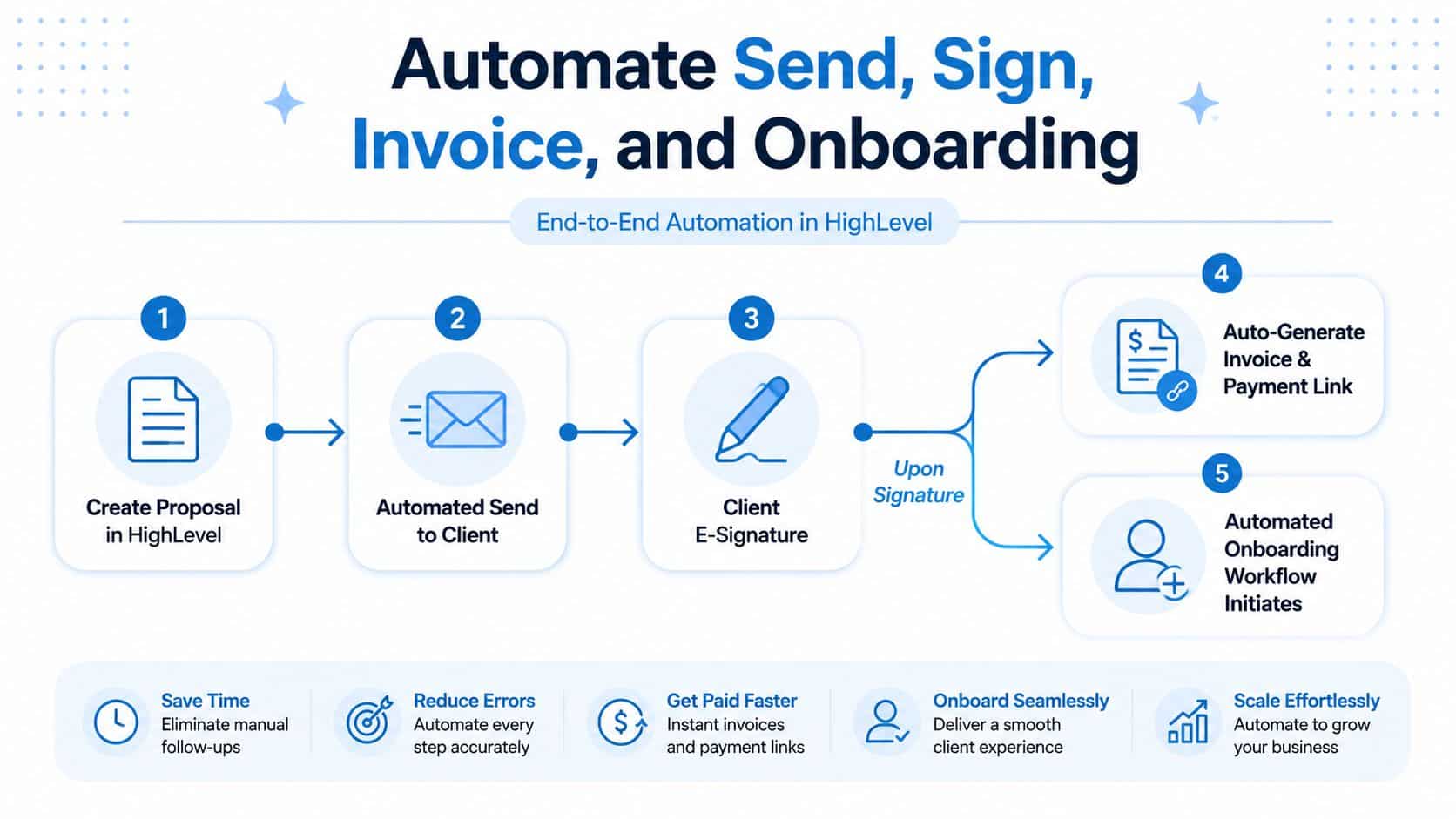
A proposal only pays off when it pushes the deal forward without manual chasing. If a prospect has to wait for you to send the document, resend it, copy the signature into another system, and then ask for payment, the process is already leaking momentum.
Wire the proposal to the pipeline
Trigger the proposal from the right pipeline stage, usually after discovery or after scope approval. That keeps the proposal tied to a real buying moment instead of floating in inbox limbo. Once the prospect opens it, the follow-up can be automated if they stall.
Connect acceptance to the next two actions
When the client signs, auto-generate the first invoice and launch onboarding at the same time. That way, the signed agreement becomes the start of operations, not the end of admin. If you need a practical refresher on billing structure, how to invoice clients is a useful companion reference before you finalize the flow.
Use a short follow-up sequence
If the prospect doesn't sign, send a reminder that references the outcome, not the paperwork. Branded sign-off emails work better when they sound like the same team that wrote the proposal, not a generic notification engine.
The handoff from signature to invoice is where good agencies save the most time. If that handoff is manual, every closed deal still feels like a small project.
HighLevel can sit at the center of that process because it supports proposals, estimates, workflows, invoices, payments, and the rest of the operating stack in one place. That's also why teams compare it against fragmented setups, since the value is less about one feature and more about keeping the entire sequence connected.
Field-Tested Checklist Before You Send
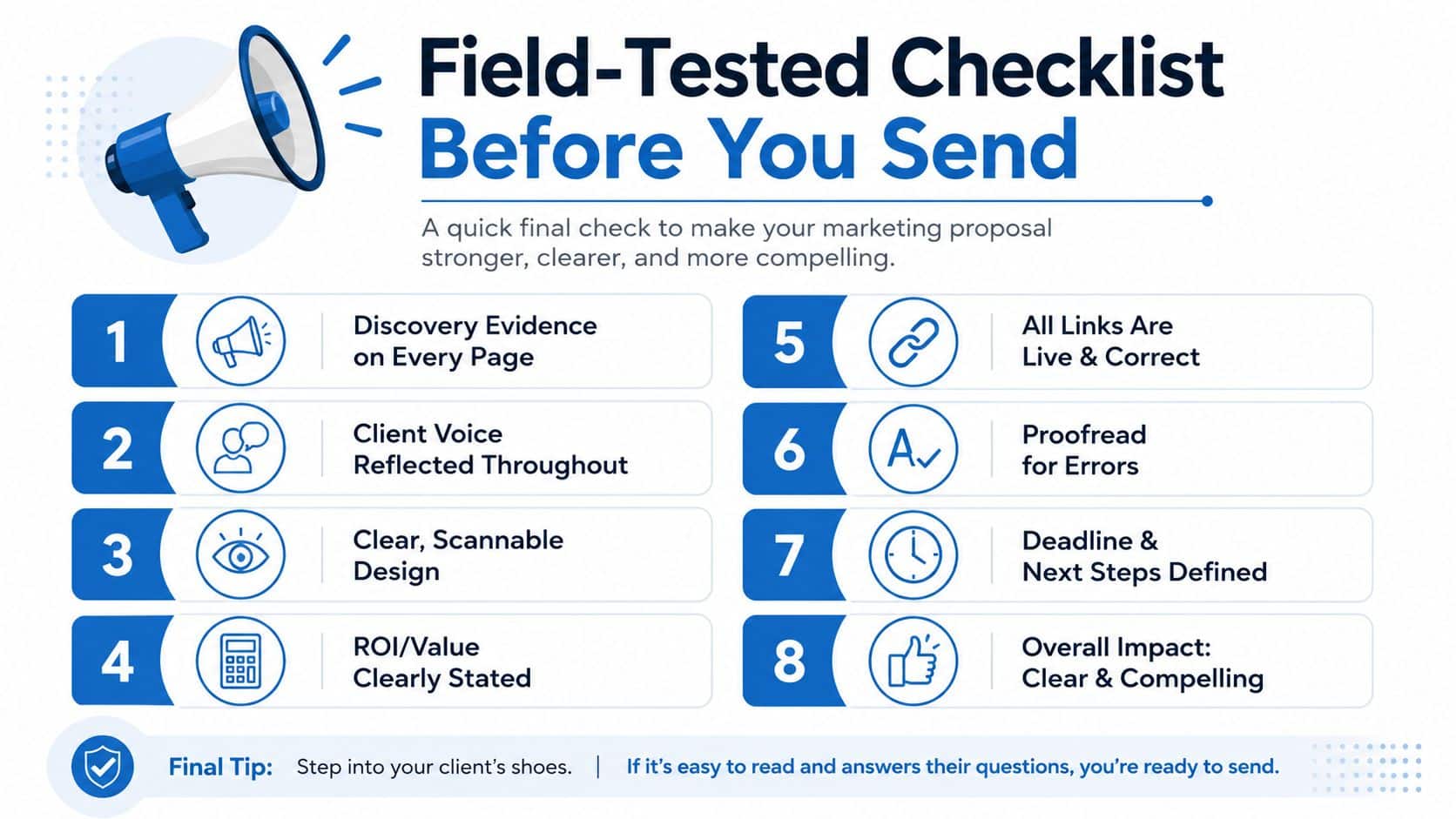
Before you send any proposal, run this checklist once. It catches the mistakes that cost deals when the buyer is already close to yes.
- Discovery evidence appears on every page: the reader can tell this offer was built from their situation, not a copied template.
- Client voice is reflected throughout: the language matches the problem they described.
- Design is easy to scan: the most important points show up fast.
- Value is stated clearly: the buyer can see why the investment makes sense.
- All links work: broken links make the proposal feel unfinished.
- Copy has been proofread: spelling and formatting errors weaken confidence.
- Deadline and next steps are obvious: there's no guessing about what happens after review.
- Automation is wired correctly: signature, invoice, and onboarding all fire the way they should.
If your answer is no to more than one of these, fix the template before you send it. A proposal that looks polished but doesn't move into the next workflow is just a prettier delay.
If you want the proposal process to stop living in documents and start living in your sales system, build it in HighLevel and connect the template to sending, signing, invoicing, and onboarding. That's the difference between a file your team forgets and a process that keeps deals moving while you focus on delivery.
