


You're staring at a sale calendar, a flat revenue chart, and a pile of inventory that isn't moving. The pressure is obvious, clear stock, make a spike, protect margin, and don't create a mess you'll still be dealing with next month. That's where flash sale meaning starts, not as a generic discount, but as a tightly timed demand event built to force a fast buying decision.
Table of Contents
- What a Flash Sale Actually Means in Plain Language
- The Anatomy of a Flash Sale
- Flash Sales vs Everyday Promotions and Daily Deals
- Three Flash Sale Formats Worth Studying
- Which KPIs Matter
- Common Flash Sale Mistakes That Quietly Kill Profit
- Your Flash Sale Checklist and How to Run It
What a Flash Sale Actually Means in Plain Language
A flash sale is a short, time-limited promotion, usually lasting a few hours and sometimes extending up to 72 hours, with many guides placing the common window at 2 to 36 hours or 24 to 48 hours to keep urgency high (flash sale statistics). The part people miss is that the discount itself is not the whole point. The short window, plus limited availability, is what turns a normal markdown into a flash sale.
Think of a small skincare brand with 4,000 jars of last season's moisturizer sitting in storage and a revenue report that's gone flat. A standard promotion might sit there for a week and train shoppers to browse slowly. A flash sale says, “Buy now, while this offer and this stock are still here.” That's the load-bearing idea.
Practical rule: if the sale doesn't create urgency, it's probably not a flash sale, it's just a discount with a deadline.
Operationally, flash sales are used to convert quickly, clear inventory, or create a concentrated revenue spike (flash sale performance report). Some retail guides also note discount depths of 30% to 70% off MSRP, with especially aggressive campaigns sometimes hitting 50% to 70% (flash sale statistics). That range helps explain why the tactic works, but it also hints at the risk. The deeper the cut, the more pressure you put on margin.
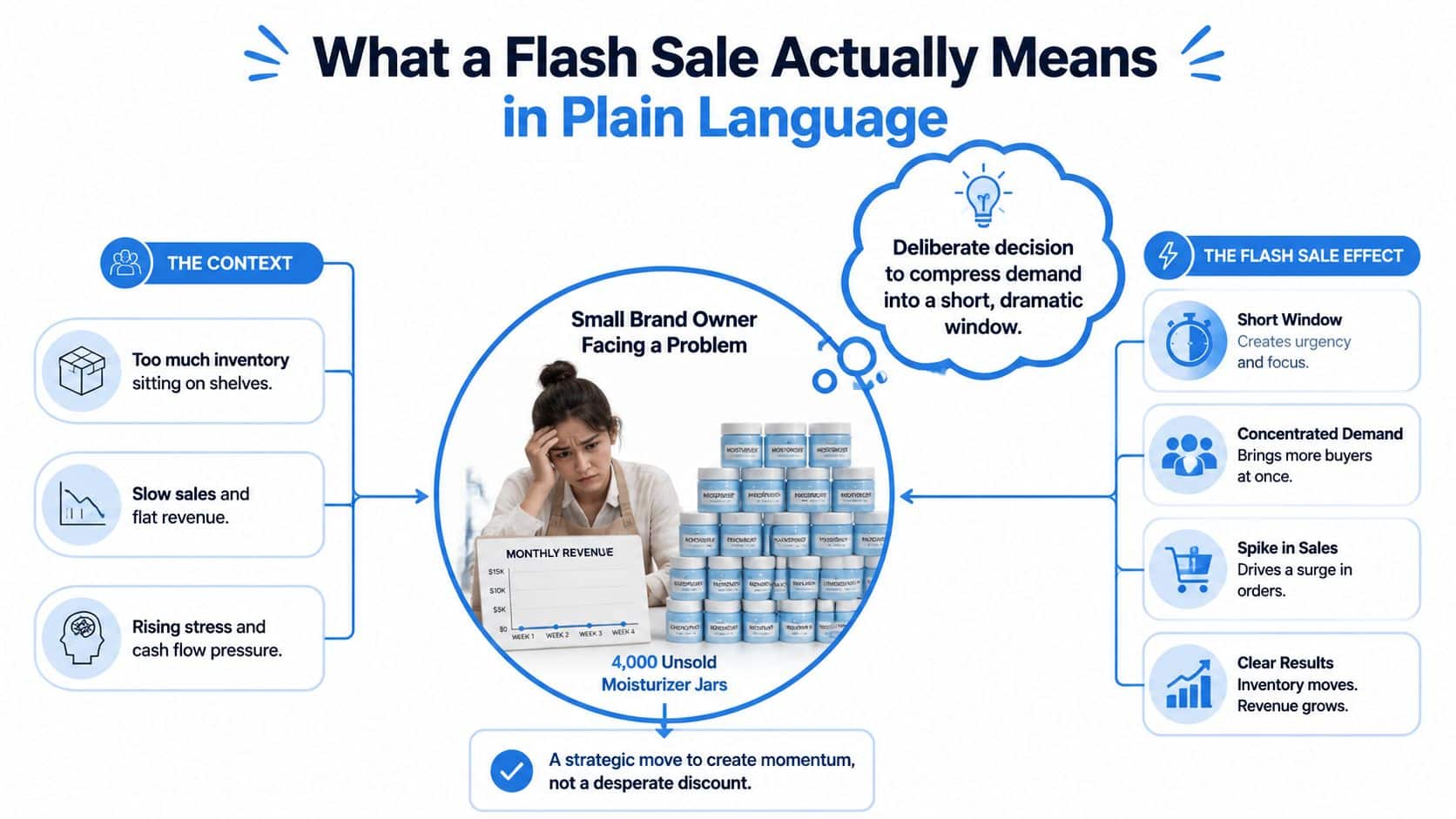
A good working definition for a teammate is simple. A flash sale is a compressed promotion that combines time pressure and scarcity so shoppers act now instead of later. That's why academic and industry definitions keep linking it to impulse buying and immediate purchase behavior. The shorter the window, the more the event behaves like a conversion trigger instead of a routine promotion.
The Anatomy of a Flash Sale
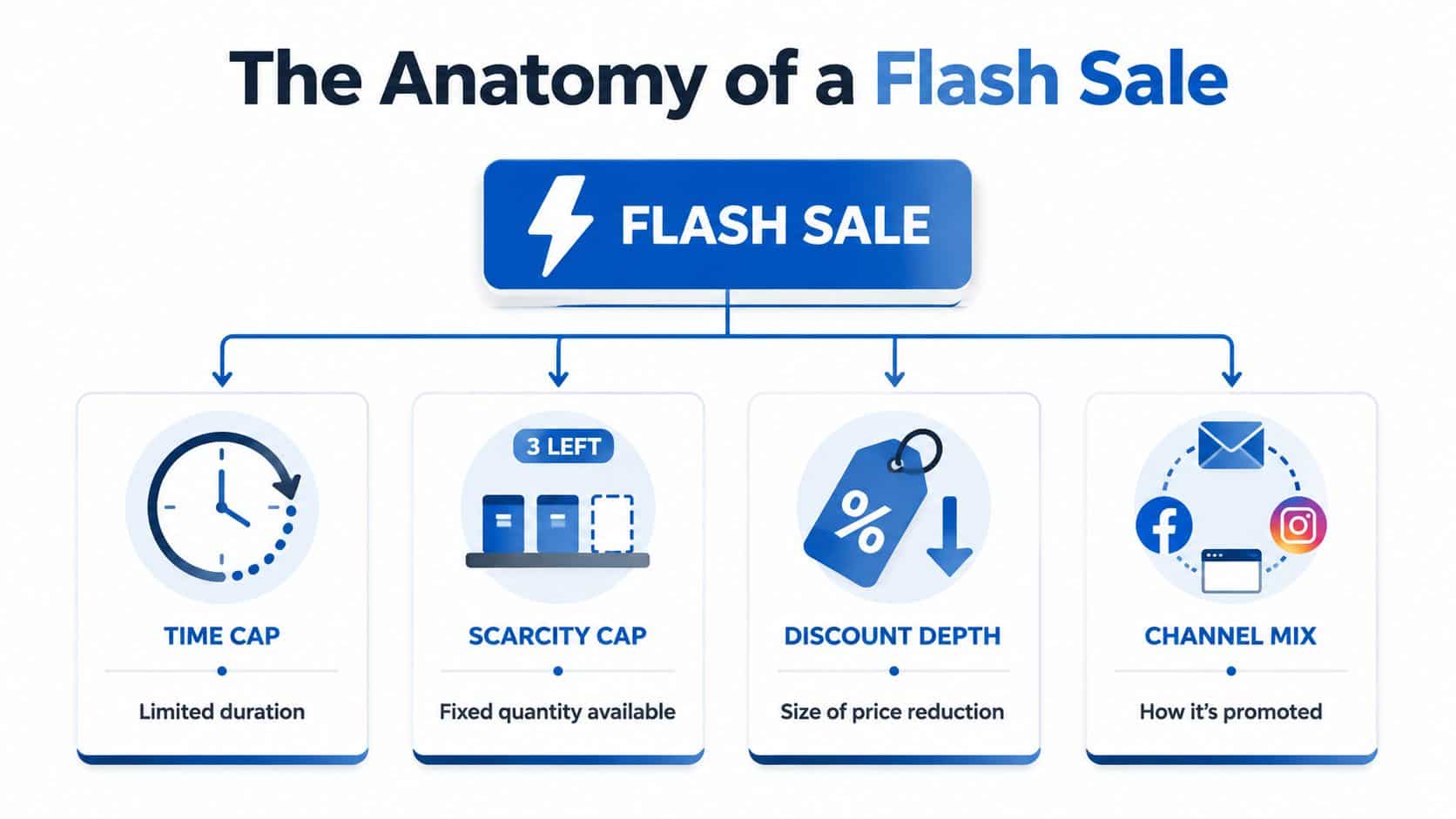
A flash sale has four moving parts, and each one carries a different job. The time cap forces a decision. The scarcity cap makes the offer feel limited. The discount depth gives shoppers a reason to act. The channel mix decides whether the right people hear about it early enough.
Remove one of those pieces and the event starts to act like something else. A discount without a time cap is just a promotion. A deadline without scarcity can feel artificial. A sale with weak distribution can be well designed and still miss the mark because too few qualified buyers see it.
Time cap and scarcity cap
The time cap is the clock. It can be a few hours, a one-day event, or a tight 48-hour window, but the buyer has to know the offer will disappear soon (flash sale glossary). The scarcity cap is the inventory limit, which is why flash sales often focus on selected products instead of the whole catalog. Put together, they ask the shopper to choose between acting now and losing the chance later.
A coffee shop running a 90-minute two-for-one on a slow Tuesday works on the same logic. The offer is easy to understand, the clock is visible, and customers know hesitation has a cost. Online, that setup usually becomes a homepage banner, a countdown timer, and limited stock messaging. Coordinated text follow-up helps during the rush, and text marketing for agencies can keep the offer in front of people while the window is still open.
Discount depth and channel mix
The discount depth is the pull. It needs to be large enough to matter, but not so large that it breaks the margin. That hidden margin pressure is one of the costs newer marketers miss, especially when the event is built to win attention fast and the post-sale math gets left for later.
The channel mix is the distribution layer, email, social, on-site banners, SMS, and other timed messages that put the event in front of the right audience. A flash sale does not usually succeed because people stumble onto it. It works because the message is pushed out quickly and repeated while the clock is still running.
That also creates a retention cost that is easy to overlook. If shoppers learn to wait for the next urgent discount, they may skip full-price purchases and train themselves to buy only during the sale window. The event can lift short-term revenue while changing long-term behavior.
A flash sale is an engineered event. The offer matters, but the pacing and distribution decide whether it behaves like a real conversion spike.
Flash Sales vs Everyday Promotions and Daily Deals
Marketers blur these tactics together because all three involve discounts. The difference is in the operating logic. A flash sale is designed for a sudden spike. A clearance sale is designed for slow inventory reduction. A daily deal sits somewhere in the middle, with a repeatable structure and predictable expectations.
The fastest way to tell them apart is to ask four questions. How long does it run. How much urgency does it create. How much inventory risk does it carry. What does the customer expect next week. If you can answer those cleanly, the tactic is easier to choose, and easier to price correctly.
| Dimension | Flash Sale | Clearance Sale | Daily Deal |
|---|---|---|---|
| Duration | Very short, often a few hours to a couple of days | Longer, usually stretched over time | Repeated on a set cadence |
| Urgency | High, driven by countdown and limited stock | Lower, more patient shopping behavior | Moderate, predictable urgency |
| Discount depth | Often deeper to trigger immediate action | Can vary, often shaped by inventory clearance needs | Usually structured for consistency |
| Inventory risk | Higher because demand is compressed | Lower because sell-through is slower | Moderate, depending on cadence |
| Post-event expectation | Customers may expect the offer to disappear quickly | Customers expect ongoing markdowns | Customers may wait for the next scheduled drop |
A flash sale is the right tool when you want a concentrated revenue event or a rapid conversion burst. It works best when stock is finite and the brand can absorb the operational strain. Clearance is better when the goal is to drain excess inventory without the same level of urgency. Daily deals work when you want predictable traffic and a repeatable promotional habit.
That distinction matters because each tactic shapes customer behavior differently. If a brand runs flash sales too often, shoppers start waiting for the next one. If it runs clearance like a flash sale, it may miss the chance to move stock efficiently. If it uses daily-deal mechanics for a one-off launch, it can blunt urgency before the event even starts.
Three Flash Sale Formats Worth Studying
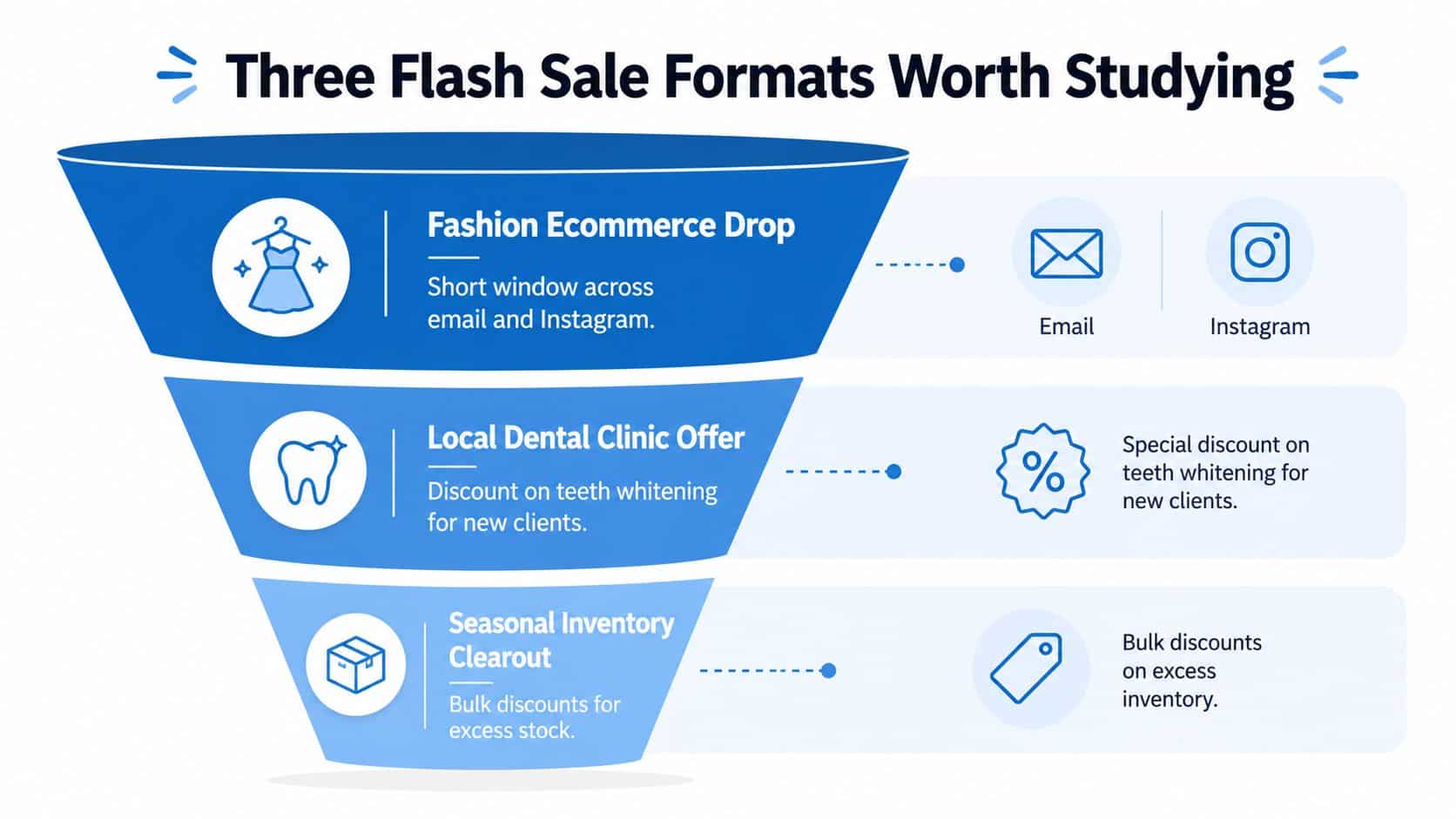
A flash sale can look simple from the outside. A short offer goes live, attention rises fast, and orders come in. The differences show up in the operational details, because a fashion brand, a local service business, and an agency are not selling the same kind of inventory. One sells products that can run out by size or color, one sells appointment slots, and one sells time and expertise. That is why the format has to fit the business model, not the other way around.
Fashion ecommerce drop
A fashion brand can announce a short window through email and Instagram, then focus on a limited set of products instead of opening the full catalog. The point is not to discount everything on the site. The point is to concentrate demand around styles that already have interest, while making the offer feel time-bound and selective. A message built with proven ad copy frameworks helps here, because the copy has to carry product appeal, timing, and limited availability without drifting into vague hype.
The follow-up sequence matters just as much as the launch. Buyers who came for one item often respond to cross-sells, restock alerts, or a next-step offer that protects margin better than the original discount did. If the sale only produces same-day revenue, it may still miss the bigger test. The better outcome is a new customer who can be monetized again later without needing another heavy discount.
Local service offer
A dental clinic can use a flash-sale-style offer to fill same-week appointment slots, such as a limited discount on a cosmetic service for new patients. Here the inventory is not physical stock, it is time on the calendar, and once a slot passes, it cannot be resold. The success metric is booked appointments that show up, because an empty chair is lost revenue.
This kind of campaign works best when the post-sale sequence starts right away. Confirmation messages, reminders, and intake follow-up reduce no-shows and protect the economics of the offer. The deeper question for a service business is whether the discounted entry point leads to future treatments or just a one-time booking from a price-sensitive customer.
Reactivation offer
An agency or B2B service provider can run a 24-hour reactivation offer for cold leads or past prospects. The message stays narrow, the time window stays short, and the next step stays easy to understand. That structure works when the audience already knows the brand and only needs a clear reason to re-engage.
A practical version of this model is to sell a prepaid package, audit, or strategy session instead of a fully custom engagement. The sale can then serve as a first paid step into a larger relationship. If the follow-up is weak, it turns into a one-time discount that is easy to forget. For teams shaping this kind of offer, prepaid service cards for agencies are a useful model to study.
Which KPIs Matter
A flash sale can look healthy in the dashboard and still be a weak trade. That happens when the top line rises, but margin gets compressed, returns creep up, or the customer you paid to acquire never buys again. For a newer marketer, the key is to stop reading revenue as the whole story and start reading it as one layer in a wider scorecard.
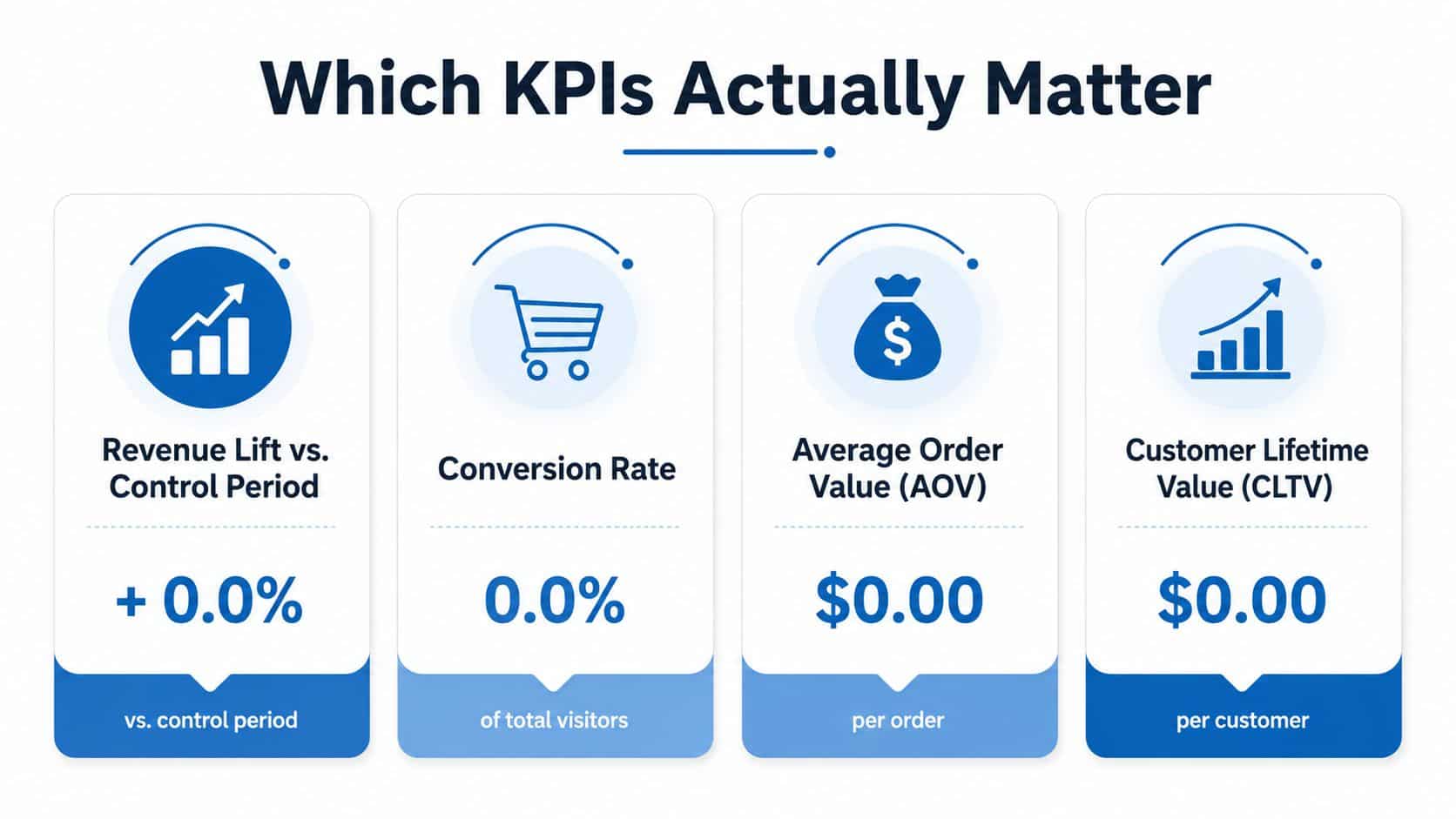
Begin with revenue lift versus a matched control period. Benchmark-style reports say flash sale windows can lift revenue sharply compared with normal days, and that very short events often show strong conversion gains (flash sale performance report). Another guide says transaction rates can rise during the sale window, and that some shoppers buy items they did not plan to buy (ShipBob flash sale guide). Those findings explain why teams run the tactic, but they do not prove the event was profitable.
The metrics stack
A useful scorecard reads like a balance sheet for the campaign. Revenue lift shows the spike. Conversion rate shows whether the offer and landing page did their job. Average order value shows whether customers added enough to offset the discount. Gross margin per order shows whether the sale still made financial sense after markdowns and fulfillment. Return rate and customer acquisition cost show whether the event created durable value or just a short burst of expensive traffic. Then check 30-day, 60-day, and 90-day repeat purchase rate to see whether the sale brought in buyers who came back.
A simple example helps. If revenue rises but margin per order falls hard, the event may have moved product while destroying the economics behind it. If conversion improves but repeat purchase stays flat, the sale may have harvested demand from buyers who were already ready to purchase, rather than adding new loyal customers.
Practical rule: if you only track revenue, you can mistake a busy day for a profitable one.
For a broader measurement framework, mastering commerce analytics 2026 is a useful companion read because it connects campaign metrics with downstream customer value, not just launch-day performance. That matters here because flash sale math breaks when you ignore what happens after checkout.
The hidden cost centers
Two cost centers usually distort the result. First is margin erosion. Second is customer behavior. If shoppers learn to wait for discounts, full-price willingness can fall over time. If fulfillment gets overloaded, returns and service issues can erase the short-term gain. The sale may still “work” on revenue, while weakening the next campaign.
The point is to treat the event like a financial decision, not only a marketing one. That is where understanding conversion rate optimization helps, because the same checkout friction that hurts normal campaigns can become more expensive during a flash sale when urgency is high and patience is low. For teams that want a compact KPI view, the most useful executive summary usually has three lines, revenue lift, margin after discount, and repeat purchase rate. Everything else supports those three.
Common Flash Sale Mistakes That Quietly Kill Profit
A flash sale can look successful in the first hour and still leave little room for profit. The trap is usually in the planning, not the launch. Teams set the discount too fast, skip the margin check, and assume the extra volume will cover the gaps. The dashboard may show movement, while the result is a thinner sale than expected.
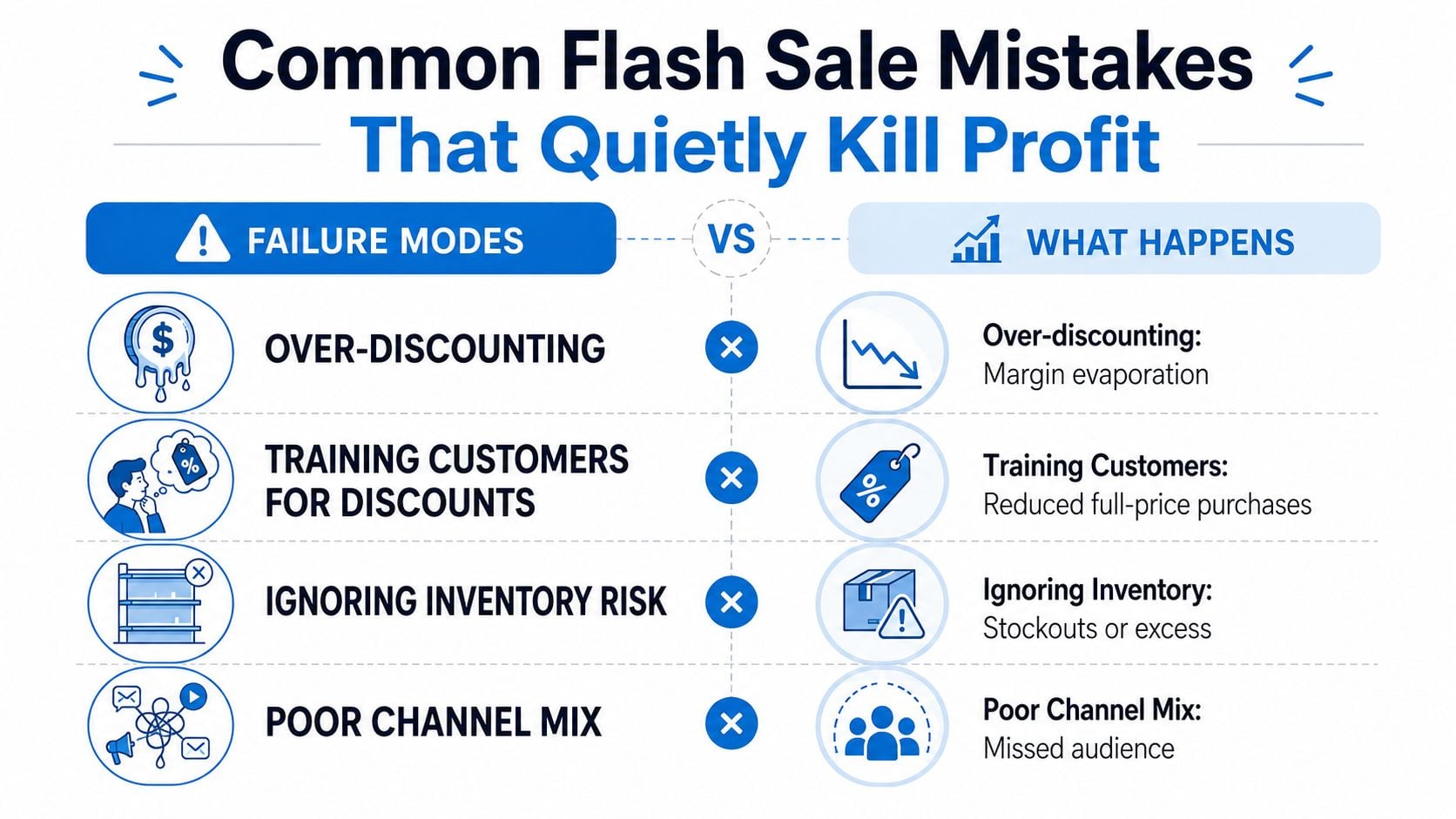
Four failure modes
-
Over-discounting. A steep cut can clear inventory, but it can also remove the margin that made the promotion worth running. Once the price drops too far, the event starts to behave like a clearance move instead of a conversion test with a clear business case.
-
Training customers for discounts. If every campaign arrives with a sale message, buyers start waiting for the next one. That weakens full-price demand over time and makes future promotions harder to price correctly.
-
Ignoring inventory risk. Flash sales pull demand into a short window, so stockouts and checkout slowdowns become more likely. If shoppers see an empty cart or a stalled checkout, the event hurts trust as well as revenue. The same logic applies to prepaid service cards for agencies, where limited availability and timing shape whether the offer feels compelling or frustrating.
-
Poor channel mix. A strong offer still fails if the right audience never sees it in time. Email, social, site banners, and SMS need to work together, or the sale loses the urgency that makes the format effective.
Each mistake starts before launch. The discount level, stock depth, audience timing, and channel plan all need to be set in advance. Senior ecommerce teams usually treat the event like a controlled test with guardrails, because the math has to survive both the sale window and the weeks after it.
Rule of thumb: if the sale cannot pay back its acquisition cost within 14 days through repeat orders or upsells, the offer design probably needs another look.
If you are turning leads into an offer and need a cleaner front end, optimize landing pages for agencies helps you examine friction before traffic arrives. The same logic applies whether you sell products, services, or packages, because the checkout path is part of the economics.
Your Flash Sale Checklist and How to Run It
A flash sale works better when you treat it like a three-part checkup. Planning comes first. Launch execution comes next. Post-sale follow-up closes the loop. If one part is weak, the event becomes harder to judge and harder to repeat.
Before launch
Fourteen days out, lock the offer, audience, and inventory assumptions. Decide what goes on sale, what stays protected, and how you will frame urgency without sounding pushy. Test the landing page, countdown timer, and checkout path before the first traffic wave arrives, because a broken page can turn a strong offer into a weak one. If you want a cleaner front end before traffic hits, optimize landing pages for agencies is a useful reminder that clarity matters more than clever copy when the window is short.
Set up the follow-up sequence before the first email goes out. A flash sale is not only about the transaction itself. It also shapes what happens after the purchase, including whether buyers come back or disappear after the discount.
On launch day
Send the announcement, monitor traffic, and watch for friction as it appears. If support volume rises, use fast-response channels so buyers do not stall mid-purchase. Some teams handle that inside a single workspace with HighLevel, which can centralize landing pages, email and SMS broadcasts, missed-call text-back, and automated follow-up in one place.
The math can fail here. A sale that looks strong on revenue can still miss its real target if service tickets pile up, checkout slows down, or the audience needed a second reminder before buying.
After the sale
Seven days later, review what sold, what bounced, and what came back. Check whether the sale led to repeat engagement, upsells, or review requests.
A clean post-sale workflow matters because a flash sale is only half-finished at checkout. The other half is retention. If you do not have a follow-up path, you leave the hardest-earned buyers without a next step, and the hidden retention cost shows up later in weaker repeat revenue.
