


You're staring at three nearly identical ad drafts, a blank HighLevel campaign, and a client asking why last month's “clever” copy didn't convert. That's where teams go wrong. They start typing headlines before they've decided the angle, mapped the intent, or chosen the platform-native format that can carry the message.
Copywriting for ads works when the sequence is disciplined. Pick the angle first, match it to buyer intent, then compress it into a format the platform can surface fast. The rest of this playbook is built around that order, because the copy itself is only one part of the decision chain.
Table of Contents
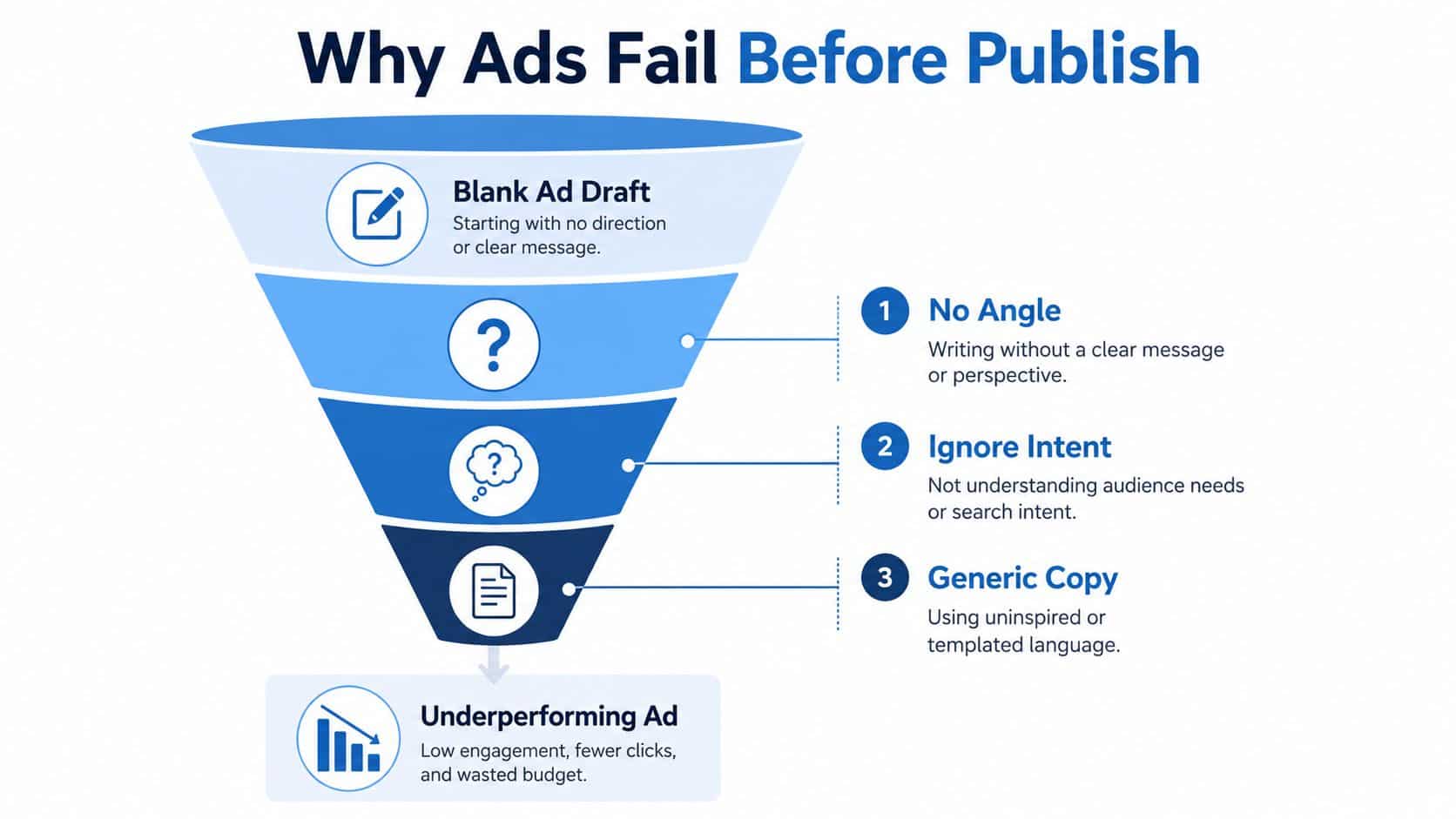
- Why Most Ad Copy Underperforms Before Anyone Hits Publish
- Picking the Angle Before the Headline
- Writing Headlines and Hooks That Survive the First Scroll
- Body Copy Formulas That Match the Angle
- Adapting the Same Offer to Facebook, Instagram, Google, and YouTube
- Calls to Action, Personalization, and Urgency Without the Sleaze
- Putting It All Together Inside HighLevel
Why Most Ad Copy Underperforms Before Anyone Hits Publish
The first mistake happens before the headline exists. Writers open with copy instead of the angle, so the ad starts with wording that sounds fine but misses the buyer's real motivation. A strong offer can still underperform if the message leads with the wrong reason to care, so the first job is making the decision, then writing the draft.
The second mistake is skipping intent. Search traffic, retargeting, and cold social traffic behave differently, even when they land in the same funnel. A transactional query needs a different promise than an informational one, and a prospect comparing vendors needs more proof than someone who just discovered the problem. If you want a clean definition of what what is CRO in marketing means in the conversion layer, that framing helps separate copywriting from broader funnel work.
The third mistake is reading the wrong metric as the verdict. CTR can show that the hook earned attention, but it will not tell you whether the offer fits the page or whether the lead quality is any good. In paid media, I have seen teams celebrate a flashy headline while the downstream pipeline stayed flat. The better read is simple, headline first, then offer, then CTA, and each layer needs the metric that matches it.
Practical rule: if you can't say who the ad is for, what problem it answers, and why this format fits the platform, the draft is not ready yet.
If you want a quick reality check on post-click behavior, the landing page conversion stats resource from Landra is useful for comparing ad expectations with page performance: landing page conversion stats.
A clean workflow keeps the account honest:
- Choose the angle first. Do not start with a headline list.
- Map intent next. Informational, commercial, transactional.
- Match format last. Meta, Google, YouTube, and Instagram all compress differently.
That order catches the quiet failures before spend starts leaking. It also keeps the rest of the workflow honest, because every variant has a job instead of just a line count.
Picking the Angle Before the Headline
A headline is only as good as the angle behind it. If the angle is fuzzy, the copy usually turns into a polished sentence that gets attention for a second and then stalls because it never makes a clear promise.
The angle is the buyer motivation the ad leads with. The mechanism is the thing that delivers the result. Those are different jobs, and mixing them is how campaigns end up with copy that sounds smart but does not change behavior.
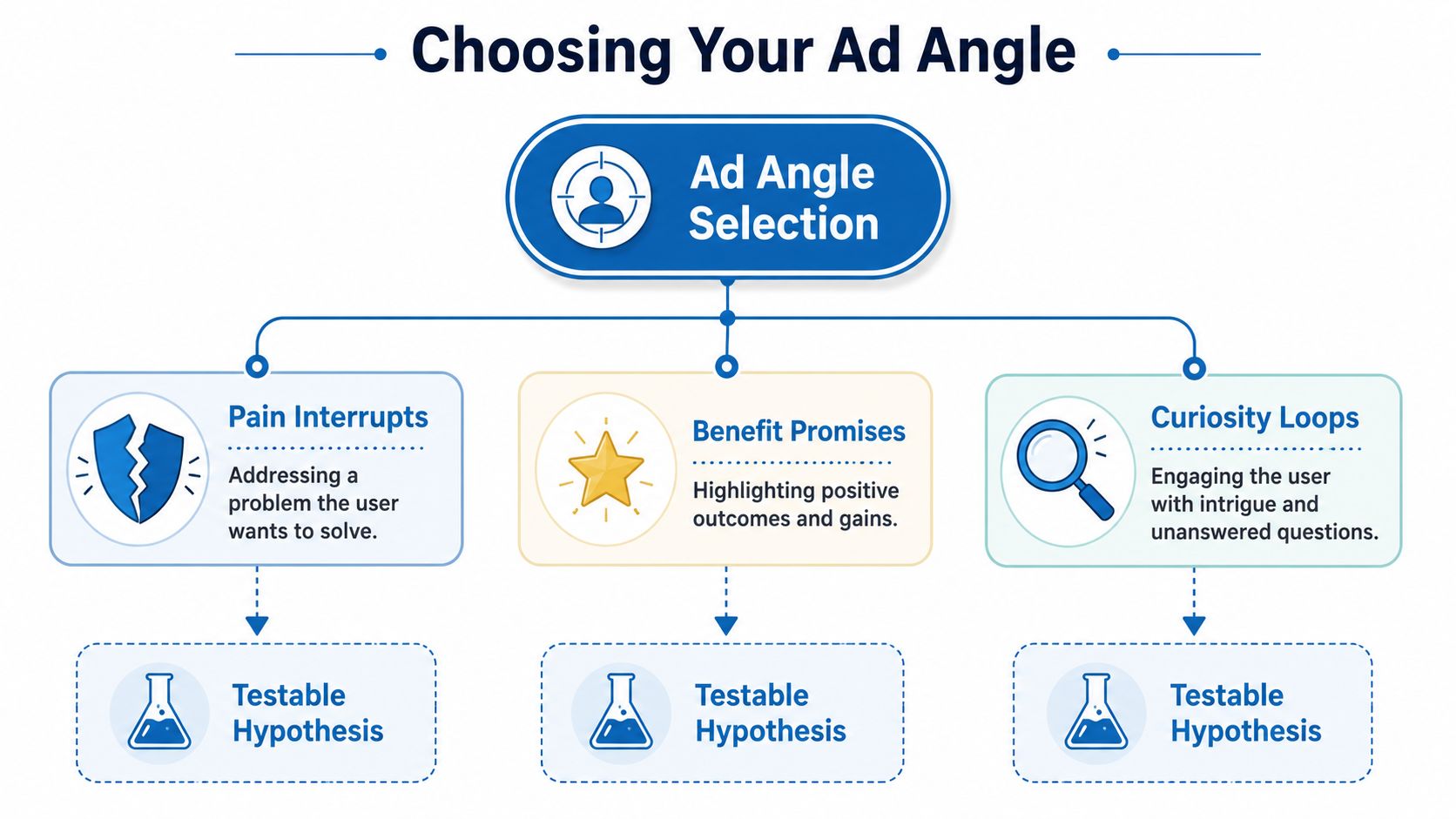
A pain angle says this problem is costing time or money now. A benefit angle says this is the outcome the buyer wants. An enemy angle points at the obstacle blocking progress. Proof uses evidence, time uses urgency, and curiosity opens a loop that the rest of the ad has to close. The offer can stay the same while the angle changes the entire message.
The fastest way to choose an angle is to ask three direct questions. What does the buyer already feel? What result do they want? What objection is most likely to stop them? If the search terms are problem-heavy, lead with pain. If comment threads are full of aspiration, lead with benefit. If competitors are making vague promises, proof usually cuts through faster.
Pick one dominant angle per ad, then build the hypothesis around that choice. If you're testing five headlines from the same angle, you're not really testing angles.
For agencies, the cleanest validation often comes from the work teams already skip. Read search terms, mine comments, and scan competitor ads that have stayed live for a while. If you need a place to cross-check offer framing against HighLevel lead magnet strategies, use the surrounding assets to decide whether the promise should educate, convert, or qualify before you write the first line.
Five angles show up again and again in paid media:
- Pain. Best when the audience is actively frustrated.
- Dream. Best when the audience already wants transformation.
- Enemy. Best when there is a clear bad habit, bad tool, or bad process to contrast against.
- Proof. Best when skepticism is high.
- Time. Best when speed or a deadline matters.
A SaaS offer can become five different ads without changing the product. One version interrupts a pain point, another promises a result, another frames the problem as wasted time. That separation matters because it turns angle selection into a testable decision, not a style preference. If two angles produce different hypotheses, they deserve separate tests.
Writing Headlines and Hooks That Survive the First Scroll
On mobile, the first glance does most of the work. That means the hook has to front-load the sharpest version of the angle before the reader's thumb moves on. Meta ads and Google's tight fields punish filler, so every extra word has to earn space.
The three hook families that hold up best are pain interrupts, benefit promises, and curiosity loops. Pain interrupts call out a problem directly. Benefit promises lead with the result. Curiosity loops create an open question, but they still need a real answer waiting in the body copy. If the hook only teases and never pays off, it turns into cheap clickbait.
The source pattern from the verified data is consistent, shorter copy wins attention, and numerals can improve response in headlines (marketing copywriting statistics). That doesn't mean every headline needs a number. It means specificity helps the reader decide faster. A headline that names the promise, the timeframe, or the outcome is easier to trust than a vague line that sounds creative.
Here's a quick scratch formula that works on almost any ad:
- State the audience.
- Name the problem or payoff.
- Add the mechanism or proof point.
- Compress to the shortest useful version.
- Cut anything that doesn't change the decision.
A useful rule of thumb is to remove helper words first. Adverbs, extra qualifiers, and vague setup phrases usually add friction, not clarity. What stays should read like the ad already knows why the reader stopped.
| Hook pattern | High-impact version | Low-impact version |
|---|---|---|
| Pain | Burned budget on weak leads? | We help you get better leads |
| Benefit | Book more calls without cold follow-up | Improve your sales process |
| Curiosity | The reason your ads look busy but convert badly | Something interesting about ads |
The AI content creation tools angle matters here because teams are now generating hook variants faster than they can judge them. AI content creation tools can help produce first drafts, but the human job is still to compress, cut, and choose the hook that matches the angle, not just the one that sounds polished.
The fastest rewrite path is simple:
- Keep the promise.
- Shorten the setup.
- Swap abstract nouns for concrete outcomes.
- Drop any line that repeats the headline.
That's the difference between a hook that survives the scroll and one that gets screened out before the body copy ever has a chance.
Body Copy Formulas That Match the Angle
Once the angle is set and the hook is pulling attention, the body copy has to carry the claim without drifting into generic persuasion. Templates help only when they support the angle instead of flattening it into something that could run for any offer. The formula should match the buyer's emotional state, not force the buyer into a shape that does not fit.
PAS works when the problem feels immediate and painful. AIDA works when the ad needs a clearer path from attention to action. Before-After-Bridge is useful when the gap between the current state and the desired outcome is easy to see. Before-Because-After adds a reason layer, which helps when the buyer needs a believable explanation before they commit.
| Formula | Best Fit Angle | Typical Length | When It Wins |
|---|---|---|---|
| PAS | Pain | Short to medium | The audience already feels the problem |
| AIDA | Benefit | Medium | You need a fuller persuasion arc |
| Before-After-Bridge | Dream | Medium | The transformation is easy to visualize |
| Before-Because-After | Proof | Medium | The buyer needs a reason to believe |
A simple rewrite approach works well:
- PAS template: Problem. Agitate. Solution.
- AIDA template: Attention. Interest. Desire. Action.
- Before-After-Bridge template: Current state. Desired state. Bridge.
- Before-Because-After template: Before. Because. After.
For example, a generic ad for a bookkeeping service like “Stay organized and save time with our software” can become a pain-led PAS version, “Reconciliations keep slipping, receipts pile up, and tax season gets messy. Use a system that keeps every transaction in one place and cuts the scramble before month-end.” The angle stays intact, the body proves it, and the call to action finally has something specific to stand on.
If the ad and the page do not say the same thing, the click gets expensive fast. That's where teams often need to build a high-converting page rather than sending traffic into a generic homepage.
A quick scoring check helps:
- Angle match. Does every paragraph reinforce the same motivation?
- Proof match. Does the body support the promise without overexplaining?
- CTA match. Does the ending ask for the next logical step?
When body copy drifts, it usually drifts by adding features that nobody asked for. Keep the promise tight, then prove it with the shortest relevant path.
Adapting the Same Offer to Facebook, Instagram, Google, and YouTube
The same offer can look like four different ads once platform constraints enter the room. Meta rewards fast readability and visual stop power. Google rewards relevance and tight intent matching. YouTube rewards a clean opening and a reason to keep watching. Instagram sits somewhere between caption-led context and image-first scanning.
A practical way to think about it is compression. Meta copy needs to land fast, Google copy has to match the query, and YouTube scripts need a hook that earns the next sentence. If you need a shortcut for scripting variations, Screen Charm's tool for teams who want to generate tutorial scripts easily is useful as a drafting aid before human editing.
The same offer, four rewrites:
- Facebook. Lead with the sharpest benefit in the first line, keep the text short, and let the visual do some of the support work.
- Instagram. Treat the caption like a companion to the image, not a standalone essay.
- Google. Keep the wording tightly tied to the search term and the offer.
- YouTube. Open with the core tension, then move to payoff once the viewer has a reason to stay.
A lot of teams waste time forcing one master ad into every placement. That usually produces copy that's too long for search, too flat for social, and too slow for video. The better move is to keep the strategic angle stable while changing the surface form to fit the channel.
Inside HighLevel, that kind of variant testing is easier to manage because the same campaign logic can hold multiple ad versions across Google and Facebook without forcing the team to rebuild the strategy every time.
Calls to Action, Personalization, and Urgency Without the Sleaze
A strong CTA closes the loop. A vague ending can erase the work the hook did, especially when the reader still has to guess what happens after the click. The line at the end should feel like the next logical step, not a polite extra.
The cleanest CTA taxonomy is simple:
- Click. Best when the next step is content or a landing page.
- Reply. Best when a conversation needs to start first.
- Claim. Best when there's an offer or asset to receive.
- Book. Best when the goal is a sales call or appointment.
- Watch. Best when the ad is built around video or education.
Generic prompts like “Learn more” often lose because they hide the value of the next step. A stronger CTA names the outcome, the action, or both. Personalized CTAs can improve conversion performance by 202% versus generic CTAs, and phrasing built around FOMO, such as “limited-time offer” or “exclusive deal,” can improve conversion rate by 33% (SmartBlogger copywriting statistics), but only when the urgency is credible and the offer is real.
Personalization is more than dropping in a first name. It means matching the message to the segment. A local services ad should sound different for owners than for managers. A SaaS ad should sound different for trial users than for churn-risk accounts. A course launch ad should sound different for cold traffic than for people who already watched a webinar.
Use segmentation to reduce uncertainty. The more specific the audience, the more specific the promise can be.
Urgency works only when it reflects reality. Deadline-driven offers, inventory limits, event dates, and launch windows are honest reasons to move now. Manufactured urgency feels manipulative because buyers can usually tell when the clock is fake.
The testing protocol matters just as much as the copy:
- Change one variable at a time.
- Run 3 to 5 variants per cell.
- Aim for 50 to 100 conversions per variation.
- Keep the test window open long enough to absorb weekday swings.
- Review hook first, offer second, CTA last.
That sequence helps isolate the underlying cause of lift or loss. CTR shows whether the hook earned attention. Conversion rate and cost metrics show whether the message held up after the click. Those are different problems, so they should not be judged the same way.
For teams running many ad cells, a lightweight tracker keeps the work organized:
- Angle
- Hypothesis
- Variant
- Primary metric
- Decision date
That keeps testing from turning into a mood-based exercise. It also makes it easier to retire a weak variation without reopening the debate every time the dashboard blips.
Putting It All Together Inside HighLevel
The cleanest operating rhythm is to keep the workflow in one place, from angle selection to test review. For digital marketing agencies, for digital marketing agencies matters because the ad, the follow-up, and the reporting can sit inside a single system instead of being scattered across disconnected tools. HighLevel's Content AI can generate ad headlines and descriptions for Google and Meta, and its ad management can support the kind of side-by-side testing this playbook depends on.
A practical 14-day starter cadence looks like this:
- Monday. Pick three angles and write the test hypotheses.
- Tuesday. Draft five hooks per angle.
- Wednesday. Launch the variants in the ad manager.
- Thursday through next Monday. Let the data breathe, then review performance.
The first review should not celebrate surface clicks. It should answer whether the angle attracted the right audience, whether the offer matched the intent, and whether the CTA asked for the right next action. If the hook wins but the conversion dies, the problem may be the offer or the page. If the page holds but the ad doesn't, the hook probably missed the buyer motivation.
A simple rule keeps the process disciplined. Do not rewrite five things at once. Test the angle first, then the hook, then the CTA. Once a winner emerges, roll it into the rest of the campaign and start the next test cell with a new hypothesis.
The point of all this isn't to produce prettier ads. It's to make every line accountable to a decision, every decision accountable to a metric, and every metric accountable to a revenue outcome.
If you want one place to draft angles, launch variants, and keep the testing notes tied to the pipeline, HighLevel gives agencies and operators a single workspace for ads, automation, and follow-up. Use it to turn copywriting for ads into a repeatable testing system, not a pile of disconnected drafts.
