


You're staring at a crowded inbox, a few recent reviews are hanging unanswered, and your newest prospects are probably checking Google before they ever click “book.” That's the moment reputation management stops being a “nice to have” and becomes part of revenue, because buyers trust visible social proof, and search visibility still matters in the funnel, as covered in SOV as a sales predictor. The best reputation management software helps you collect more reviews, reply faster, and spot patterns before they turn into lost deals. It also needs to fit your workflow, because the wrong tool becomes one more login nobody uses.
The market backing this category is real. Mordor Intelligence estimates the global reputation management software market will reach USD 4.42 billion in 2025, USD 4.91 billion in 2026, and USD 9.68 billion by 2031, with a 14.60% CAGR from 2026 to 2031, which tells you this is a fast-scaling category, not a side feature in a broader stack. On the usage side, 6sense reports over 266,905 companies are using reputation management tools, with Trustpilot at 124,771 customers, Podium at 26,576, Yotpo at 23,139, and Birdeye at 15,022 customers in its dataset. That concentration matters, because adoption tends to cluster around tools that can operationalize reviews, messaging, and automation at scale.
Table of Contents
- 1. HighLevel Best White-Label Software for Agencies
- 2. Birdeye Best Overall
- 3. Podium
- 4. Reputation
- 5. Yext Reviews
- 6. SOCi Best for Multi-Location
- 7. ReviewTrackers by InMoment
- 8. NiceJob Best Budget Option
- 9. Trustpilot Business
- 10. Grade.us by Traject
- Top 10 Reputation Management Software Comparison
- How to Choose the Right Reputation Stack
- Implementation that Actually Sticks
- Turn Reputation Management into Your Growth Engine
1. HighLevel Best White-Label Software for Agencies
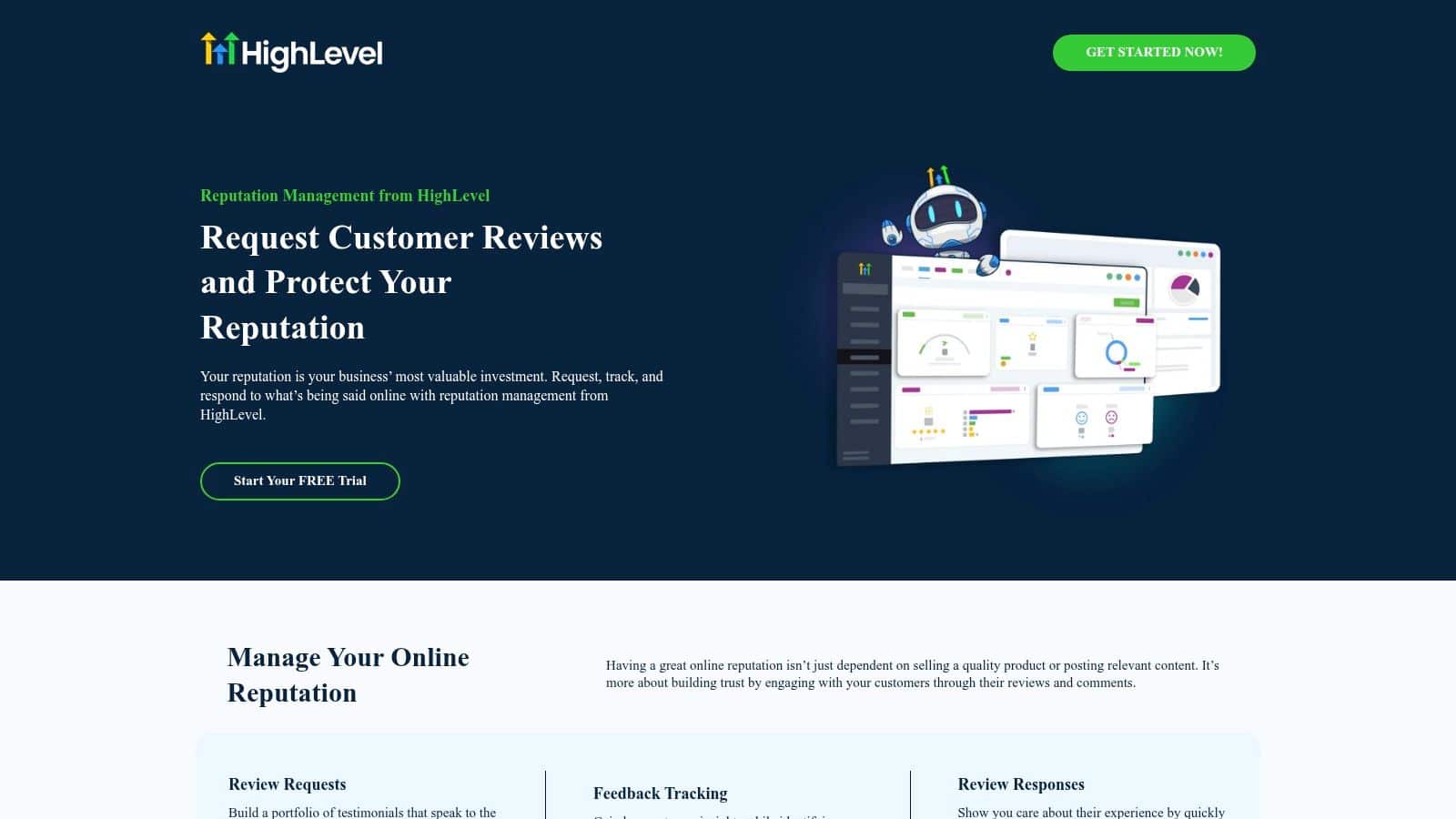
HighLevel is the strongest pick for agencies because it doesn't treat reputation management like a bolt-on. Its HighLevel CRM advantage comes from folding review requests, response workflows, conversation management, and CRM activity into one system, so you can run client reputation programs without stitching together separate tools. The white-label model matters just as much as the feature set, because agencies don't just need software, they need something they can resell cleanly under their own brand.
Why HighLevel stands out for agencies
The practical advantage is simple. You can automate review requests by SMS and email, push replies into a unified inbox, and use AI-assisted drafting to keep response times down without sounding robotic. For agencies handling multiple local brands, that combination cuts the usual chaos of toggling between inboxes, review sites, and client communication tools.
HighLevel also fits the way agencies make money. The unlimited sub-account model lets you separate clients cleanly, while the white-label layer makes the experience feel like your own platform instead of a third-party add-on. That creates room to package reputation management as a recurring service, not a one-off setup project. Its review widgets, including video display options, also help you turn positive feedback into site-level social proof that clients can use on landing pages and location pages.
A few features make the stack more commercially useful than a reviews-only tool. The CRM, workflows, call tracking, booking, and payment features mean review collection doesn't sit in isolation, it connects to lead capture and follow-up. That matters when a five-star review comes from a customer who also needs a quote, an appointment, or a return visit.
Practical rule: if you're an agency, pick the platform that lets you own the client relationship and the workflow, not just the inbox.
For agencies comparing reputation tools, the difference between a feature list and a business model is huge. HighLevel's billing, branding, and automation design make it easier to standardize delivery across accounts, which is exactly where reputation services become profitable. If you're also building demand programs for clients, the demand generation for dev agencies angle is a useful reminder that reputation work performs best when it sits inside a broader revenue engine.
2. Birdeye Best Overall
Birdeye earns the “best overall” label because it covers the core reputation job without feeling narrow. It combines review generation, monitoring, responses, widgets, messaging, listings, and other customer experience functions into a single environment, which makes it a strong default choice for multi-location teams that want central control. Its AI-driven workflows also make it useful for organizations that need speed, consistency, and a cleaner handoff between local teams and headquarters.
One reason Birdeye gets adopted so often is that it handles the unglamorous part of reputation work. That means routing, triage, and follow-up. A centralized inbox, review workflows, and location-level controls help larger brands keep response quality consistent without forcing every store manager to invent their own process.
Where Birdeye helps most
Birdeye is strongest when your business has multiple locations or a serious review load. Review marketing widgets and microsites make it easier to put social proof back into the funnel, while the AI agents help teams move faster on routine tasks and escalate the reviews that need human attention. That's the right shape for organizations that care about governance as much as volume.
The trade-off is that Birdeye can feel heavier than a focused reviews-only product. Pricing is customized, and many buyers will find that the enterprise orientation shows up in both onboarding and contract structure. If you're a very small team, some of the breadth can be overkill.
A good way to judge Birdeye is to ask whether you need a reputation tool or a reputation operating system. If you want more than collection and response, and you care about permissions, reporting, and multi-location oversight, Birdeye makes sense. If you only need a simple review-request workflow, it may be more than you need.
3. Podium
Podium is the messaging-first choice, and that matters more than most comparison pages admit. Reputation management is easier when the same platform that handles customer questions can also trigger a review request at the right moment. Podium brings SMS, webchat, voice, payments, and a unified inbox together, so it works especially well for service businesses that live and die by response speed.
It's also a good fit for front-desk teams. The reason is operational, not just technical. The person answering the phone can often become the person who earns the review, and Podium turns that handoff into a repeatable process instead of relying on memory or goodwill.
HighLevel text message marketing platform is a useful comparison point if you're evaluating how closely you want messaging and reputation to connect in one stack.
What Podium does well
The strongest Podium use case is simple, fast review generation through text. Textable review invites are easy for customers to act on, and the unified dashboard gives teams one place to manage conversations that start in different channels. For local businesses, that can reduce friction in the exact moment when a happy customer is most willing to leave feedback.
Podium also includes AI voice and text assistants, which expands it beyond review collection. That helps teams route leads, answer calls, and keep conversations moving when human staff are busy. The practical upside is that reputation work becomes part of the same daily workflow as sales and service.
The downside is that Podium is more platform than point solution. If you only want review requests and monitoring, it may feel bigger than your needs. It also tends to be packaged in a solution-selling model, so you'll want to be clear about which channels and automation features you'll use.
4. Reputation
Reputation is the enterprise-grade option for teams that need more than review management. It fits businesses where governance, location benchmarking, and reporting matter as much as public responses. Healthcare systems, auto groups, and other complex networks usually match that profile.
The platform's strength is structure. It centralizes reviews, surveys, social, listings, and messaging, then layers analytics on top so leadership can see trends by location and category. That makes it useful when reputation is not a marketing side project, but a measurable part of operational performance.

Why enterprises choose it
The main reason to choose Reputation is control. Location benchmarking, executive scorecards, and managed services give large organizations a way to keep standards tight across many sites. That matters when a corporate brand has to support local execution without losing visibility into what is happening on the ground.
There is also a compliance angle. In regulated environments, approval flows and managed response processes reduce the risk of off-brand or noncompliant replies. Public responses need a different workflow than internal messages, and enterprise reputation software handles that difference directly.
The trade-off is clear. If you are small, the platform is probably too much. Pricing is custom, the procurement process is heavier, and the feature set is built for organizations that already have internal teams ready to manage it.
If your current pain is “we can't keep up,” Reputation may be the right answer. If your pain is “we need a simple system to start collecting more reviews,” it is likely too large for the job.
Practical rule: enterprise tools pay off when you need governance, not just convenience.
For teams trying to improve local reputation with this, the right fit is usually a business with enough location complexity that a basic widget or inbox no longer solves the problem. In that scenario, the value comes from standardization, not simplicity.
5. Yext Reviews
Yext Reviews makes the most sense when reputation is only one part of a broader digital presence strategy. It sits inside the Yext ecosystem, which is important because the review workflow becomes more useful when listings, pages, and structured data are already under the same roof. That's especially relevant for teams trying to keep location information, review responses, and on-site review display aligned.
The upside is coherence. Teams already invested in Yext can manage review listening, replies, and publication without forcing another vendor into the stack. That can simplify admin work and make the whole local search operation feel cleaner.
Where Yext fits best
Yext Reviews is strongest for organizations that care about accuracy across the full search journey. Unified review inboxes, AI-generated replies with local context, and the ability to embed reviews on site all support that goal. It also helps push star ratings into Google Ads, which can be useful when paid and organic visibility are part of the same local strategy.
The platform's enterprise controls are a real plus for multi-location governance. Permissions and audit trails make it easier to manage who can respond, approve, or publish content. That reduces risk when many locations need to stay on brand.
The limitation is value concentration. Yext Reviews tends to be most compelling when paired with other Yext modules, especially listings and pages. As a standalone reputation purchase, it can feel expensive relative to what you get.
The right buyer is usually already thinking in systems, not features. If listings accuracy, local pages, and reviews all need to be managed together, Yext makes sense. If you only want review collection and response, there are leaner options.
6. SOCi Best for Multi-Location
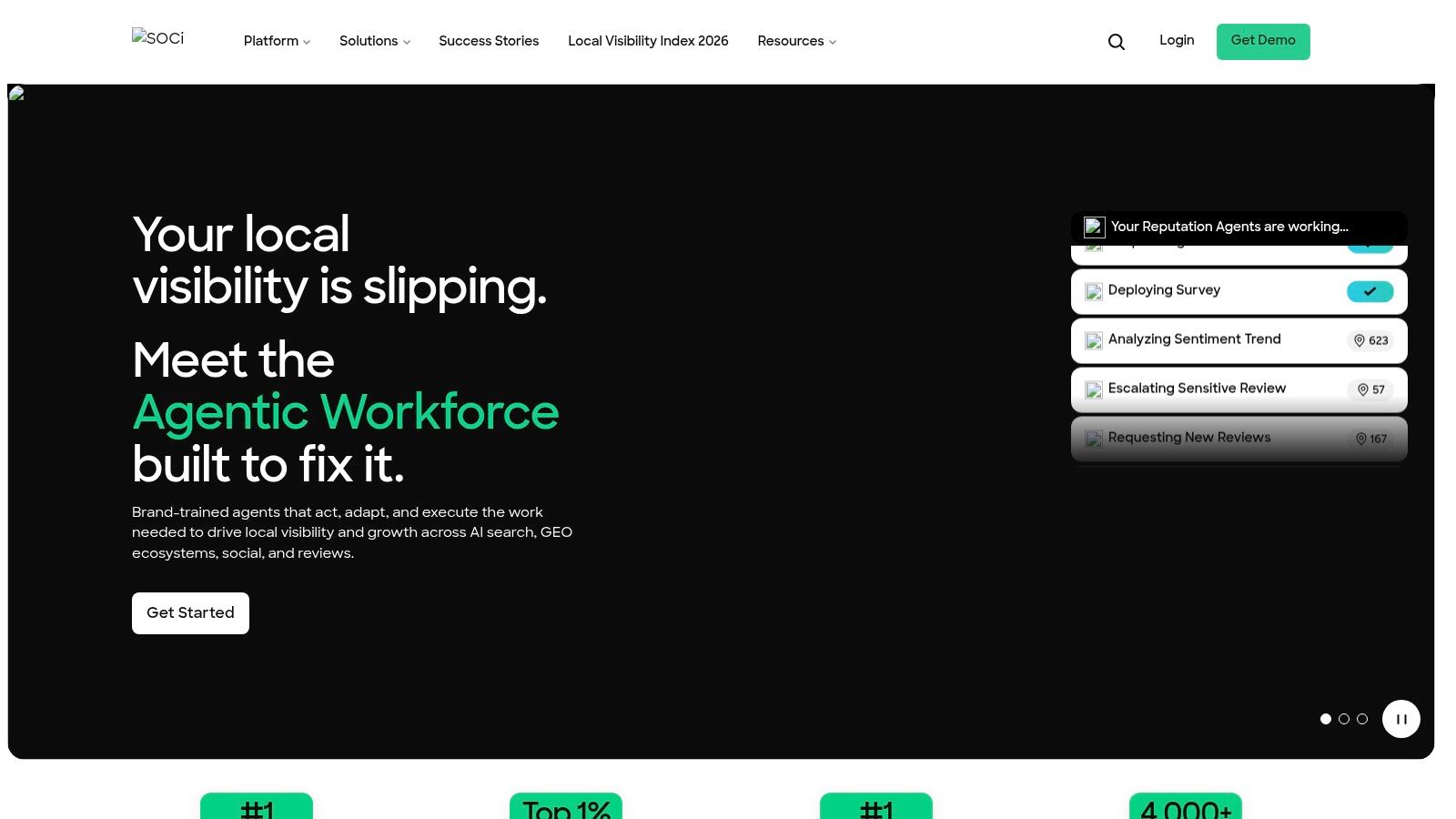
SOCi is built for distributed brands that need corporate control and local flexibility at the same time. That's a hard balance, and SOCi's reputation tools are designed around it. The platform's AI agents and location-aware workflows make it especially relevant for franchises, regional chains, and multi-location businesses with many people touching customer feedback.
The reason it stands out is consistency at scale. Corporate teams can set the rules, local teams can execute, and the platform helps keep the whole thing from fragmenting into store-by-store improvisation.
Why SOCi works for distributed brands
SOCi's Genius Reviews feature is a major reason multi-location brands evaluate it. It helps draft brand-safe replies while still allowing local context, which is exactly the kind of compromise larger organizations need. Add centralized dashboards, competitive insights, and local SEO support, and it becomes a broader local marketing system rather than a narrow review tool.
That breadth is useful, but it comes with weight. SOCi is not built for a single shop or a tiny services business. It's an enterprise platform, and the pricing reflects that.
The practical choice is whether your organization needs governance across a large footprint. If the answer is yes, SOCi helps create a repeatable process that local teams can follow. If the answer is no, the overhead will probably outweigh the benefit.
A lot of buyers underestimate how much time is lost when each location invents its own response style. SOCi's AI guardrails are valuable because they reduce that drift while still letting replies sound human.
7. ReviewTrackers by InMoment
ReviewTrackers is a focused reputation product for teams that want to centralize review operations without buying a full customer experience suite. That narrowness is part of the appeal. It's easier to learn than a giant all-in-one platform, and it maps well to businesses that mainly care about monitoring, responding, and reporting on reviews by location.
The platform also suits organizations that want review work to become more operational. Alerts, templates, approvals, and location-based reporting make it possible to manage reviews as a repeatable process instead of a reactive task.
SMS vs email review conversion rates are worth thinking about when you build request flows, because the channel you choose affects adoption and workload even when the software looks similar on paper.
What makes it practical
ReviewTrackers is effective because it keeps the work tight. Teams can monitor reviews from major sites in one dashboard, route replies through approvals, and see trends by store or clinic. That makes it a strong fit for multi-location operations that need accountability without a lot of feature noise.
It's also easier to roll out than many enterprise suites. That matters because reputation tools fail when staff don't adopt them. A cleaner interface and a narrower scope can lead to better usage than a bigger platform that nobody touches after onboarding.
The compromise is that advanced social and listings functions live elsewhere. If your plan is to manage reputation, local presence, and social publishing inside one system, ReviewTrackers will probably feel incomplete.
Use it when review operations are the priority. Don't use it when you're trying to replace three separate marketing systems with one platform.
8. NiceJob Best Budget Option
NiceJob is the practical choice for small businesses that want more reviews without a complex rollout. It's straightforward, relatively easy to understand, and built around the simple idea that happy customers should be guided into leaving public feedback before the moment passes.
That simplicity is the point. Many SMBs don't need an enterprise dashboard. They need a tool that starts working quickly and doesn't create another admin burden.
Why budget buyers like it
NiceJob keeps the workflow focused on review requests, monitoring, and social proof. Automated campaigns and AI-assisted replies handle the repetitive work, while widgets and sharing tools help turn reviews into visible trust signals on the website. For service businesses, that combination is often enough to create a steady review engine.
It also helps that the pricing and commitment model is lighter than many competitors. Month-to-month terms and a transparent entry point make it easier for smaller teams to try without getting locked into a long procurement cycle.
The trade-off is that it's not built for deep governance or complex multi-channel orchestration. If you need fine-grained permissions, enterprise analytics, or broad local marketing infrastructure, it will feel limited.
automate review requests using the simple path first, then add sophistication only when the team is ready. That's usually the right order for small businesses, because too much process early on kills adoption.
9. Trustpilot Business
Trustpilot Business is different from many reputation platforms because the public review ecosystem is the product. That makes it especially relevant for brands where the Trustpilot presence itself is part of the funnel. If buyers already search for your company on Trustpilot, or if public trust on that domain affects conversion, it deserves a serious look.
The advantage is visibility. Trustpilot gives you tools to invite reviews, respond, analyze performance, and showcase ratings through widgets and marketing assets. For some businesses, that public footprint is the whole point.
When Trustpilot is the right fit
Trustpilot Business works best when the brand profile on Trustpilot is a strategic asset, not just a third-party listing. That's true for companies that lean on the domain in SEO, ads, or comparison shopping. It also makes sense for teams that want clear plan tiers and an accessible entry point before moving into paid functionality.
The main limitation is scope. If you need broad review orchestration across many channels, Trustpilot is not the broadest tool on this list. Its best value lives on its own domain, which is both a strength and a constraint.
Use it if your customers already trust Trustpilot as a place to validate your business. Skip it if you need a wider review operations system tied to CRM, messaging, and local workflow.
10. Grade.us by Traject
Grade.us is the agency-friendly alternative for teams that want to package reputation services without the complexity of a larger enterprise suite. It focuses on review funnels, monitoring, widgets, and white-label delivery, which makes it a solid choice for resellers and consultants who need something easy for clients to understand.
Its value comes from clarity. The product is built around getting more reviews, handling negative feedback, and presenting the results in a branded way.
Why agencies still use it
Grade.us works because it's straightforward to deploy. Multi-step review funnels and white-label dashboards let agencies sell a branded service without building their own software layer. That can be enough for shops that want reputation management to live beside SEO, ads, or web design as an add-on offer.
The trade-off is breadth. Compared with all-in-one customer experience suites, Grade.us is narrower and lighter on advanced AI. That's fine if your service model is centered on review acquisition, but it's not ideal if you want messaging, scheduling, CRM, and reputation in one place.
If you're comparing agency tools, ask one question first. Can this platform help me retain the client by making delivery simpler? If the answer is yes, it's worth considering. If not, it may just become another monthly cost.
Top 10 Reputation Management Software Comparison
| Solution | Key features | UX ★ | Value 💰 | Best for 👥 | Unique selling point ✨ |
|---|---|---|---|---|---|
| HighLevel: Best White-Label Software for Agencies 🏆 | CRM + unified inbox, funnels, workflows, payments, reputation, mobile app | ★★★★☆ | 💰 Higher‑tier for white‑label; unlimited contacts included | 👥 Agencies & SMBs reselling services | ✨ True white‑label + unlimited sub‑accounts; native AI across messaging & reviews |
| Birdeye: Best Overall | AI reviews, centralized inbox, listings, multi‑location governance | ★★★★★ | 💰 Custom/enterprise pricing; add‑ons common | 👥 Franchises & multi‑location brands | ✨ Deep multi‑location controls & AI agents for triage |
| Podium | Messaging‑first inbox, SMS review invites, payments, voice AI | ★★★★☆ | 💰 Quote‑based, industry‑packaged | 👥 Local service & retail SMBs | ✨ SMS‑first review generation + phone/voice AI |
| Reputation | Reviews, surveys, analytics, compliance, location benchmarking | ★★★★☆ | 💰 Custom annual pricing; enterprise focus | 👥 Regulated verticals & large networks | ✨ Strong compliance & verticalized governance |
| Yext Reviews | Unified review inbox, AI responses, embed widgets, local context | ★★★★ | 💰 Best value when bundled with Yext Listings/Pages | 👥 Teams using Yext for listings/pages | ✨ Seamless Listings + Reviews integration for local SEO |
| SOCi: Best for Multi-Location | AI 'Genius' agents, dashboards, workflows, local publishing | ★★★★ | 💰 Quote‑based enterprise pricing | 👥 Franchises & distributed brands | ✨ AI guardrails + corporate‑to‑local governance |
| ReviewTrackers (by InMoment) | Aggregation, alerts, templates, location packaging | ★★★★ | 💰 Sales‑call pricing; location‑based plans | 👥 Store & clinic networks | ✨ Purpose‑built review operations with light learning curve |
| NiceJob: Best Budget Option | Automated review/referral campaigns, widgets, optional sites | ★★★★ | 💰 Transparent self‑serve pricing; month‑to‑month | 👥 Service SMBs on a budget | ✨ Clear pricing, easy onboarding, optional managed sites |
| Trustpilot Business | Public review collection, analytics, widgets, APIs | ★★★★ | 💰 Tiered plans with free entry option | 👥 Brands relying on public review discovery | ✨ High‑visibility domain + marketing assets (stars in ads) |
| Grade.us (by Traject) | Multi‑step review funnels, white‑label dashboards, widgets | ★★★★ | 💰 Agency‑friendly/reseller pricing | 👥 Agencies & resellers | ✨ White‑label funnels & reseller collateral for scale |
How to Choose the Right Reputation Stack
The best reputation management software is the one that matches your operating model, not just your feature wishlist. Market growth shows the category is expanding fast, but the buying mistake I see most often is choosing the tool with the longest feature page instead of the one the team will run every week. That's where implementation complexity and time-to-value become a real differentiator, especially for SMBs asking whether a platform needs extensive training or setup, a gap that buyers still complain about in discussions on G2.
Start with the business model. Agencies need white-labeling and sub-accounts, multi-location brands need governance and benchmarking, and single-location SMBs usually need simple review requests plus a way to reply fast. If the tool doesn't match how you sell, serve, or report, it's going to feel awkward no matter how powerful it is.
You also need to decide whether reputation is a standalone workflow or part of a broader operating system. Tools like Birdeye, SOCi, Reputation, and Yext make sense when reviews sit next to listings, messaging, and analytics. Tools like NiceJob and ReviewTrackers make more sense when you want a tighter scope and faster rollout.
The right question isn't “Which tool has the most features?” It's “Which tool will my team keep using after the first month?”
Use this lens when you compare options:
- Agencies: prioritize white-label delivery, sub-accounts, and upsell potential.
- Multi-location brands: prioritize permissions, reporting, and centralized oversight.
- SMBs: prioritize speed, simple onboarding, and review request automation.
- Public-review-led brands: prioritize visibility on the review domain itself.
- Operational teams: prioritize dashboards that turn feedback into action.
The market concentration data from 6sense tells you something else too. A few platforms already hold most of the observed footprint, which means buyers are rewarding tools that combine review capture, messaging, and automation. That doesn't make niche tools bad, but it does mean the winning platform usually solves more than one problem at once.
Implementation that Actually Sticks
A reputation platform only works if people use it consistently. That sounds obvious, but a lot of launches stall because the team treats the software as a feature purchase instead of a process change. The best implementations connect review requests to existing customer touchpoints, then make response ownership crystal clear.
Start with timing. Review requests should go out after a real positive interaction, not as a random blast. In service businesses, that might be after a completed appointment or job. In multi-location retail, it might be after a purchase or resolved support issue. The software matters, but the trigger matters just as much.
Next, define who replies and who escalates. A front-line user can handle simple praise, but negative feedback usually needs a clear path to a manager, location lead, or HQ team. That's where unified inboxes and role-based workflows earn their keep, because they prevent awkward silences and off-brand responses.
Then, build a reporting habit. Reviews are not just a marketing asset. They're operational feedback. If the same complaint appears across locations, someone needs to see it and act on it, not just answer it publicly.
A clean rollout usually looks like this:
- Map the customer moments: identify the best trigger points for review requests.
- Assign ownership: decide who monitors, who responds, and who escalates.
- Standardize tone: write response guidelines so every location sounds consistent.
- Connect the stack: make sure reviews tie into CRM, messaging, and follow-up.
- Review the patterns weekly: look for themes, not just star ratings.
The businesses that win with reputation software don't treat it like a dashboard. They treat it like a feedback loop. That's why all-in-one platforms usually outperform disconnected point tools over time, because the workflow stays inside one system instead of scattering across inboxes and logins.
Turn Reputation Management into Your Growth Engine
The best reputation management software doesn't just collect reviews, it turns customer feedback into a repeatable growth system. That happens when review requests, response workflows, and social proof all sit inside a process your team can sustain. If you're using the right tool, you'll spend less time chasing comments and more time spotting patterns that help you improve service, close more leads, and keep customers coming back.
The strategic difference is simple. Point solutions help you react. Better platforms help you operate. When you centralize feedback, the review stream becomes more than a list of public comments, it becomes a live signal about customer experience, local performance, and brand trust.
For agencies, the biggest upside is packaging. A white-label platform lets you sell reputation management as a recurring service without adding more tools to your own stack. For multi-location businesses, the upside is control. Corporate can see what's happening, local teams can respond quickly, and the brand stays consistent. For SMBs, the upside is momentum. One steady workflow can create visible social proof faster than sporadic manual follow-up.
If you're still unsure, choose the platform that removes the most friction from your daily work. That's usually the one your team will use, and usage is what turns software into results. In reputation management, adoption beats elegance every time.
HighLevel gives agencies and growing businesses a clean way to manage reviews, automate follow-up, and keep customer conversations inside one platform. If you want a white-label reputation system that sits alongside CRM, messaging, and automation instead of adding another disconnected tool, visit HighLevel and see how it can simplify your reputation workflow.
