


74.5% of SMBs say reputation management is critically important, but 62.6% still depend on fragmented native review platforms instead of one centralized workflow. That gap is the biggest opportunity in local competition right now.
The businesses that win aren't always the ones with the most reviews, they're the ones with the fastest, most consistent system for seeing feedback, responding well, and turning happy customers into fresh proof. Reputation management for small businesses has moved far beyond “check the stars and reply when you remember.”
Table of Contents
- Why Reputation Management Matters More Than Ever for Small Businesses
- What Reputation Management Actually Means for Small Businesses
- Key Metrics and KPIs That Prove Reputation Management Works
- The Five-Step Reputation Management Strategy for Small Businesses
- Implementing Reputation Workflows in HighLevel
- Common Pitfalls That Undermine Small Business Reputation
- Small Business Reputation Management Case Studies
Why Reputation Management Matters More Than Ever for Small Businesses
The paradox is hard to miss. 74.5% of SMBs call reputation management critically important, yet 62.6% still lean on native review platforms instead of a centralized workflow, which leaves responses scattered and slow. That matters because a customer doesn't experience your intent, they experience your reaction time and consistency.
The pressure isn't coming from one channel anymore. Customers still read Google reviews, but they also notice Yelp, Facebook, forums, and branded search, and they're increasingly seeing what AI assistants say about a business in summary form. As one useful read on brand reputation strategy for growth puts it, reputation has to be treated like strategy, not cleanup.
Why the gap exists
Most small businesses don't fail at reputation because they don't care. They fail because the work gets split between whoever is free, which usually means the owner answers some reviews, the front desk answers others, and no one owns follow-up. That's where delays, missed mentions, and inconsistent tone creep in.
The result is predictable. Two businesses with similar offerings can look very different online because one has a system and the other has inboxes, tabs, and memory. If you want sharper visibility into what's happening across channels, reporting tools for agencies are a good reminder that measurement needs structure, not guesswork.
Practical rule: reputation isn't a marketing task you squeeze in after hours, it's an operating rhythm that has to run every week.
Why the lag hurts locally
Local buyers rarely do deep research. They compare a few businesses, scan ratings, skim recent feedback, and choose the option that feels safest. That's why reputation management for small businesses is really a conversion system, not just a brand exercise.
The businesses that win don't always have the lowest price. They often have the clearest proof, the freshest feedback, and the most visible responsiveness. When your response system is fragmented, you're not just slower, you're easier to overlook.
What Reputation Management Actually Means for Small Businesses
Reputation management is the ongoing work of watching what the market sees, reacting to it well, and shaping the next signal customers encounter. It's broader than review collection and much more durable than crisis cleanup. It's an immune system, always on in the background, catching weak signals before they become a public problem.
A neighborhood bakery makes the idea concrete. It notices Google reviews quickly, replies in a way that sounds like a real person, fixes a service issue before a frustrated customer posts again elsewhere, and then surfaces positive moments where future buyers will see them. That's not one task, it's a system.
The five functional areas
A complete system has five pieces. First, monitoring, so nothing public slips through unnoticed. Second, response, so feedback gets a timely and consistent reply. Third, review generation, so satisfied customers are asked at the right moment.
Fourth, resolution, which means turning negative experiences into recoveries instead of arguments. Fifth, amplification, where positive proof gets reused on your site, booking pages, and marketing assets. If you want a tactical example of this side of the work, 5 star review strategy for SMBs is a helpful complement because it focuses on how to ask without sounding robotic.
What it is not
Reputation management is not just logging into a review site once a week. It's also not the same as reputation repair, which starts after damage has already spread. A business can have a clean profile and still have a weak reputation system if no one is capturing feedback, escalating problems, or learning from patterns.
A strong reputation system makes the next good outcome easier to repeat.
The difference shows up in daily operations. A business with a real system doesn't ask, “Who can handle this review?” It already knows who's on point, what the tone should be, when escalation happens, and how positive feedback gets reused. That's why reputation management for small businesses belongs in operations, not as a loose marketing add-on.
Key Metrics and KPIs That Prove Reputation Management Works
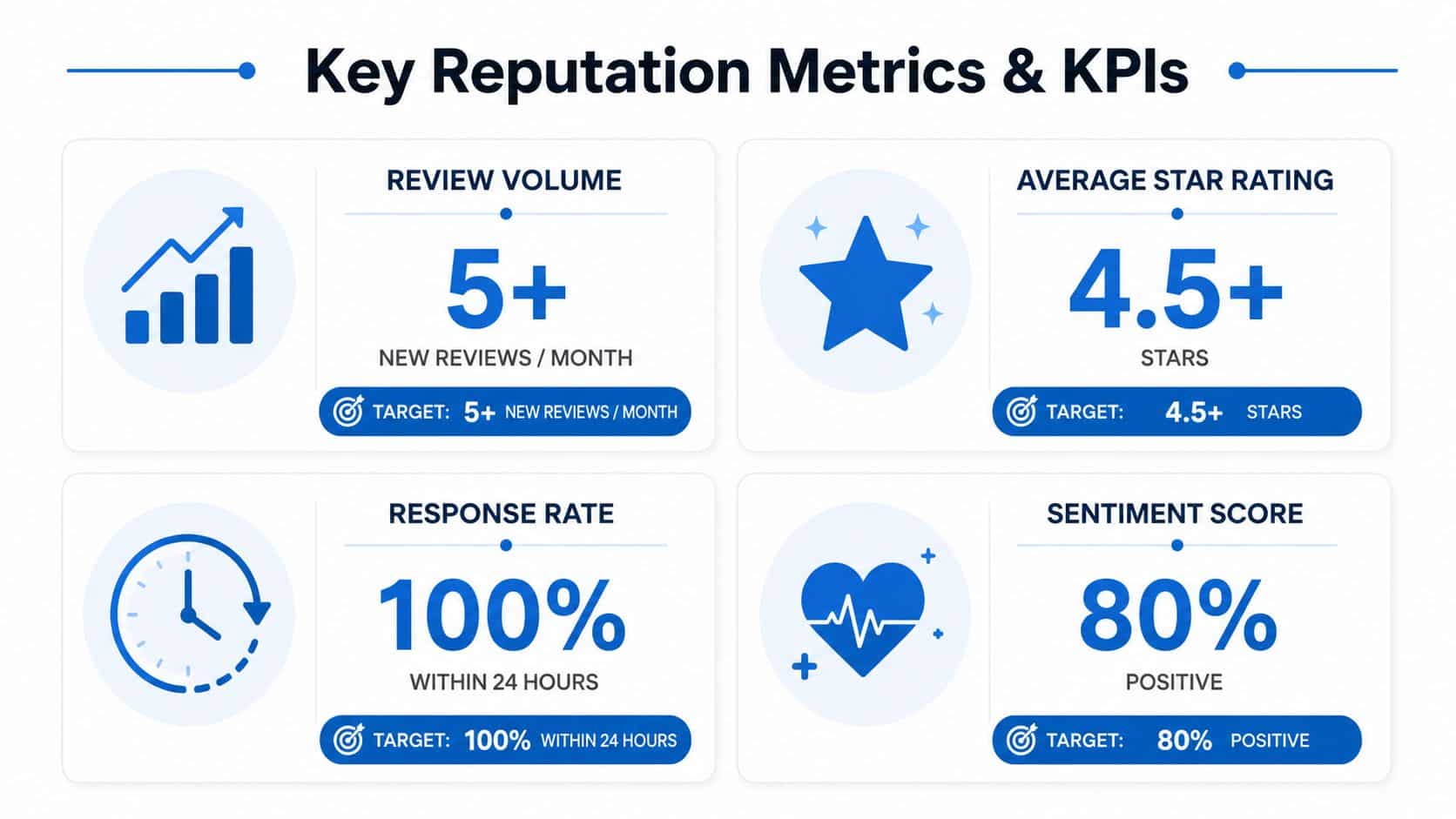
If you can't measure it, you can't manage it. The right metrics don't just show whether people are leaving feedback, they reveal whether your system is influencing trust and buying behavior.
Consumer behavior makes the case clearly. In a BrightLocal survey cited by Wharton, 86% of consumers read reviews for local businesses, 95% of people ages 18 to 34 do so, and 57% will only buy from a business with four or more stars. The same source says people read an average of 10 reviews before trusting a business, and 40% only consider reviews written within the past two weeks. Those figures explain why recency and visibility matter as much as volume. Wharton's local business reputation research summary is still one of the clearest snapshots of that behavior.
The metrics worth watching
The first KPI is average star rating, because it's the quickest shorthand buyers use. But star rating alone doesn't tell the whole story, especially if your reviews are stale or your responses are weak. A business can look polished and still lose buyers if the newest feedback is thin.
The second is review velocity and recency. Fresh reviews help confirm that the business is still active and still delivering. The third is response rate and response speed, because unanswered reviews signal neglect even when the rating itself looks fine.
A fourth metric is negative sentiment ratio, which helps you track whether complaints cluster around the same service issue. The emerging fifth metric is AI search visibility and entity accuracy, because the question is no longer only what customers read on review sites, it's what answer engines and assistants summarize when someone asks about your business.
If you're comparing platforms or workflows for the follow-up side of these metrics, it helps to compare SaaS automation tools before you commit to a stack.
What good measurement looks like
A useful dashboard doesn't drown you in vanity numbers. It shows whether the business is asking at the right time, answering quickly, and surfacing enough fresh proof to influence purchase decisions. That matters because speed and consistency often matter more than a polished one-off response.
Track whether your reputation system is creating momentum, not just collecting comments.
For many small businesses, the goal isn't to chase a perfect rating. It's to build a dependable process that keeps trust visible, current, and easy to verify. That's the practical meaning of reputation management for small businesses, a feedback loop, not a trophy case.
The Five-Step Reputation Management Strategy for Small Businesses
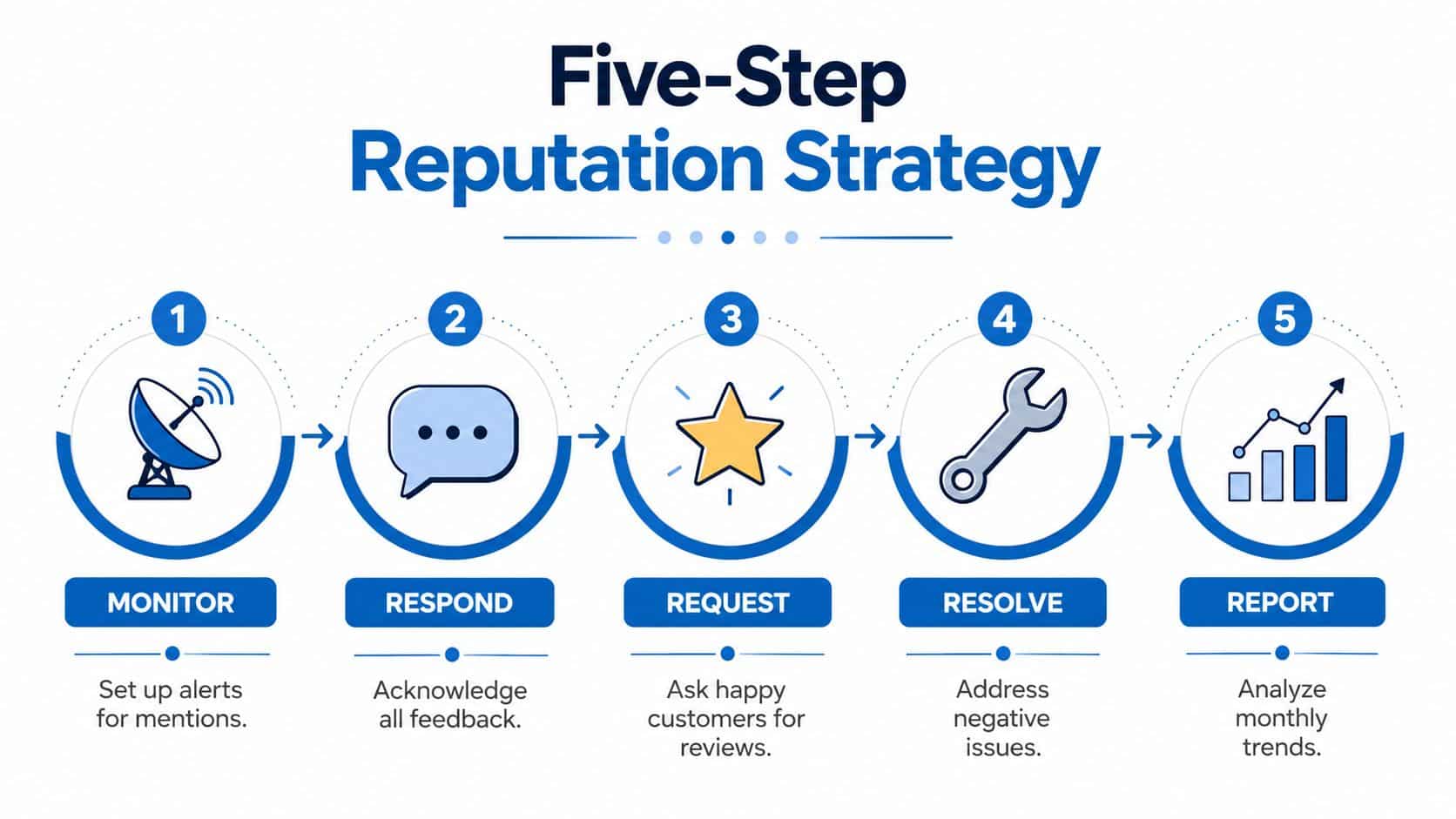
A real reputation strategy works like a loop, not a checklist. Once the loop is built, every customer interaction can create a new review opportunity, a new service recovery, or a new piece of social proof.
1. Monitor everything in one place
Start by pulling mentions, reviews, and messages into a single view. The mistake most small businesses make is checking one platform only, then discovering a complaint or compliment somewhere else days later. A single queue fixes that by making the work visible.
2. Request reviews at the moment of satisfaction
Random review requests feel weak. Ask when the customer has just had a win, right after a job completion, a successful appointment, or a solved issue. The best HighLevel lead generation playbook style systems are built around timing, not hope.
3. Respond with a defined voice
Positive reviews deserve gratitude, but not the same canned sentence every time. Negative reviews need a calm acknowledgment, a useful next step, and no defensiveness. If the complaint is serious, move quickly into an escalation path instead of debating in public.
4. Resolve before the issue hardens
Public recovery matters because it shows future buyers how the business behaves under pressure. The common mistake is thinking the reply itself is the fix. In practice, the public response and the private remedy have to work together.
5. Amplify the proof
Once a good review comes in, reuse it on your website, booking page, or sales materials. Don't hide proof that already exists. It can also help with AI-facing surfaces when your brand data and customer signals stay consistent.
The basic error at each step is the same, treating reputation as a one-time action instead of a repeating workflow. Businesses that fix that don't just get better reviews, they get a sturdier operating loop.
Implementing Reputation Workflows in HighLevel
A strong reputation strategy becomes much easier once the repeatable parts are automated. The point isn't to remove the human touch, it's to make sure the human touch happens at the right moment, every time.
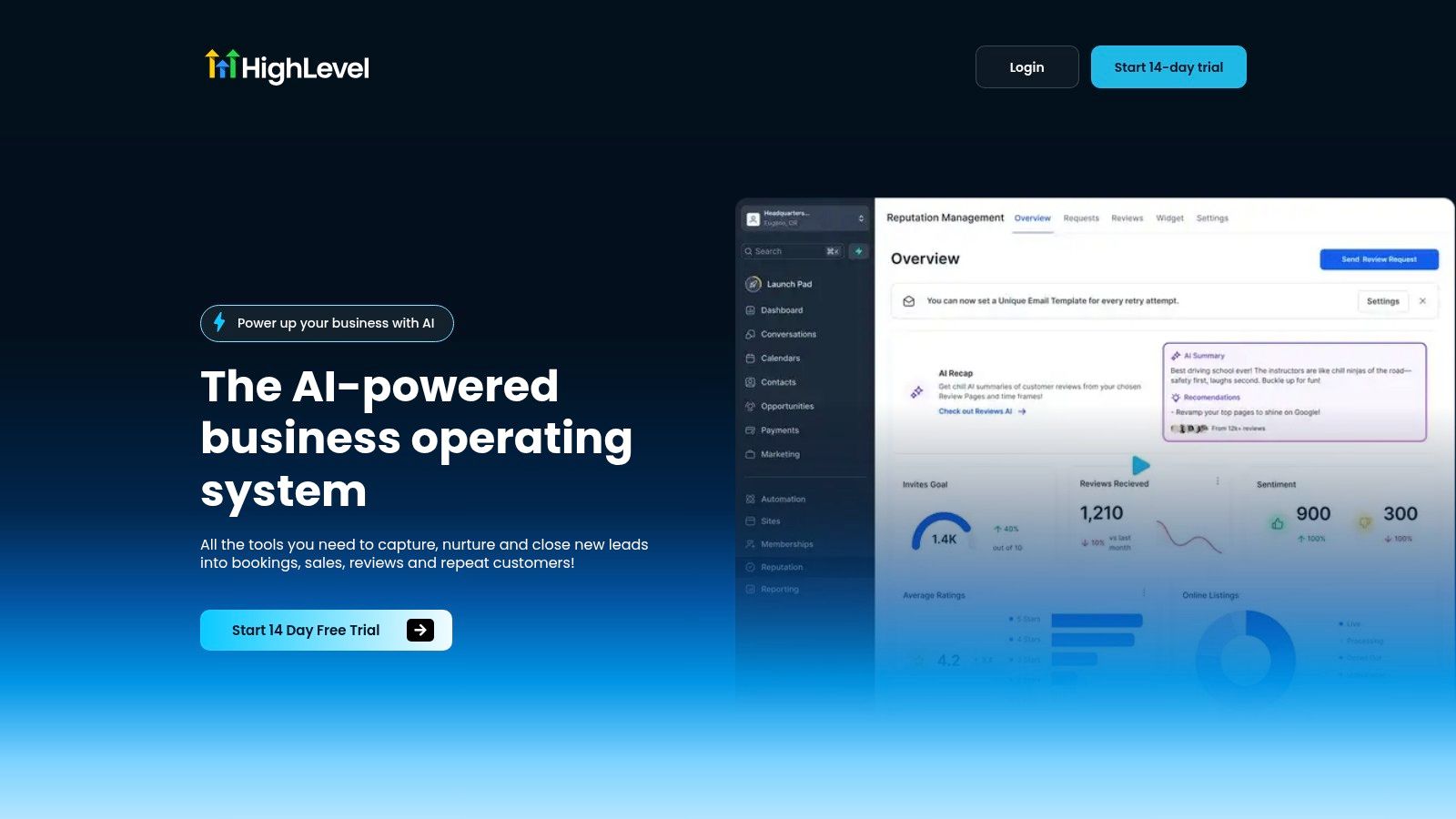
One practical approach is to use a platform like HighLevel for workflow control. It includes reputation management, automated review requests, AI review replies, review widgets, and a unified communication layer, so the business doesn't have to stitch those pieces together by hand. For agencies, the marketing platform guide is worth a look because the implementation logic is similar across client accounts.
The workflows that matter
A service business can trigger a review request after a job is marked complete, then route any negative reply into an internal alert. If the review is positive, the workflow can branch into a thank-you response and a request to reuse the testimonial on the website. That kind of branching is where automation starts saving time without making the experience feel mechanical.
The missed-call text-back workflow matters too. When a lead calls and nobody answers, silence can become a reputation issue before anyone even books. A fast text-back lowers the chance that a frustrated prospect decides the business is unresponsive.
How to keep the tone human
AI-assisted review replies can work well if the brand voice is controlled. The risk is using them as autopilot, which produces responses that sound polite but not real. A good workflow uses templates as a starting point, then lets a team member adjust the specifics before sending.
Automation should reduce delay, not erase judgment.
The review widget is another useful piece because it places live proof on booking pages and service pages where buyers are already deciding. That's more useful than burying testimonials in a separate page nobody visits. It also gives agencies a clean way to standardize reputation reporting across sub-accounts without rebuilding the process for each client.
Common Pitfalls That Undermine Small Business Reputation
Most reputation problems aren't caused by one bad review. They happen when a business creates weak habits around review collection, response quality, and visibility, then assumes volume alone will carry the brand.
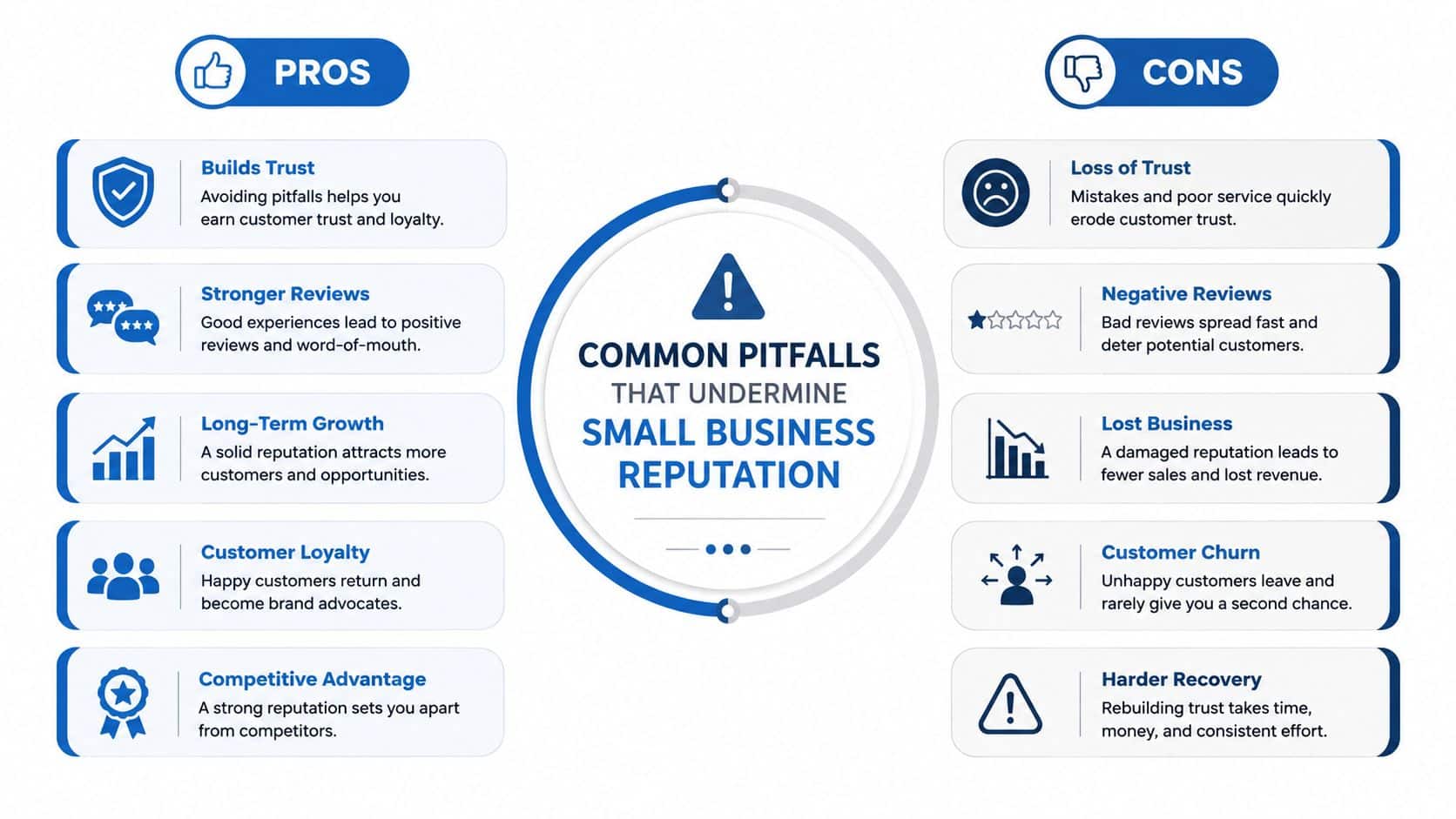
A common mistake is treating review acquisition as the finish line. It isn't. If your responses are thin, defensive, or inconsistent, you're still leaving trust on the table. If you want another angle on how reputation connects to demand creation, small business lead generation tactics is a useful companion resource because the review request moment and the lead capture moment often overlap.
Where businesses usually go wrong
The first pitfall is generic responses. Copy-paste replies tell buyers you're managing a queue, not a relationship. The second is defensiveness, which turns a solvable issue into a public warning sign.
The third is ignoring recency. A stack of older praise can't fully offset the effect of sparse recent feedback, especially when customers are scanning for the latest signal. The fourth is ignoring AI search visibility, which means the business may look fine on a review site while answer engines summarize it poorly elsewhere.
The fifth is running reputation manually without centralization. That usually leads to missed comments, half-finished follow-up, and burnout. If missed calls are a recurring problem, it's worth looking at ways to recover lost revenue from missed calls before those gaps spill into the public review layer.
What to do instead
Use clear ownership, fast alerts, and a response standard that sounds like your team. Ask for reviews at the right moment, not all the time. And make sure the same business data, names, and locations appear consistently across the places AI systems and humans inspect.
Volume without freshness and responsiveness looks busy, not trustworthy.
That's the main trap. Reputation management for small businesses works best when it's treated as an operating system, not a pile of tasks.
Small Business Reputation Management Case Studies
A plumbing contractor I worked with had a profile that looked tired. The average rating sat at 3.6 stars, and replies were often slow enough that negative reviews stayed visible without context. The fix wasn't a branding overhaul, it was a tighter workflow, job-completion review requests, and response templates that still left room for the technician's name, the specific job, and the actual problem solved.
Within that system, the business started asking customers after the service was finished, not days later when the experience had already faded. Negative reviews got public acknowledgments and a private follow-up path, while positive customers were encouraged to leave detailed feedback. The bigger shift was operational, not cosmetic. The owner stopped relying on memory and started using a repeatable process that made good service easier to see.
The second example was a multi-location service business that needed consistency more than heroics. Each location had its own customer flow, but the same reputation standards had to apply everywhere, so monitoring, review requests, and amplification were centralized. One platform handled the workflow logic, while location-specific replies and widgets kept the brand local enough to feel credible.
What changed wasn't just the number of reviews. The business gained a cleaner public presence because every location followed the same rules for asking, responding, and escalating. That's the real advantage of a system, it removes the guesswork that causes one location to look great and another to look forgotten.
The most useful lesson from both cases is simple. Reputation improves faster when the process is built into service delivery, not left to afterthought. Strong businesses don't just hope for better reviews, they build the conditions that make them more likely.
If you want to centralize review requests, follow-up, replies, and reporting in one place, visit HighLevel and see how its workflows and reputation tools can support the way your business already operates. It's built for teams that want fewer gaps, faster response times, and a cleaner reputation system without adding more manual work.
