

You're getting clicks, form fills, and the occasional promising conversation, but revenue still feels unpredictable. Leads sit in an inbox, salespeople follow up inconsistently, and nobody can say whether the problem is the ad, the landing page, the offer, or the handoff to sales.
That's the situation that leads business owners to ask, what are funnels used for? The practical answer is simple: funnels turn scattered attention into a managed customer journey. They show where people enter, what happens next, why some prospects advance, and where others disappear.
Table of Contents
- The Real Reason Funnels Exist in 2026
- Defining a Funnel and Its Four Core Stages
- Common Funnel Types and When to Use Each
- Key Metrics That Reveal Where a Funnel Is Leaking
- Practical Use Cases for Agencies and Small Businesses
- When the Classic Funnel Breaks and What to Do Instead
- Best Practices and a Practical Funnel Checklist
The Real Reason Funnels Exist in 2026
A funnel exists because attention alone isn't revenue. A visitor can read a service page, download a guide, send a message, and still need several useful interactions before deciding to buy. Without a defined process, each interaction remains isolated. The business collects activity, but it can't connect that activity to a commercial outcome.
A well-designed funnel gives every stage a job. One step captures interest. Another answers questions. A later step creates a clear buying decision. After the sale, the system supports delivery, reviews, repeat purchases, referrals, or reactivation.
Practical rule: If a lead enters your business and nobody knows what should happen next, you don't have a funnel. You have traffic and hope.
The need is especially clear in B2B and considered purchases. Buyers may move between search, social media, email, direct messages, calls, and a website before they commit. A static website can explain an offer, but it usually doesn't coordinate follow-up, qualification, booking, payment, and retention.
That's why a funnel should be treated as a revenue operating system, not a diagram on a presentation slide. It connects marketing activity to sales action and customer care. A marketing platform with CRM can bring those functions into one workspace, so the team can see the contact, conversation, stage, and next action together.
Start by asking four operational questions:
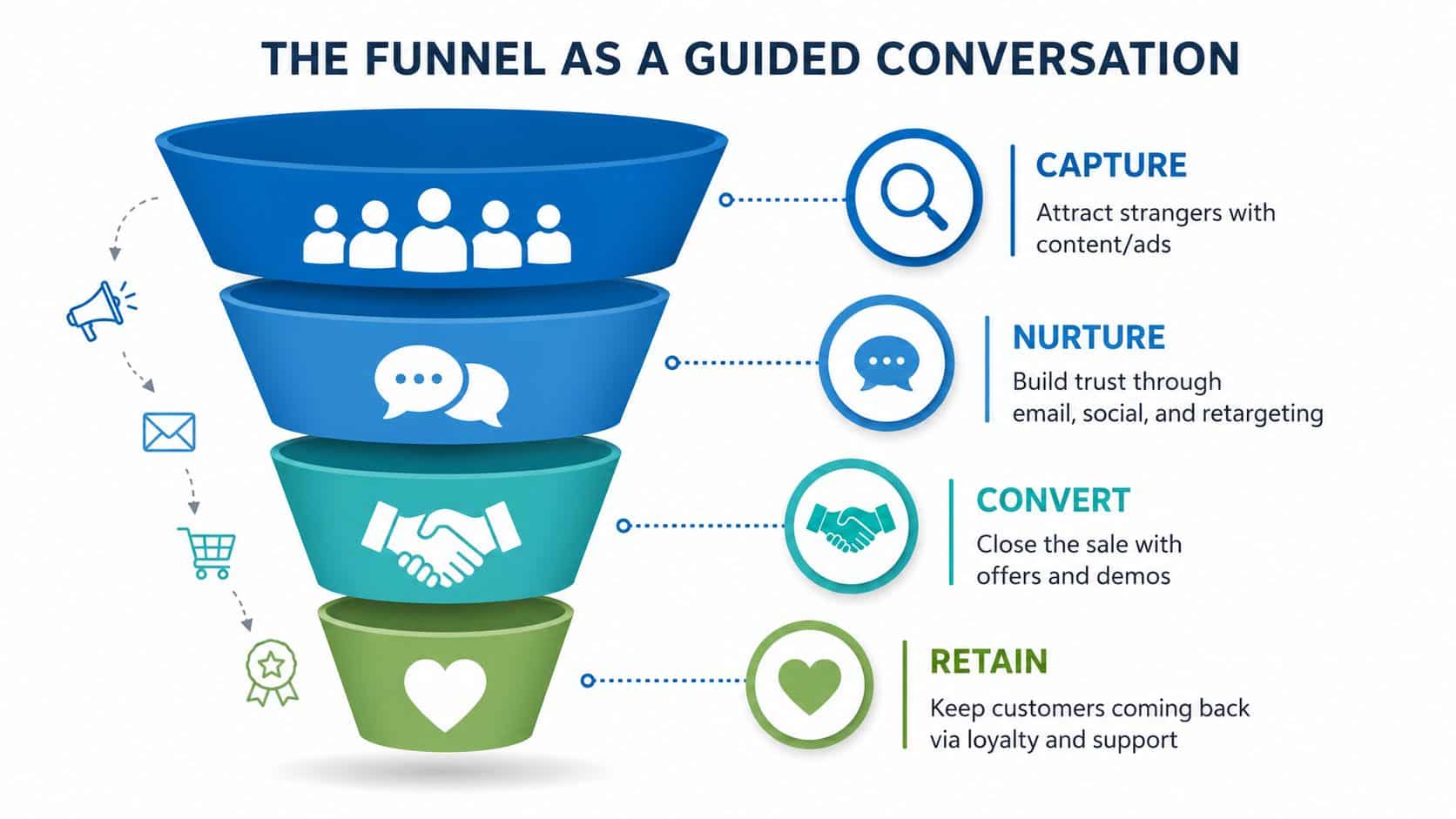
- Capture: How does a stranger become a known contact?
- Nurture: What information or experience helps that person move forward?
- Convert: What event marks the sale, booking, or signed agreement?
- Retain: What brings the customer back, earns advocacy, or restarts the conversation?
When those answers are visible, growth becomes easier to inspect. If leads are arriving but appointments are scarce, the booking stage needs attention. If appointments happen but deals stall, the offer, qualification, or sales handoff may be responsible. The funnel makes that diagnosis possible.
Defining a Funnel and Its Four Core Stages
Think of a funnel as a guided conversation with a stranger. You wouldn't meet someone for the first time and immediately demand a purchase. You'd establish relevance, answer questions, understand their situation, make a suitable recommendation, and maintain the relationship if they become a customer.
A funnel applies that logic to marketing and sales. It's a sequence of pages, messages, actions, and records that moves a person from first contact toward a defined business outcome. A website is a collection of information. A pipeline is an operating map for sales. A funnel connects the customer-facing journey with the internal process that manages it.
Capture creates a usable starting point
The capture stage turns anonymous attention into an identifiable contact. Common entry points include a form, quiz, phone call, chat widget, social message, webinar registration, or booking request.
The output is not merely an email address. It should include useful context, such as the service requested, the problem described, the source channel, or the preferred appointment time. That information helps the next stage become relevant instead of generic.
Nurture builds enough confidence to continue
Nurture is the follow-up conversation. It might include educational email, SMS reminders, retargeting, social content, a sales call, a demonstration, or answers to objections. The marketing team often owns the automated sequence, while sales or service staff handle higher-intent conversations.
This stage matters because buying journeys rarely end at the first interaction. Average sales funnel conversion rates are often only 3% to 7%, while B2B sales cycles average 84 days and typically require 5 to 20 touchpoints before a close, according to Marketing Week's history of the sales funnel. The exact sequence varies, but the operational lesson is consistent: follow-up needs structure.
Convert gives the prospect a clear decision
Conversion is the moment the prospect takes the action your business values. That might be paying for a product, booking a consultation, signing a proposal, starting a membership, or accepting an estimate.
A good conversion step removes uncertainty. It states what happens next, what the customer receives, how payment works, and how the business will respond. A vague “contact us” button often creates more work for both sides than a specific booking or checkout path.
Retain extends the value of the relationship
Retention begins after conversion. It includes onboarding, support, renewal reminders, review requests, loyalty offers, referrals, and win-back campaigns. For a local business, retention may mean seasonal reminders. For a course creator, it may mean a membership upgrade. For an agency, it may mean reporting, renewal, and referral workflows.
The most useful funnel therefore spans capture, nurture, convert, and retain. An all-in-one workspace can connect forms, conversations, automation, calendars, payments, and customer records instead of forcing staff to reconstruct the journey across disconnected tools.
Common Funnel Types and When to Use Each
The right funnel depends on what you sell, how much explanation the buyer needs, and what action should happen first. A local service provider shouldn't copy a course creator's webinar sequence, and a high-consideration B2B consultancy shouldn't rely on a product checkout alone.
Lead generation funnels
A lead generation funnel trades useful information for permission to follow up. The entry point may be an advertisement, search result, social post, or referral. The middle asset could be a checklist, guide, estimate request, quiz, or consultation form.
The conversion moment is the completed form or conversation. This structure fits agencies, local services, consultants, and businesses that need to qualify demand before a salesperson invests time.
Webinar funnels
A webinar funnel works when the buyer needs education before making a larger decision. Registration is the capture event. The webinar, replay, reminder sequence, and question handling form the middle. The conversion may be a course purchase, strategy call, membership enrollment, or service package.
This model is useful for coaches and specialists who need to demonstrate a method, explain a complicated problem, or address objections in a structured setting.
Sales funnels
A sales funnel guides someone toward a direct purchase. It may begin with an advertisement or product page, continue through testimonials, order-form details, payment, and follow-up, and end with checkout.
This works best when the offer can be understood without a long sales conversation. The funnel may still include abandoned-cart messaging, order bumps, upsells, or human support, but the core path leads directly to payment.
Membership funnels
A membership funnel is designed around recurring access rather than a single transaction. It may use a free resource, trial, low-commitment offer, or educational event to introduce the community. The middle asset is the member area, course library, group, or recurring content experience.
The conversion point is enrollment, while retention depends on onboarding, useful programming, reminders, and reasons to continue participating.
Booking funnels
A booking funnel sells time, access, or an appointment. A prospect may arrive from local search, an ad, a referral, or a missed phone call. The middle includes a service selection, availability calendar, qualification questions, reminders, and sometimes a deposit or paid booking.
The conversion is a confirmed appointment. This is usually the clearest fit for clinics, trades, legal practices, consultants, and other service businesses.
| Funnel Type | Primary Job | Best Fit |
|---|---|---|
| Lead generation | Capture and qualify interest | Agencies, consultants, local services |
| Webinar | Educate before a considered offer | Coaches, experts, course creators |
| Sales | Move a ready buyer to checkout | Products and clearly packaged services |
| Membership | Convert and retain recurring customers | Communities, courses, subscriptions |
| Booking | Turn intent into scheduled time | Appointment-based businesses |
Choose the architecture that matches the buyer's next decision. A funnel should reduce the distance between interest and an appropriate action, not add steps because another business uses them.
Key Metrics That Reveal Where a Funnel Is Leaking
A funnel becomes useful when each stage has a measurable handoff. You don't need dozens of dashboard tiles. You need enough visibility to identify the first point where interested people stop progressing.
Start at the top with visitor-to-lead conversion. For many B2B teams, this rate is commonly around 1% to 3%, according to industry funnel benchmarks from GetGanguly. If traffic is relevant but few people submit a form, inspect the promise, page clarity, form friction, and next-step explanation before changing the entire campaign.
Landing pages provide another useful comparison point. Pages often convert at around 2.35% on average, with top performers reaching 5.31% or more, according to the same benchmark source. These figures are reference points, not targets that apply identically to every audience or offer.
Diagnose the handoffs
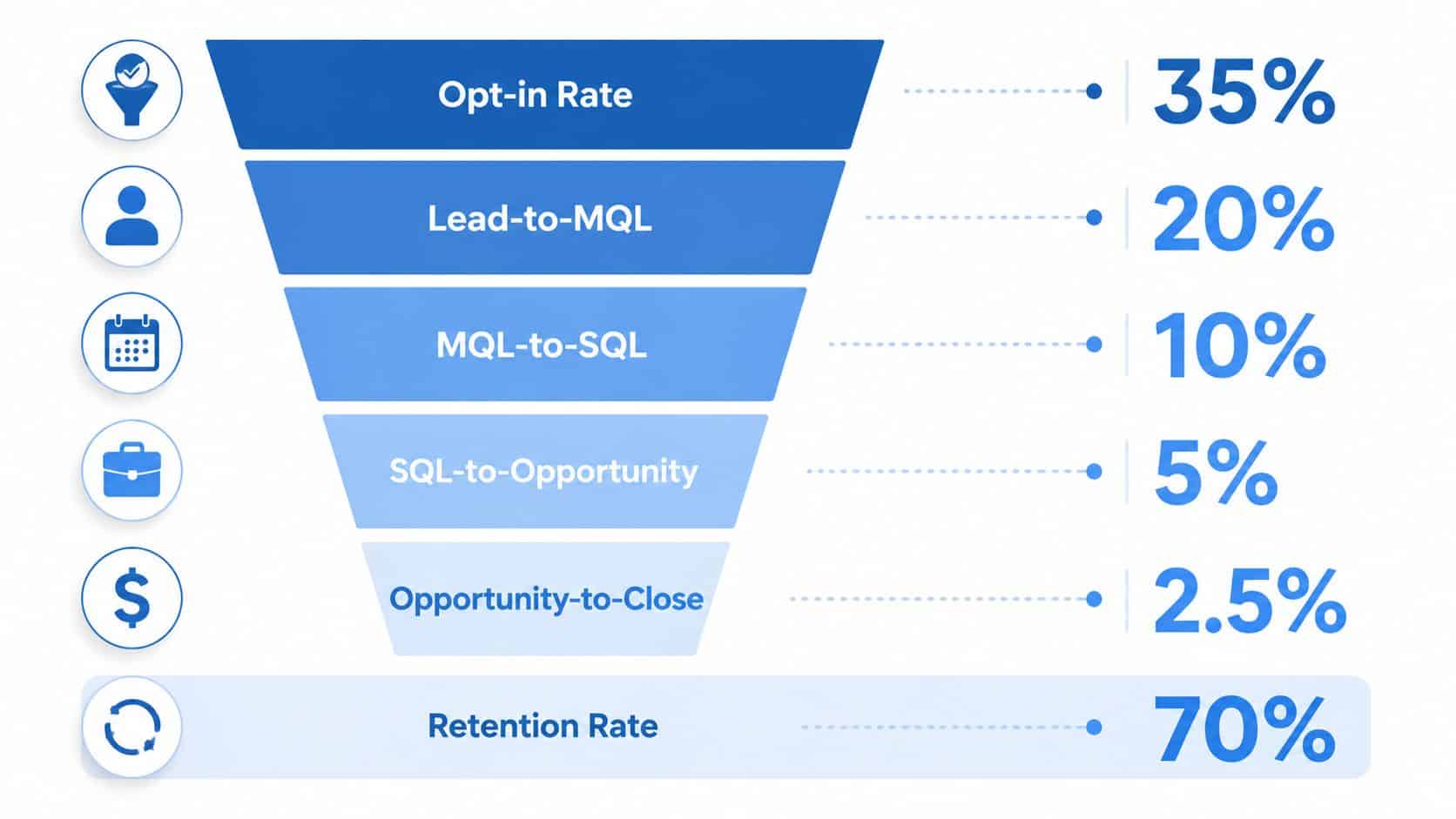
After capture, watch the progression through qualification and sales. B2B benchmark ranges show approximately 25% to 35% from lead to MQL, 13% to 26% from MQL to SQL, 50% to 62% from SQL to opportunity, and 15% to 30% from opportunity to close, as reported in HiBob's sales funnel conversion benchmarks.
These ranges help you ask better questions:
- Lead to MQL: Are forms attracting the right people, and are qualification rules clear?
- MQL to SQL: Does sales agree with marketing about what counts as serious intent?
- SQL to opportunity: Are discovery calls uncovering a real problem, budget, and fit?
- Opportunity to close: Is the proposal understandable, timely, and easy to accept?
A weak stage doesn't always mean the team at that stage is failing. Poor targeting creates weak leads. Weak positioning creates hesitant opportunities. Slow follow-up makes a good inquiry look cold. Measure the handoff before assigning blame.
Put the scorecard where work happens
Track the source, stage, owner, last contact, next action, and outcome in the CRM. Then compare performance by offer, channel, audience, and salesperson. For practical guidance on improving product-page paths and calls to action, review this product video conversion advice.
The same discipline applies after the sale. Watch whether customers return, renew, refer, or respond to reactivation. For agencies building a fuller measurement practice, these conversion optimization essentials for agencies help connect page changes to business outcomes rather than surface-level activity.
Practical Use Cases for Agencies and Small Businesses
A plumber illustrates the value of a funnel better than a whiteboard does. Someone searches for urgent help, calls while driving, reaches voicemail, and contacts another provider if nobody responds. The funnel's job is to preserve that opportunity.

A local service business
The capture points might include a phone call, website form, Google ad, or social message. If the call is missed, an automated text can acknowledge the inquiry and direct the person to a booking calendar. The contact record can store the service type, location, preferred time, and conversation history.
The nurture stage is short but important. Reminder messages reduce forgotten appointments, while a staff member can answer questions from the same conversation record. A deposit, estimate, or payment link can then complete the conversion without forcing the customer through a separate process.
After the job, the business can request a review, send maintenance reminders, and reactivate past customers around seasonal needs. Owners researching a broader small business lead gen approach can use the same structure across paid ads, organic search, referrals, and repeat business. Guidance on proven small business ad strategies can help improve the quality of the traffic entering that system.
A coach or course creator
A coach may begin with a social post, lead magnet, or registration page for a live training session. Reminder emails and messages improve attendance, while the webinar answers objections and demonstrates the coach's process. The conversion may be a course, group program, consultation, or membership.
After enrollment, onboarding messages direct the customer to the first lesson or community space. Later communications can promote the next level of support, invite feedback, and bring inactive members back into the experience.
An agency managing client accounts
An agency needs the same funnel logic across many client businesses, but each account has different offers, audiences, calendars, and follow-up rules. A structured sub-account model keeps client data separate while allowing the agency to standardize snapshots, reporting, automation patterns, and onboarding.
The operational benefit is fewer disconnected handoffs. The account manager can inspect lead status, messages, appointments, payments, and reactivation activity without asking several tool owners to reconstruct what happened.
When the Classic Funnel Breaks and What to Do Instead
The classic funnel is useful for organizing work, but it's not a perfect description of how people buy. Buyers move between channels, revisit earlier questions, ask peers for recommendations, compare alternatives, and return after an apparently inactive period.
The pressure shows up inside sales teams. Lead qualification is now the number one challenge for sellers, according to Outreach's sales data analysis. That finding suggests a funnel is more valuable as an operating system for filtering and prioritizing intent than as a promise that every prospect will move neatly from top to bottom.
Replace the straight line with loops
A modern funnel should support movement in both directions. A lead who isn't ready can enter a nurture audience rather than disappear. A past customer can receive a relevant win-back message. A satisfied customer can enter a review and referral loop.
Use practical signals to manage those loops:
- Lead scoring: Prioritize people who match the offer and show meaningful intent.
- Reactivation: Send targeted email, SMS, or messaging campaigns to inactive contacts.
- Advocacy: Request reviews, referrals, and testimonials after a successful outcome.
- Expansion: Offer a relevant upgrade, add-on, renewal, or membership tier.
Attribution also becomes less tidy. A buyer may discover a business through one channel, ask a question through another, and convert after a direct conversation. Track the complete contact history and the stage outcome, but don't pretend one click explains the entire decision.
The funnel still works when it reflects these loops. It should tell the team who needs attention, what evidence supports that priority, and which action can move the relationship forward.
Best Practices and a Practical Funnel Checklist
A useful funnel begins with a business decision, not a software template. Before building pages or writing automation, define the offer, the audience, the next action, and the person responsible for the handoff.
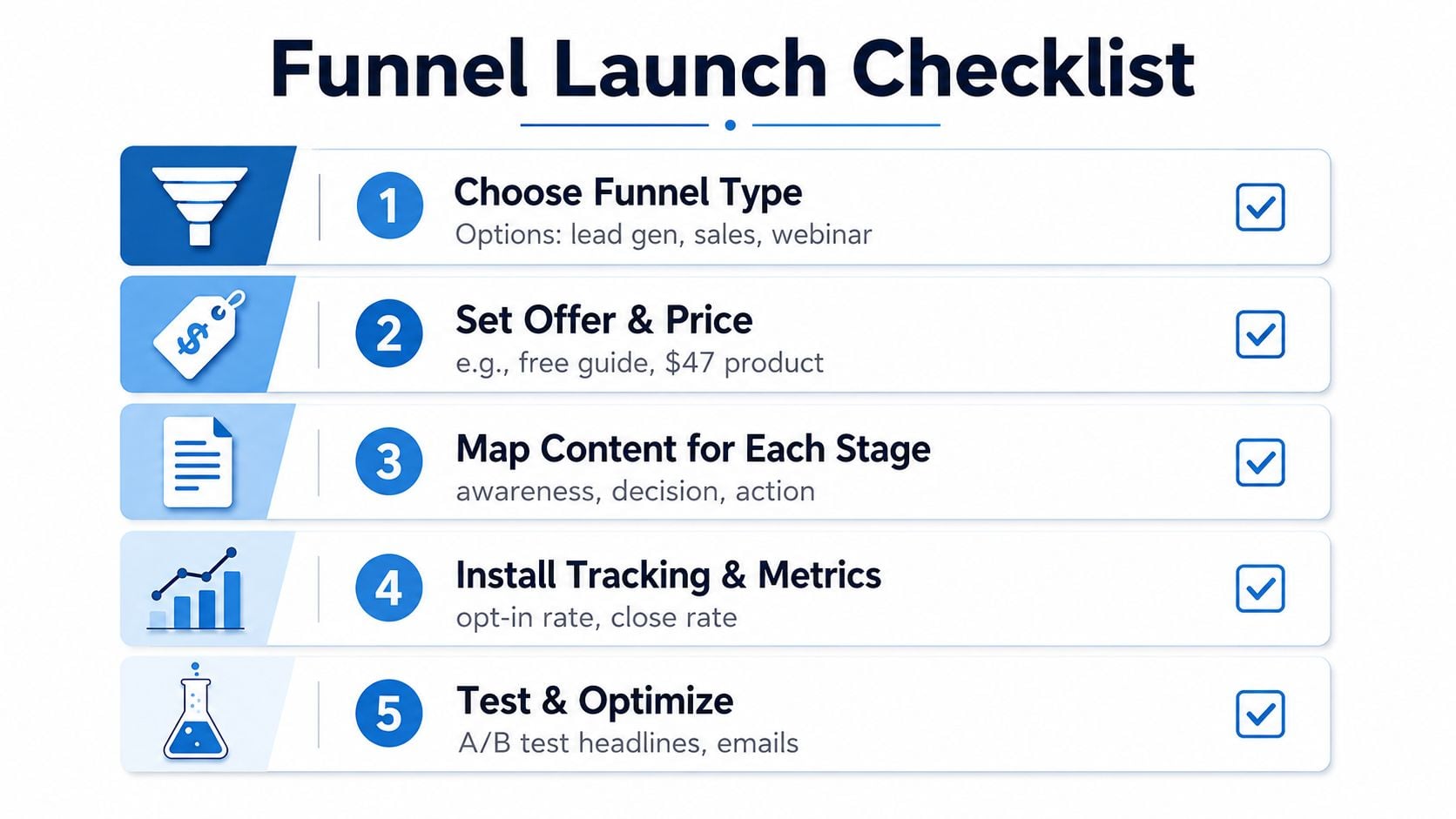
Use this launch checklist:
- Choose the funnel type: Match lead generation, webinar, sales, membership, or booking architecture to the buyer's next decision.
- Define one stage outcome: Give each stage one primary metric, such as a completed form, qualified conversation, booked appointment, paid order, or renewal.
- Write the follow-up path: Decide what the contact receives immediately, what happens if they don't respond, and when a human takes over.
- Connect booking and payment: Keep calendars, reminders, estimates, invoices, deposits, and checkout as close to one flow as practical.
- Instrument the handoffs: Record source, stage, owner, last activity, next action, and final outcome.
- Plan the post-sale loop: Include onboarding, review requests, referrals, repeat purchases, and reactivation before launch.
Review the funnel by stage, not by total lead volume. If capture is healthy but qualification is weak, refine the promise and targeting. If qualified opportunities stall, improve the sales process, proof, proposal, or payment experience. If customers disappear after purchase, fix onboarding and retention before spending more on acquisition.
For teams that need to improve your landing page design, start with one conversion path and one audience. A platform such as HighLevel combines funnel pages, forms, CRM records, conversations, workflows, calendars, payments, memberships, reviews, and reactivation tools in one workspace. That makes it possible to manage the lifecycle without forcing staff to switch between disconnected systems.
A funnel is a living operating system. Review it, update it, and extend it beyond the first sale.
If your agency or small business needs one workspace for lead capture, follow-up, booking, payments, reviews, and reactivation, explore what HighLevel offers. Build the customer journey around the stages your team can measure and manage, then use those records to improve the next conversation.
