


You’re probably staring at a stack of tools right now, trying to make them behave like one system. One app sends the leads, another stores them, a third handles the page, and a fourth collects payments, then someone forgets to follow up and the sale goes cold. That’s the problem sales funnel software is supposed to solve. The strongest platforms don’t just build pages, they reduce leakage between first click and follow-up, which matters because structured lead management has been tied to 50% more sales-ready leads at 33% lower cost in Forrester’s reporting.
For small businesses, the question isn’t whether funnels matter. It’s whether you want to patch together five tools and babysit integrations, or run the whole customer journey in one place. That’s why the best sales funnel software for small business usually comes down to a trade-off between an all-in-one operating system and a specialized stack. HighLevel sits at the center of that conversation because it’s built to replace tool sprawl, while options like ClickFunnels, Leadpages, SamCart, and Kartra each win on a narrower use case.
Table of Contents
- 1. HighLevel
- 1. HighLevel
- 2. ClickFunnels 2.0
- 4. Systeme.io
- 5. HubSpot Marketing Hub
- 5. HubSpot Marketing Hub
- 6. GetResponse
- 7. Keap
- 8. Leadpages
- 9. Kajabi
- 10. SamCart
- Top 10 Sales Funnel Software Comparison
- Choosing Your Winner, All-in-One vs. a Specialized Stack
1. HighLevel
HighLevel makes sense fast for a small business that has outgrown a patchwork setup. If leads arrive through SMS, web forms, Instagram DMs, calls, and booking links, the platform keeps the conversation, the CRM, the funnel, and the follow-up in one place instead of spreading them across separate tools. That matters because the cost of tool sprawl is not just subscription fees. It is the time lost switching between inboxes, calendars, spreadsheets, and automation rules while leads cool off.
Why HighLevel stands out
HighLevel is the benchmark for the all-in-one camp because it is built to reduce integration overhead. It centralizes a unified inbox, CRM, landing pages, funnel builders, forms, quizzes, booking, payments, memberships, reputation management, and broadcast campaigns. For a small business, that combination matters when the process is more important than any single feature. If the team needs to capture a lead, assign it, book it, collect payment, and keep the follow-up moving, one system is easier to run than five subscriptions that barely stay in sync.
The trade-off is straightforward. You get less best-in-class specialization in exchange for fewer handoffs and less admin work. That is often the right call for service businesses, agencies, local operators, and small teams that care more about conversion consistency than about assembling a custom stack piece by piece. For a broader look at the same positioning, see the HighLevel integrated marketing stack.
Practical rule: if a small business needs CRM, booking, SMS, payments, and follow-up automation, the software should behave like one system, not five subscriptions pretending to cooperate.
Its AI layer is also a practical fit for teams that need help keeping pace with inbound activity. It can support faster responses and lighter admin load, which is useful when the same person who manages leads also handles sales, scheduling, and client communication. That said, HighLevel only pays off when the business is ready to commit to one operating system. If your team prefers a single-purpose landing page tool or a separate checkout platform, a specialized option may feel simpler at the start.
1. HighLevel
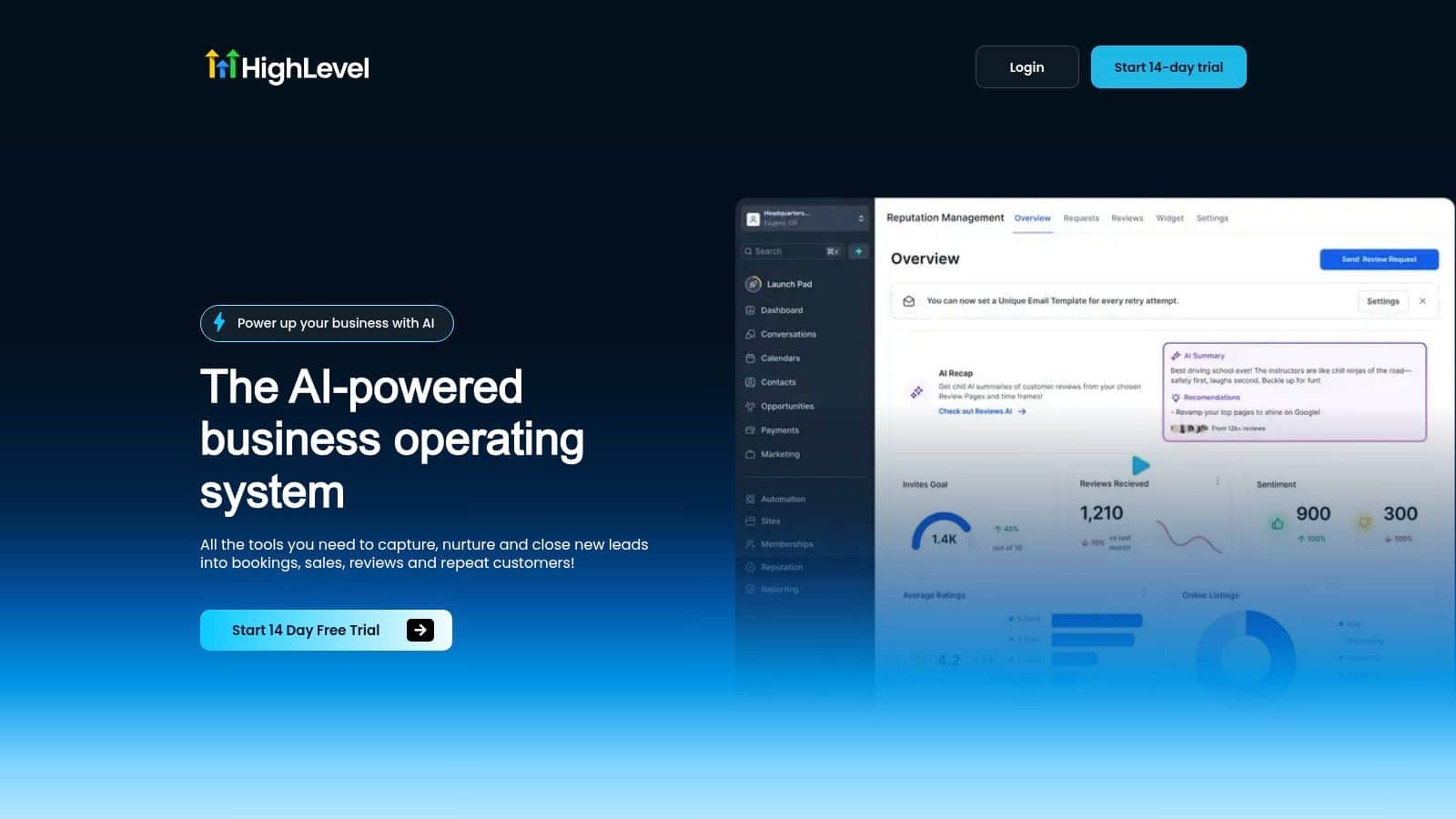
HighLevel makes sense the moment your business has too many moving parts. If your leads come in from SMS, web forms, Instagram DMs, calls, and booking links, the platform’s value is obvious, because it keeps the conversation, the CRM, the funnel, and the follow-up in one operating system instead of scattering them across separate tools. That alignment fits the broader shift in funnel software, where modern buyer guides now treat the category as integrated lifecycle management rather than a page builder with a checkout bolted on (industry overview).
Why HighLevel stands out
HighLevel is the benchmark if your real problem is tool sprawl. It centralizes a unified inbox, CRM, landing pages, funnel builders, forms, quizzes, booking, payments, memberships, reputation management, and broadcast campaigns. That matters because the cost of a lost lead isn’t just the lead itself, it’s the time your team wastes jumping between inboxes, calendars, and spreadsheets to figure out what happened.
Practical rule: if a small business needs CRM, booking, SMS, payments, and follow-up automation, the software should behave like one system, not five subscriptions pretending to cooperate.
Its AI layer is also a real differentiator. Conversation AI, voice support, AI review replies, and content assistance all help reduce the manual work that usually breaks follow-up consistency. For agencies, the structural advantage is even clearer, because unlimited contacts on published plans and unlimited sub-accounts on the Unlimited plan make it easier to manage multiple clients without redesigning the stack every time a new account comes in.
The platform isn’t light, though. It has enough depth that new users can feel the learning curve immediately, and smaller teams that only need a single page plus a checkout can find it heavier than necessary. That’s the trade-off with a true all-in-one, you get less stitching, but you do have to learn the system.
Pricing and trial
HighLevel offers a 14-day free trial. Public pricing includes Starter at $97/month, Unlimited at $297/month, and Agency Pro at $497/month. The published tiers also position the platform for different operating models, with Starter aimed at smaller users, Unlimited for larger multi-client work, and Agency Pro for white-label and SaaS-mode workflows.
For small businesses, the most important pricing question isn’t the sticker price by itself. It’s whether the platform replaces enough separate subscriptions, support headaches, and admin time to justify the move. That’s where HighLevel usually earns its keep, especially for agencies, local service businesses, coaches, and multi-location teams that want capture, nurture, close, and reactivate inside one place.
Best fit and trade-offs
HighLevel works best when the business needs a conversion infrastructure, not just a funnel. It’s the strongest option for teams that care about response speed, multi-channel follow-up, and eliminating integration overhead. It’s less attractive if the only job is “build me a landing page,” because the platform’s real value shows up when the workflow is complex enough to deserve consolidation.
- Best for: agencies, local service businesses, coaches, and SaaS-style operators
- Not ideal for: solo users who only need a simple page and checkout
- Main advantage: one system for capture, nurture, close, and reactivation
The official platform site is HighLevel, and the internal stack perspective is worth pairing with the HighLevel integrated marketing stack if you’re deciding whether consolidation is the right move.
2. ClickFunnels 2.0
A small business that needs a funnel live fast usually cares more about clarity than depth. ClickFunnels still fits that situation because it keeps the path straightforward. A non-technical owner can build a landing page, an order form, an upsell, and a membership area without spending days on setup. That kind of speed matters when the priority is getting offers in market, not assembling a larger stack.
Its main strength is that it stays funnel-first. The platform pushes you toward a sequence of pages and offers instead of asking you to behave like a web designer or CRM admin. For a business with one core offer, or a narrow set of offers, that keeps decisions manageable and reduces setup friction.
Why ClickFunnels still works
ClickFunnels is strongest when the funnel itself is the product. The drag-and-drop builder, funnel templates, and built-in A/B testing help non-technical teams move quickly, and the surrounding ecosystem is mature enough that most users are not starting from a blank page. The trade-off is that the platform performs best when you stay inside its structure. Once you try to bolt on a more custom stack, the simplicity starts to work against you.
The category has moved toward broader lifecycle management, but ClickFunnels still performs well for funnel-centric execution, especially for lead generation, product launches, and webinar flows. If your bottleneck is the page itself, a focused page optimization reference like how to improve landing page performance with HighLevel helps show where the issue sits. Sometimes the problem is the funnel. Sometimes it is the page and the follow-up behind it.
ClickFunnels is a good fit when speed beats polish. If the goal is to get a working funnel live quickly, it handles that job well.
The downside is familiar to anyone who has supported a growing small business. Pricing can feel high compared with budget platforms, and once a workflow depends on the ecosystem, it becomes harder to swap individual pieces later. That is not a flaw by itself, but it does mean the purchase decision should be based on the workflow you want, not on the idea of a general marketing platform.
The site is ClickFunnels, and it remains a credible choice for small businesses that want a classic funnel builder without the overhead of a broader operating system.
4. Systeme.io
Systeme.io works well when the main constraint is budget and the goal is to get a real funnel live without adding another expensive tool to the stack. For small businesses that are still testing the offer, it gives enough structure to validate demand before committing to a more advanced platform. That makes it a practical starting point for first-time funnel builders, early-stage founders, and side businesses that need to keep overhead low.
The appeal is simple. Funnels, email automation, courses, an affiliate program, and basic ecommerce all sit in one place, so you can keep the workflow contained instead of stitching together separate systems. It does not try to match the depth of larger suites, but it is easy to understand and quick to get moving.
Why budget-conscious teams choose it
The free starting point is the main draw. The research notes a free forever plan with 2,000 contacts and 3 funnels, plus paid tiers that stay near the bottom of the category, which makes it easier to test an idea before spending more (pricing overview). For a very small business, that can be enough runway to prove the offer before upgrading.
The trade-off is depth. Design flexibility is basic, analytics are lighter, and customization is narrower than what you get from higher-end suites. That works if the priority is launching a straightforward funnel quickly, then learning from real traffic and real leads. It becomes a constraint if you need advanced segmentation, more detailed reporting, or a brand presentation that requires more control.
There is also a practical operations angle here. A lot of small businesses spend too much too early because they buy separate tools for email, courses, checkout, and automations before the funnel has traction. A simpler setup reduces that overhead, and the email automation guide is a useful reference if you are deciding which pieces need to live in one system versus outside it.
Systeme.io fits best when the business wants a light, contained stack and can accept fewer options in exchange for lower complexity. It is less convincing for teams that already know they need richer reporting or more polished customization, because its strength is keeping the first version of the funnel manageable.
5. HubSpot Marketing Hub
HubSpot works well for small businesses that need marketing and sales to stay organized around a single CRM. It is not the most funnel-first tool in this list, but it becomes a strong option when the problem is tool sprawl, scattered contact data, and too much manual handoff between marketing and sales. Teams with longer sales cycles or a heavier inbound motion often end up here because the reporting structure is hard to outgrow.
The value is in how much sits in one place. Landing pages, forms, email, automation, ads, reporting, and CRM are built to work together, so the funnel is tied to the rest of the customer record instead of living on its own island. That matters when an owner wants to see how contacts move from first visit to closed deal, not just whether a page converted.
Why CRM-heavy teams choose it
HubSpot’s ecosystem is a big reason it gets considered for growing teams. The platform has an app marketplace with 2,000+ integrations, plus deep CRM integration and multi-touch attribution on higher tiers (Systeme.io). That matters when a business already expects to connect accounting, scheduling, support, or other operational tools and does not want a closed system that forces workarounds.
The trade-off is packaging. Seats, credits, and contact tiers can make cost planning harder, especially for small teams that are not used to enterprise-style pricing. HubSpot can also feel heavier than the business needs if the funnel is simple and the sales process is short.
A practical way to judge it is by reporting needs. If the team only needs a landing page, a follow-up sequence, and a basic handoff, HubSpot may be more system than they need. If they need attribution, lifecycle visibility, and a CRM that marketing and sales can both trust, it starts to make sense. For teams still sorting out whether email and automation should live together or stay separate, the email automation guide is a useful reference before committing to a larger stack.
HubSpot is strongest when the business wants one system for contact management, automation, and reporting, and is willing to accept more complexity in exchange for that control.
5. HubSpot Marketing Hub
HubSpot is the safest answer for teams that already care about CRM discipline. It’s not the most funnel-first platform on this list, but it’s one of the strongest when marketing, sales, and reporting need to stay tightly connected. Small businesses with longer sales cycles or a stronger inbound motion often end up here because the data model is hard to beat.
HubSpot’s real strength is that it doesn’t treat the funnel as a separate island. Landing pages, forms, email, automation, ads, reporting, and CRM all sit together, so the business can track contacts through a more complete lifecycle. That’s especially valuable when owners want attribution and visibility instead of just page-level results.
Why it fits CRM-heavy teams
The platform’s scale comes from its ecosystem. The research notes an app marketplace with 2,000+ integrations, plus deep CRM integration and multi-touch attribution on higher tiers (pricing and feature overview). That’s useful if you already know you’ll be syncing with other tools and don’t want a closed system.
The challenge is pricing complexity. Seats, credits, and contact tiers can make it harder to forecast cost, especially for smaller teams that aren’t used to enterprise-style packaging. So while HubSpot is strong technically, it can feel heavier than a small business really needs if the sales process is simple.
HubSpot is best when reporting matters as much as conversion. If the owner wants one source of truth for contacts and campaign performance, the platform makes sense.
If your funnel is mainly a lead-gen mechanism feeding a sales team or a more structured pipeline, HubSpot is a serious option. If the business mostly needs fast capture and simple follow-up, the overhead may be more than you want.
The official site is HubSpot Marketing Hub, and it belongs in the conversation whenever CRM depth is part of the buying criteria.
6. GetResponse
GetResponse is a smart fit for businesses that already think in email sequences. It started from email marketing and expanded into funnels, webinars, landing pages, and website tools, so the experience feels better for email-first teams than for people looking for a pure funnel builder. If your business relies on ongoing nurture, it’s a strong middle-ground option.
Its strength is integration without full suite complexity. You get a funnel layer, but the email engine is still the main event. That works well for creators, ecommerce brands, and service businesses that need automation and webinars to support lead generation.
Why email-first businesses like it
The platform’s biggest selling point is that it combines funnel tools with unlimited monthly email sends on paid plans and marketing automation that can support more advanced workflows on certain tiers. That’s a practical advantage for businesses that send often and don’t want email volume becoming the bottleneck.
GetResponse also works well when the funnel is part of a broader nurture sequence rather than a standalone launch system. If you run webinars, educational campaigns, or lead magnets that need a follow-up series, it’s a sensible fit. The downside is that the funnel builder itself is less specialized than the dedicated funnel-first tools on this list, so it’s not where you go if your main priority is page optimization.
The best way to think about GetResponse is as an email platform with funnel capability, not a funnel platform that happens to have email. That distinction matters because the tool’s strengths reflect where it started.
The website is GetResponse, and it’s a reasonable choice for small businesses that want broadband marketing tools without moving into a heavier all-in-one operating system.
7. Keap
Keap is built for small businesses that need lifecycle automation more than they need flashy funnel design. It combines CRM, pipelines, email, SMS, invoices, appointments, and visual automations, which makes it useful for service businesses where the sale doesn’t happen in one click. If your process includes consults, reminders, and follow-up sequences, Keap is worth a look.
What stands out here is the way it ties marketing to service delivery. Small businesses often lose leads because no one owns the follow-up, or because the customer journey gets messy after the first form fill. Keap is designed to keep that sequence organized.
Why lifecycle automation matters here
Keap’s strengths are the practical ones, not the cosmetic ones. It offers lead scoring, reminders, reporting, and mobile access, so teams can stay on top of appointments and sales activity without layering multiple systems together. For owners who want one place for pipeline management and reminders, that’s useful.
The trade-off is cost and complexity. Keap’s starting price sits above many small-business tools, and advanced automation design takes some learning. That means it’s best for businesses that know they’ll use the system extensively, not for people who just want to spin up a page and collect a few emails.
If the money is made in follow-up, not in the first page view, Keap is more relevant than a pure page builder.
It’s a strong choice for SMBs that need a structured CRM plus automation, but not the best fit for simple one-off funnels. The platform is Keap, and it deserves attention from service businesses that live or die by response consistency.
8. Leadpages
Leadpages is the best reminder that the page itself still matters. If your main bottleneck is turning traffic into leads, the landing page layer is usually where the biggest gain lives, and Leadpages is built for that job. It’s not a full funnel suite, and that’s exactly why some small businesses should choose it.
The platform focuses on fast page creation, lead capture, and testing. That makes it a good fit when you already have email and checkout handled elsewhere, but need the page that sits in front of them to convert better.
Why page quality matters
Leadpages is strong because it helps teams move quickly on the top of the funnel. The research points to AI page generation, drag-and-drop editing, built-in A/B testing, popups, alert bars, and integrations, with Smart Traffic and personalization on higher tiers. It also supports marketing performance improvement via CRO, which is the right lens for businesses that want to squeeze more from existing traffic.
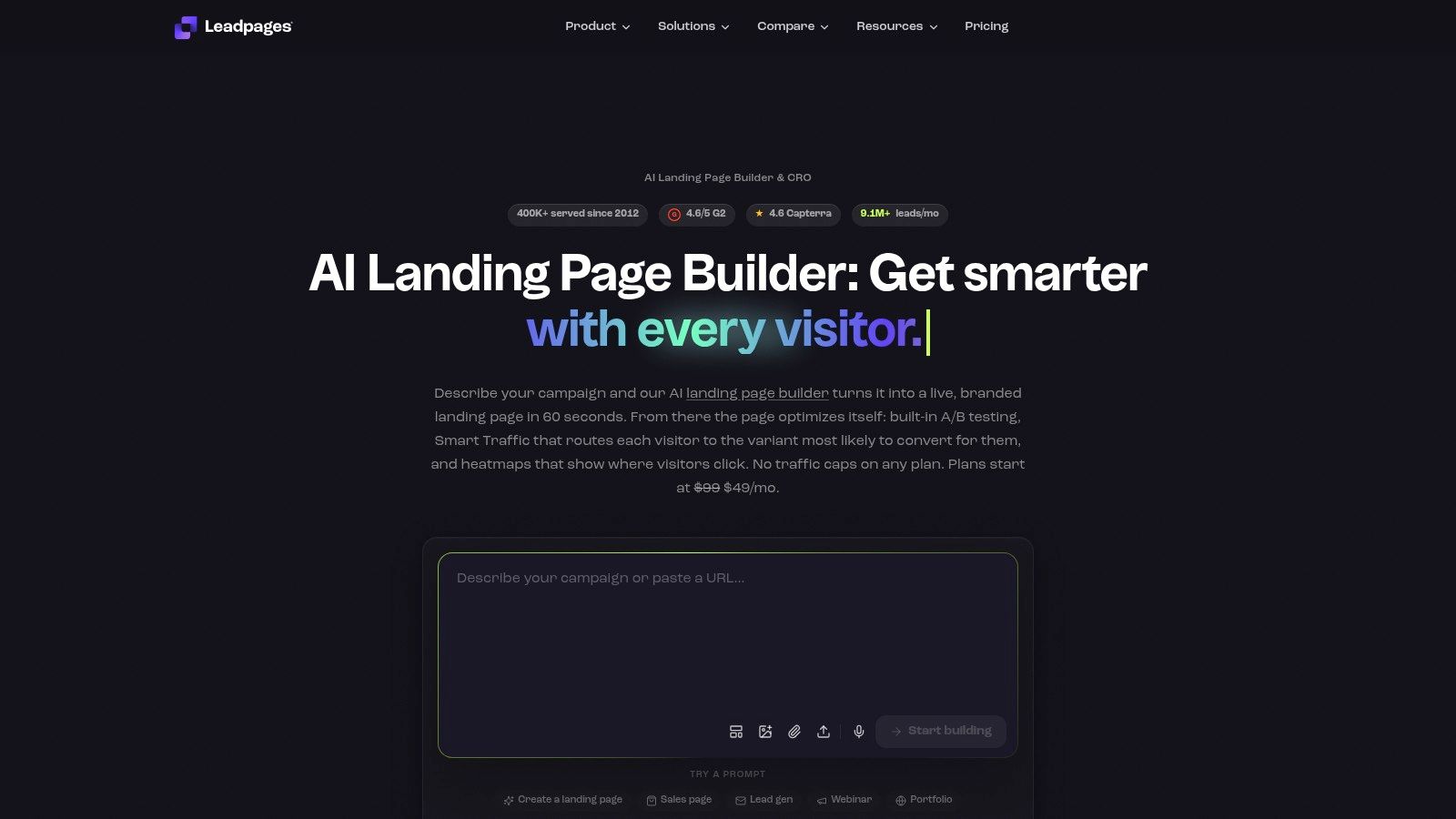
The weakness is obvious. Leadpages is not the system you buy if you want the whole customer lifecycle in one place. It’s the page layer, and you’ll still need a CRM or ESP for the rest. That makes it a stronger fit for businesses with a decent stack already in place than for teams looking to consolidate.
A useful way to judge it is this. If the page is where the funnel leaks, Leadpages is a direct fix. If the problem is follow-up, booking, or payments, it’s the wrong tool to lead with.
The official site is Leadpages, and it’s one of the clearest examples of a specialist tool doing one job well.
9. Kajabi
Kajabi belongs on the shortlist for course creators, coaches, and membership businesses that want the product, the funnel, and the delivery system in one environment. It’s a premium option, but the appeal is obvious if your business model revolves around digital content, communities, and recurring access.
The biggest advantage is simplicity after the sale. You don’t need to move people from a funnel builder to a course platform to a membership tool, because the whole experience stays inside one system. That reduces operational drag and makes the customer experience cleaner.
Why creators shortlist it
Kajabi combines products, courses, memberships, community features, email, funnels, and payments. The research notes unlimited funnels and landing pages across plans, plus branded mobile app support and affiliate programs, which gives creators a lot of flexibility if their main goal is to package expertise and sell it repeatedly.
The internal resource on how to build a membership site pairs naturally with Kajabi because this is the kind of platform people choose when they want one environment for launch and delivery.
The trade-off is price. Kajabi sits at a higher level than many SMB funnel tools, so it makes sense when the business is already monetizing digital products well enough to justify the overhead. It’s less attractive if you’re still testing offer-market fit or only need a simple lead-gen funnel.
Kajabi is a platform for businesses that think in product ecosystems, not just campaigns. The site is Kajabi, and it’s a serious contender if your funnel ends in a course, community, or membership.
10. SamCart
SamCart is the checkout specialist on this list. If your funnel already gets traffic and leads, but the money page underperforms, SamCart is built to fix that part of the journey. It’s especially relevant for creators and small businesses selling digital products, subscriptions, or other offers where checkout optimization can make a meaningful difference in the buying experience.
The platform doesn’t try to be a full marketing suite. That’s good news if what you want is a sharper checkout layer without adding extra complexity to the rest of the stack.
Why checkout optimization is its lane
SamCart’s value comes from the money page features, including optimized checkout pages, one-click upsells, order bumps, subscriptions, and advanced analytics on higher plans. The research also points to affiliate management and customer portal features, which can help businesses keep the post-purchase journey organized.
That specialization is also its limitation. You still need email automation, a CRM, and usually a landing page tool around it. For businesses already running a basic stack, that’s fine. For teams trying to reduce tool sprawl, it can feel incomplete.
SamCart makes sense when the checkout is the bottleneck, not when the whole funnel is broken.
The platform is strongest when you know your traffic converts but the payment step needs work. If your main issue is follow-up, lead management, or lifecycle automation, a broader system will serve you better. If your issue is cart optimization, SamCart is a credible specialist.
The website is SamCart, and it’s the most focused checkout-first option in this comparison.
Top 10 Sales Funnel Software Comparison
| Product | Core capabilities | 👥 Target audience | ✨ Unique selling points | ★ Quality | 💰 Price / Value |
|---|---|---|---|---|---|
| 🏆 HighLevel | CRM + unified inbox (SMS/WhatsApp/FB/IG), funnels/pages, forms + Conversation AI, bookings/payments, reputation, broadcasts, automations | Agencies, local service businesses, coaches, course creators | Native AI across messaging/voice/reviews; unlimited contacts & sub-accounts (Unlimited); mobile-first app; full customer lifecycle in one platform | ★★★★★ | 💰 $97 Starter → $297 Unlimited → $497 Agency Pro (14‑day trial) |
| ClickFunnels 2.0 | Funnel/page builder, templates, native checkout, A/B testing, memberships | Non-technical marketers, product launch teams | Funnel-first UX; deep template library; quick time-to-launch | ★★★★☆ | 💰 Mid–high; tiered plans (higher than freemium) |
| Kartra | Pages/funnels, email/SMS automation, checkout (1‑click upsells), memberships, analytics | Small teams wanting integrated stack | Truly integrated all-in-one; campaign marketplace; flexible billing/subscriptions | ★★★★ | 💰 Mid; pricing shown after signup/trial |
| Systeme.io | Funnels, email campaigns, courses/memberships, affiliates, webinars | Budget SMBs, beginners, solopreneurs | Free‑forever tier; low-cost plans; fast to learn & deploy | ★★★★ | 💰 Free plan + low-cost paid tiers, budget-friendly |
| HubSpot Marketing Hub | Landing pages, forms, email, automation, CRM, ads, reporting, 2000+ integrations | Scaling SMBs → enterprise; inbound marketing teams | Deep CRM + reporting, multi-touch attribution, extensive integrations | ★★★★★ | 💰 Free → Enterprise; powerful but can be costly/complex |
| GetResponse | Sales funnels, landing pages, email, webinars, courses | SMBs and creators on a budget | Unlimited monthly emails on paid plans; built-in webinar tools | ★★★★ | 💰 Competitive pricing; good value for email+funnels |
| Keap (Infusionsoft) | CRM, visual automations, lead scoring, checkout/invoicing, SMS, appointments | SMBs focused on lifecycle automation & growth | Strong automation capabilities; SMB support and templates | ★★★★ | 💰 Higher starting price; strong ROI for automation-heavy users |
| Leadpages | AI page generation, drag-and-drop landing pages, A/B testing, popups | Page-centric marketers who use external CRM/ESP | Fast AI page creation; Smart Traffic personalization on higher tiers | ★★★★ | 💰 Clear mid-tier pricing; AI credits on plans |
| Kajabi | Courses, memberships, funnels, email automations, community, payments | Coaches, creators, course creators selling digital products | Unified product delivery + marketing; branded mobile app; strong creator features | ★★★☆ | 💰 Premium pricing; higher cost for all-in-one course delivery |
| SamCart | Optimized checkout pages, 1‑click upsells, subscriptions, A/B testing (Pro+), affiliate center | Creators & SMBs optimizing conversion & AOV on checkout pages | Checkout-first focus; one-click upsells/order bumps; dunning & subscriptions | ★★★★ | 💰 Mid; Pro required for advanced features (7‑day trial) |
Choosing Your Winner, All-in-One vs. a Specialized Stack
The best sales funnel software for small business comes down to one real question. Do you want one platform to own the whole workflow, or do you want to assemble the best tool for each stage? There isn't a universal winner, because the right answer depends on how much complexity your business can tolerate and how much time you want to spend managing systems.
For most agencies, local service businesses, coaches, and small teams that need more than a landing page, HighLevel is the most efficient choice. It reduces the hidden costs of tool sprawl by bringing capture, nurture, booking, payments, reputation, and follow-up into one place, which is exactly where small businesses lose money when the stack gets messy. That's also why the category itself has shifted so hard toward integrated lifecycle management, because modern funnel software is no longer just about page creation, it's about keeping the whole customer journey connected (category overview).
Specialized tools still make sense. Leadpages is a smart buy if your conversion bottleneck is the page itself. SamCart is strong if checkout needs optimization. Kajabi works when the business is really a product or membership business. ClickFunnels is still useful for people who want the classic funnel workflow without the weight of a broader operating system.
If you're deciding based on cost, don't stop at the monthly fee. Count the integrations, the switching time, and the admin burden of keeping separate tools synced. That's where all-in-one platforms often become cheaper in practice, even when the line item looks higher on paper.
If you're ready to stop stitching together disconnected tools and want a single system for leads, follow-up, booking, payments, and automation, take a close look at HighLevel. It's built for small businesses that need their funnel software to do more than collect names, it needs to move revenue forward.
