


You’re staring at a messy pipeline again. A seller texted yesterday, your team meant to follow up, and now the thread is buried under new leads, a skipped call, and three different places where deal notes should’ve lived. That’s the cost of the wrong CRM in investing, missed follow-up, lost seller trust, and dispositions that stall because nobody can see the next action fast enough. The best CRM for real estate investors isn’t the one with the prettiest dashboard, it’s the one that keeps every lead, task, offer, and closing step moving without forcing your team to stitch together five tools and hope nothing breaks.
Purpose-built investor CRMs do three things better than generic sales software. They centralize lead capture, they enforce follow-up, and they keep deal activity visible enough that nobody “forgets” a motivated seller. The platforms below are sorted by how they work in a day-to-day investor workflow, not by vendor hype, so you can match the tool to your deal volume, your team size, and how much of your stack you want inside one system.
Table of Contents
- 1. The HighLevel Property Investor Playbook
- 2. REI BlackBook
- 3. FreedomSoft
- 4. REsimpli
- 5. CarrotCRM, formerly InvestorFuse
- 6. REI Reply
- 7. Forefront CRM
- 8. Left Main REI, Salesforce-Based
- 9. Beast Mode CRM, Podio-Based by REI Automation Squad
- 10. Pebble, Land Investors
- Top 10 CRMs for Real Estate Investors, Features & Pricing
- Pick the CRM That Matches Your Deal Volume, Not Your Wish List
1. The HighLevel Property Investor Playbook

The HighLevel Property Investor Playbook is the strongest choice for investors who want an operating system, not just a contact database. It gives you a done-for-you Property Investor Snapshot, website and offer-funnel templates, automations for lead capture and follow-up, and training materials so you can launch without building from scratch. The cleanest way to think about it is simple, this is the stack for investors who want to move from lead to offer inside one environment, instead of bouncing between a CRM, funnel builder, calendar app, inbox, and review tool.
Practical rule: If your current process breaks because follow-up lives in one tool and marketing lives in another, this is the one to test first.
Because it sits on HighLevel, the Playbook inherits the platform’s unified inbox for SMS, social DMs, email, and live chat, along with visual workflows, ad management, Content AI, payments, and reputation tools. That matters for investors because speed-to-lead and consistency are where most deals leak, not in the final contract stage. For teams that want the broader architecture behind that stack, the platform’s HighLevel for marketing stack overview shows why it’s built to centralize capture, nurture, booking, and reactivation in one workspace.
Who it fits best
This is the best fit for solo wholesalers, scaling acquisitions teams, and agency-style investor operators who manage multiple workflows or multiple brands. The Unlimited plan’s unlimited sub-accounts and contacts make it the clear choice for teams that don’t want to outgrow their software after one good quarter. It’s also the right option if you’re running a lead-gen machine and need one system for calls, SMS, calendars, offers, and reputation.
The tradeoff is obvious. It’s feature-rich enough to overwhelm a casual operator, and the monthly cost is real. But if your goal is to reduce tool fragmentation and make follow-up reliable, this is the most complete option on the list.
Why it stands out
- Ready-to-launch investor assets mean less setup and fewer blank-slate decisions.
- Unified communication keeps the full lead history in one place.
- Automation plus AI helps reduce missed follow-up and slow response times.
- Scales cleanly from one operator to a larger team.
- Trial access lets you validate the fit before committing.
2. REI BlackBook
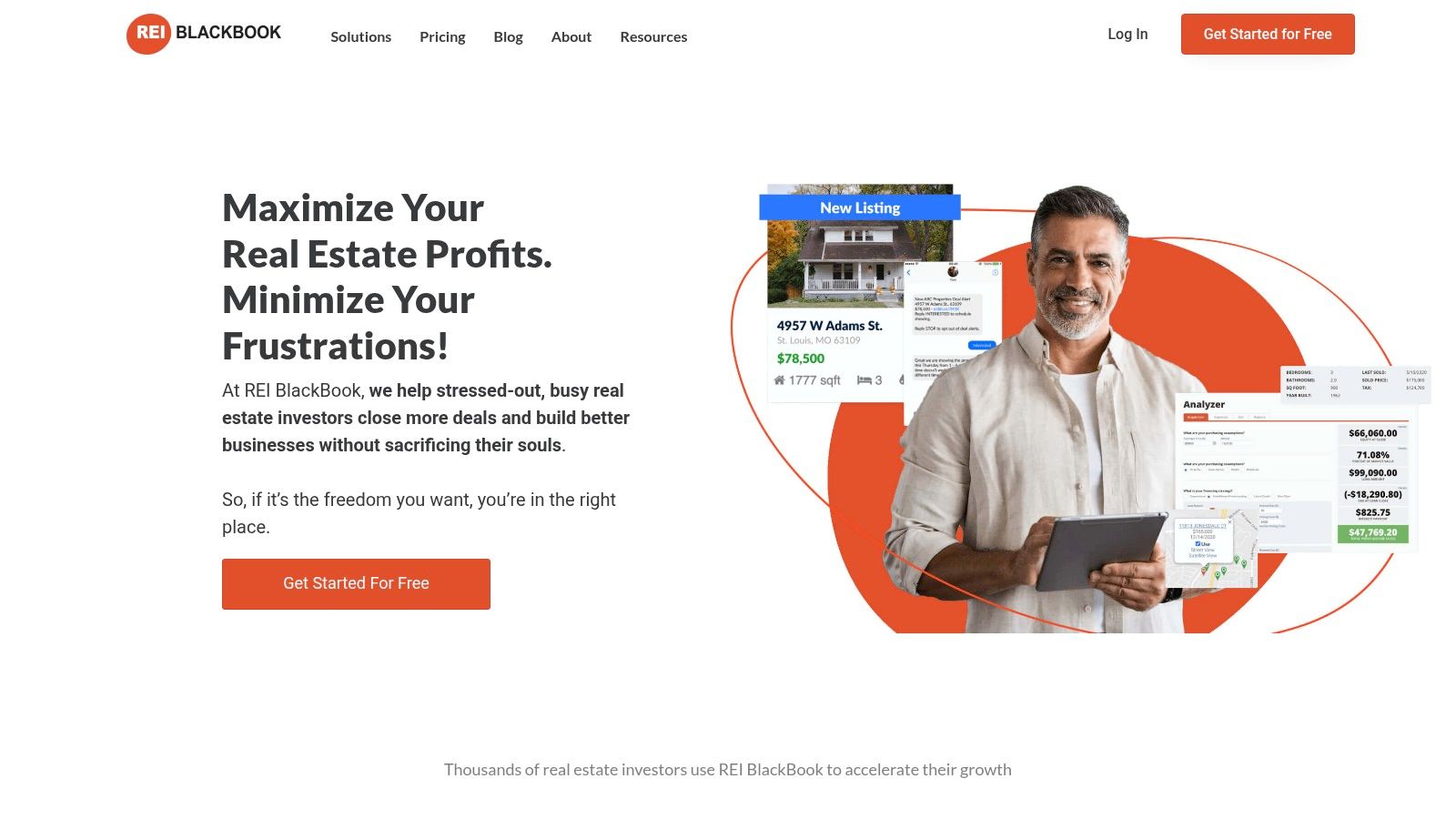
REI BlackBook is the all-in-one choice for investors who want lead generation, follow-up, and deal management under one roof. It pushes hard on the “replace your stack” angle with phone, SMS, email, pipeline tracking, websites, funnels, list pulling, direct mail, and driving-for-dollars tools in one ecosystem. That makes it a strong fit for teams that hate juggling vendors and want a single system of record for day-to-day acquisition work.
Who it fits best
This is best for solo wholesalers who are ready to consolidate tools and for small-to-mid acquisitions teams that need enough depth to support volume. It also works for operators who want a true operating system instead of a light CRM bolted onto separate marketing tools. If you’re still building your process and want one vendor to handle most of it, REI BlackBook keeps the workflow tighter than a generic CRM ever will.
The main caution is usage cost and platform weight. SMS, voice, and data actions can add to the bill, and a heavy system like this usually deserves a real onboarding window. If your team won’t use the features, you’ll pay for more than you need.
The smartest REI CRM choice is rarely the one with the most modules. It’s the one your team will actually run every single day.
For investors comparing follow-up stack depth, the same logic applies to best lead tracking software tools. Tracking only works when the data and the next action live together.
3. FreedomSoft
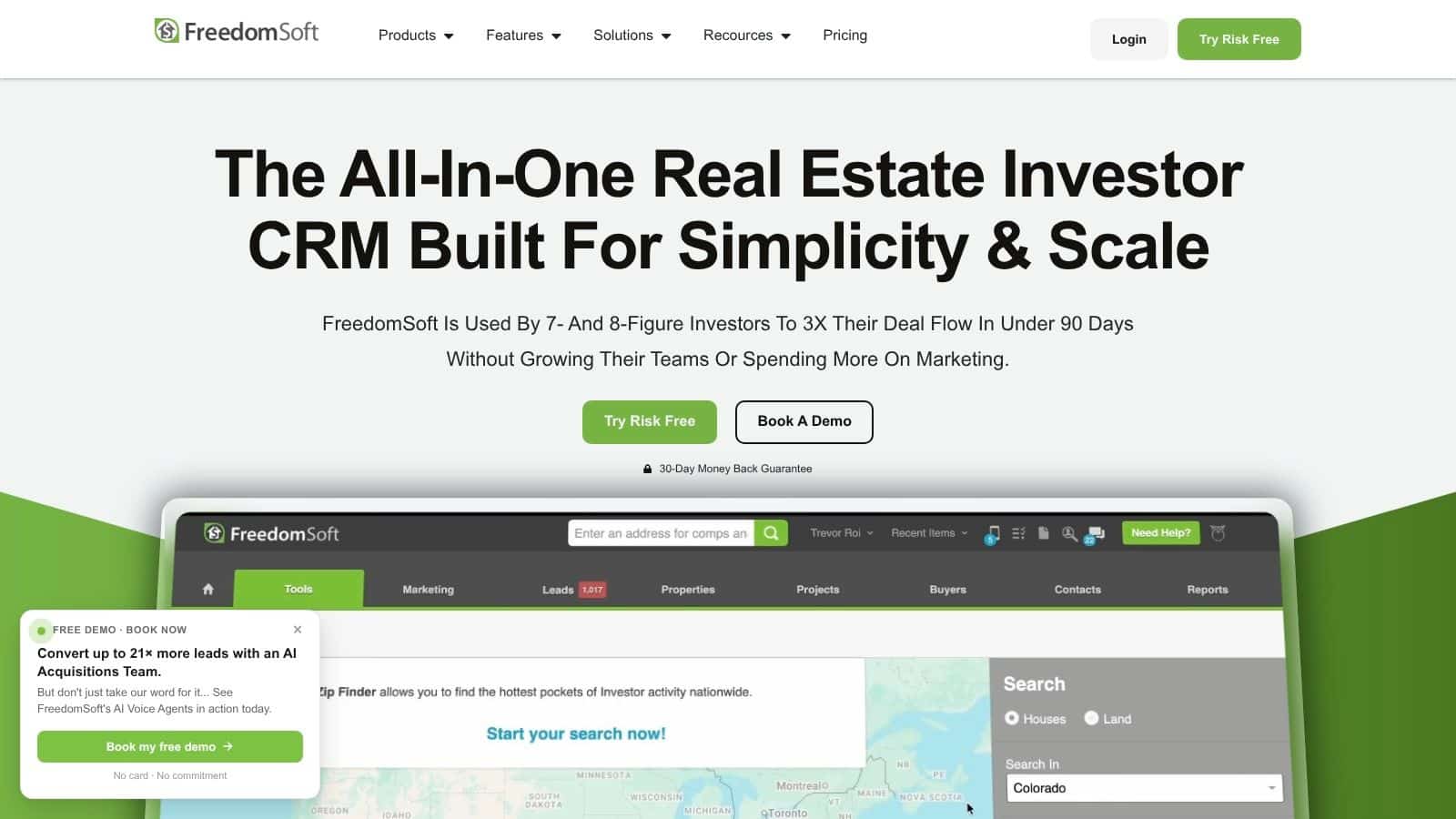
FreedomSoft has long been one of the most recognizable all-in-one investor platforms because it goes beyond contact management and into actual deal workflow. You get list building, dialer tools, direct mail, websites, deal analysis, dispo tools, and native AI voice agents aimed at speed-to-lead and follow-up. That breadth makes it attractive to investors who want a single vendor for sourcing, nurturing, and closing.
The platform is especially useful when an investor is tired of duct-taping together lead data, outbound calling, and offer management. It gives you a cleaner handoff from prospecting into deal work, which is where a lot of smaller teams lose momentum.
Who it fits best
FreedomSoft fits solo operators and growing acquisitions teams that care more about end-to-end deal flow than polish. It’s a practical choice if you’re doing outbound lead generation and want tools for list building, direct mail, and follow-up inside the same system. It also works well for teams that need disposition support and don’t want to buy separate software for every stage.
The downside is cost creep. Usage fees for SMS, voice, and AI can add up at scale, so heavy-volume teams need to watch the overages carefully. It’s powerful, but it’s not the cheapest way to stay organized.
What it does well
- List building and dialer tools keep sourcing and outreach close to the CRM.
- Native AI voice agents help with speed-to-lead and missed-call recovery.
- Deal analysis and dispo reduce the need for extra software.
- Clearer plan structure makes it easier to estimate fit before buying.
4. REsimpli
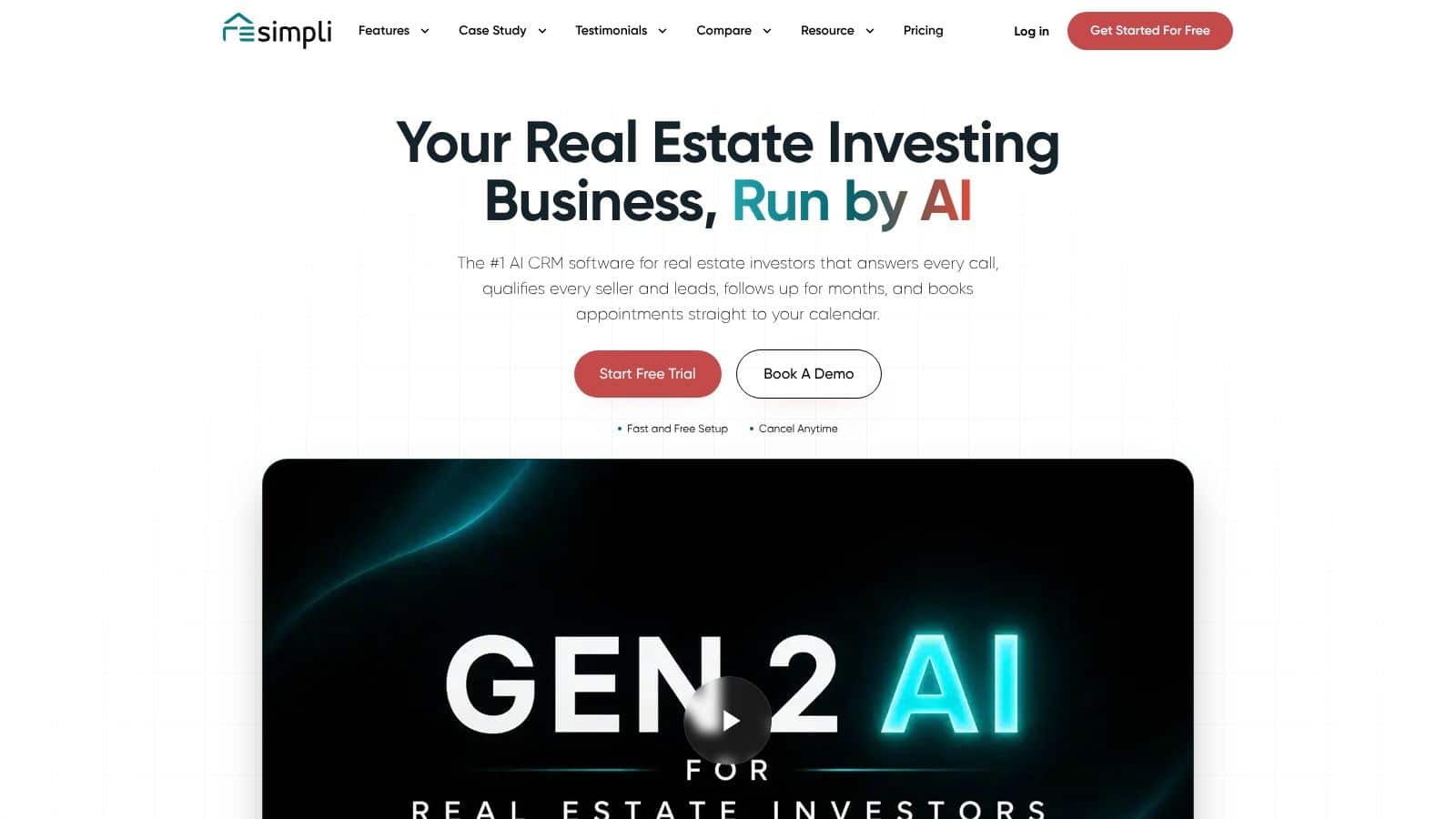
REsimpli is built for investors who want broad functionality without spending weeks assembling a custom stack. It combines CRM, dialer, SMS, email, websites, list stacking, skip tracing, direct mail, accounting, KPI dashboards, and AI agents. In plain English, it’s one of the broadest single-vendor systems on this list, and that makes it useful for teams that want to turn on a platform and start working.
The best argument for REsimpli is simplicity at launch. You’re not chasing integrations just to get a workable acquisition pipeline, and that matters when speed matters more than elegance. The platform is especially attractive if you want operational visibility, since the KPI and accounting layers keep more of the business in one place.
Who it fits best
REsimpli is best for scaling acquisitions teams and multi-market operators who want one bill and minimal integration headaches. It’s also a good fit for investors who are comfortable paying for AI-enabled workflows if those workflows save manual labor. If you want the widest feature net without going all the way into enterprise software, this is a strong middle path.
The cost warning is straightforward. AI bundles can add a lot to the monthly number, and usage fees still apply beyond plan allotments. That’s fine if your team uses the system heavily, but not if you’re buying software to sit idle.
Best use case: Teams with enough lead volume to benefit from automation, but not so much complexity that they need Salesforce-level customization.
5. CarrotCRM, formerly InvestorFuse
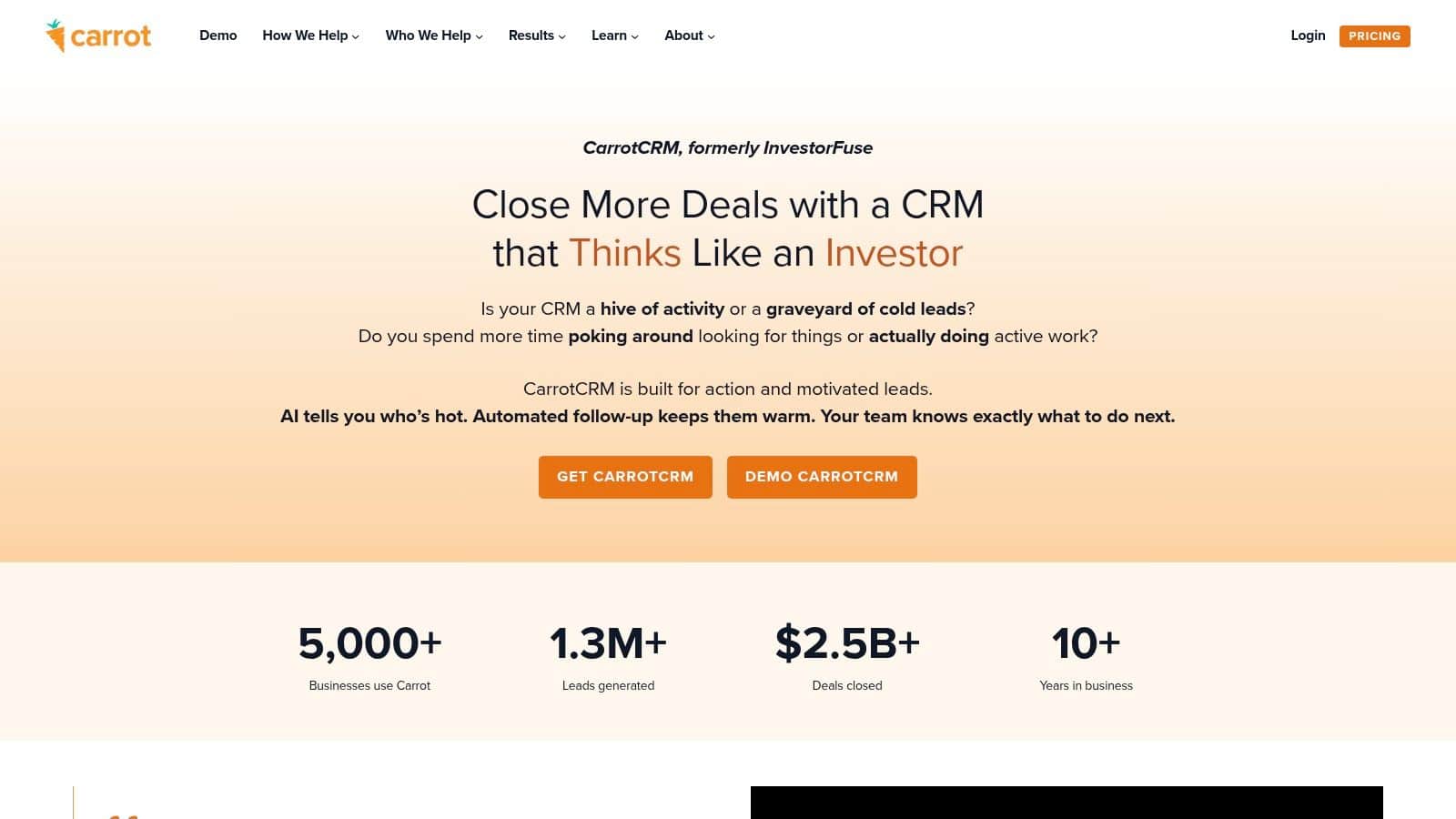
CarrotCRM, formerly InvestorFuse, is the cleanest choice on this list for investors who care about action discipline more than feature sprawl. Its entire model is built around next steps, due dates, and a “Your Day” dashboard that keeps the team focused on what needs attention. That makes it unusually effective for inbound and referred leads, where response quality matters more than blasting volume.
This is the CRM for teams that already know what they want to sell and just need a system that prevents lead decay. It doesn’t try to be a giant operating system, and that’s the point. It stays light, focused, and fast.
Who it fits best
CarrotCRM is best for solo wholesalers and small acquisitions teams that rely on inbound leads, referral traffic, or Carrot websites. It also suits investors who want a focused CRM that complements a best-of-breed stack instead of replacing everything. If you value adoption and clarity over complexity, this is one of the easiest systems to get running properly.
The main limitation is by design. It doesn’t do bulk SMS or email blasting, and it’s not a data-list machine. If you need skip tracing, dialers, or direct mail, you’ll need additional tools.
For teams thinking about focused lead follow-up, the same discipline shows up in real estate CRM for agents, where the best systems keep the pipeline visible and the next action obvious.
6. REI Reply
REI Reply is the budget-friendly play for investors who want automated follow-up without paying for a heavier operating system. It centers on CRM, pipelines, SMS and calling workflows, missed-call text-back, and AI assistants. The big differentiator is its telecom model, which lets you bring your own Twilio usage rather than paying a hidden markup to the platform.
That makes REI Reply appealing to lean operators who know they need automation but don’t want a full all-in-one suite yet. It’s a conversation engine first, and that’s a useful category if your biggest leak is slow response.
Who it fits best
This is the best choice for solo wholesalers and small teams that care about texting speed and low upfront software cost. It’s especially relevant for operators who already understand telecom setup and don’t mind handling the details themselves. If you’re building a lean follow-up system and want to avoid all-in-one bloat, it does the job well.
The tradeoff is clear. You’re taking responsibility for telecom management, including Twilio and A2P 10DLC setup. That’s fine for experienced operators, but it can frustrate teams that want a more turnkey experience.
If your current bottleneck is text follow-up, then the right comparison isn’t just CRM software. It’s your whole SMS workflow, and that’s why a guide to SMS for agencies is useful when you’re deciding how much of the communication stack should live inside your CRM.
7. Forefront CRM
Forefront CRM is for investors who want a clean, visual, and very focused system. It doesn’t try to be a giant all-in-one platform. Instead, it keeps lead, offer, and task tracking simple enough that teams can use it every day without a long adaptation period.
That simplicity is the point. For some investor teams, especially newer ones, the fastest way to close more deals is to reduce software friction, not add another layer of bells and whistles.
Who it fits best
Forefront fits solo wholesalers, small acquisitions teams, and anyone who wants “just CRM” without a lot of extra machinery. It’s also a good option for mobile-first operators who want lead visibility on the go and don’t need built-in list stacking or direct mail. If your business process already lives elsewhere and you just need a better place to track action, this is a sensible choice.
The limitation is equally obvious. It’s not an all-in-one, and that’s not a flaw if you already have a stack in place. If you need sourcing tools or marketing automation inside the CRM itself, you’ll outgrow it fast.
Why it feels different
- Visual pipelines make deal status obvious at a glance.
- Simple task management keeps the next action from disappearing.
- Mobile access helps field-heavy teams stay current.
- REI-specific workflow design avoids the generic-sales-tool problem.
8. Left Main REI, Salesforce-Based
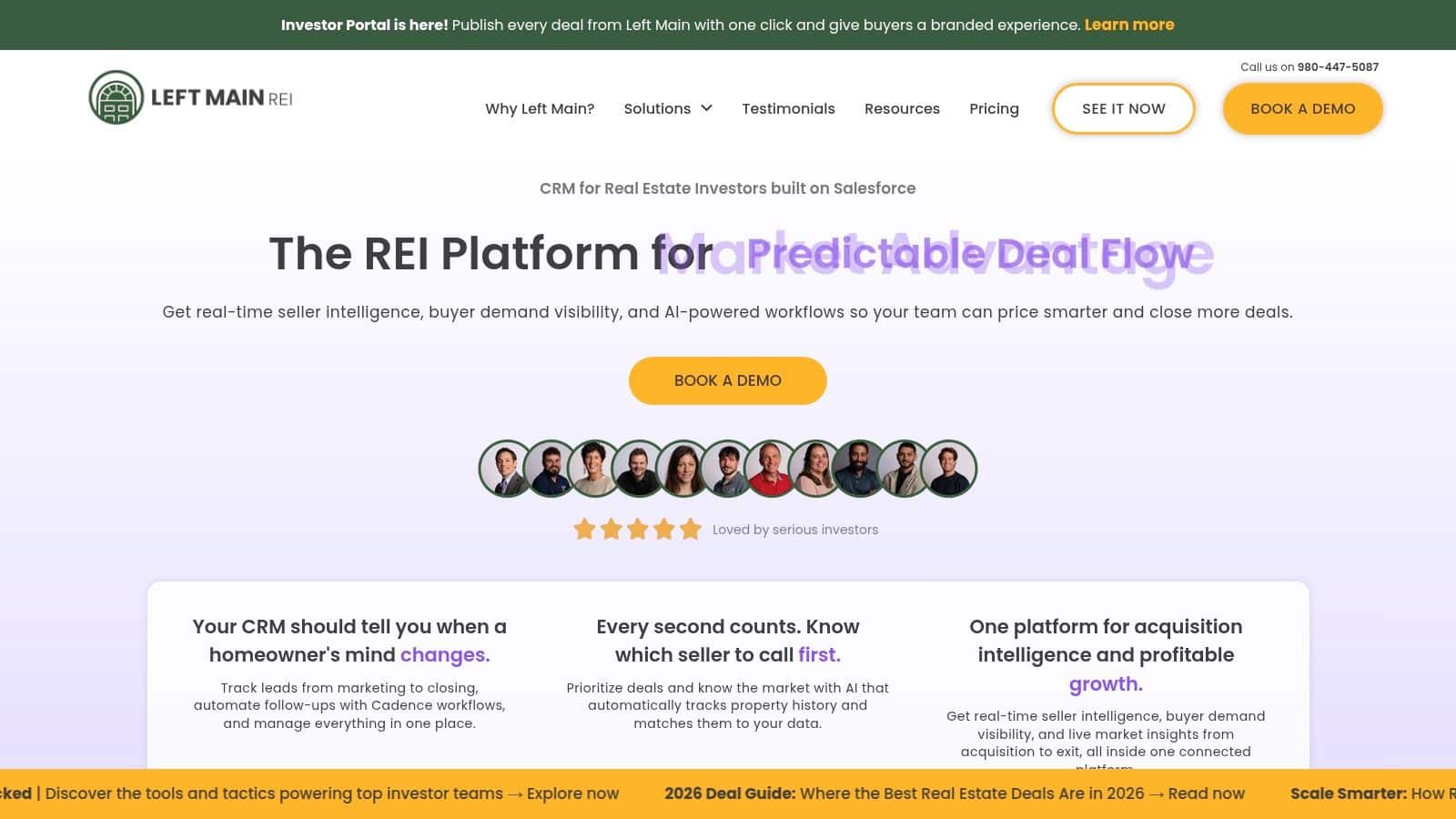
Left Main REI is the premium option for investors who’ve already outgrown SMB software and need enterprise-level flexibility. Because it’s built on Salesforce, it brings scale, security, customization, and deep automation to the table. It also adds REI-specific layers like property sales AI, DealSignals, DispoSignals, and an investor portal for publishing deals.
This is not a casual buy. It’s a serious operating choice for firms where the CRM has to support acquisition, transaction management, and investor-facing workflows across a larger team.
Who it fits best
Left Main REI is the best fit for agency operators, larger acquisitions teams, and commercial or multi-entity investor firms that need more than a standard lead tracker. It’s also the strongest option for teams that already understand Salesforce or are willing to invest in implementation. If you’re scaling processes across multiple users and need extensibility, this sits in a different class from the lightweight investor tools.
The downside is friction. Higher entry cost and more implementation effort are part of the package, and teams without Salesforce experience should expect onboarding. But for the right buyer, that tradeoff is exactly why it works.
If your organization already treats CRM as infrastructure, not software, then this kind of build starts to resemble the CRM versus project board decision that agency teams make when they move from convenience to control.
9. Beast Mode CRM, Podio-Based by REI Automation Squad
Beast Mode CRM is the Podio-based pick for investors who want a proven REI workflow without building from scratch. It bundles automation, KPI tracking, offer handling, contract workflows, and follow-up sequences inside the Podio ecosystem. The appeal here is practical, you’re getting a system designed by people who understand investor operations, not a generic board pretending to be one.
The Podio foundation does mean customization can get deeper and more technical. That’s not a problem if your team likes flexibility, but it can become a drag if no one owns the system well.
Who it fits best
This is a smart choice for growing acquisitions teams and operators who want more structure than a basic CRM but don’t want to jump straight to Salesforce. It also suits teams that already use Podio or have process help from a consultant. If you want strong KPI visibility and a well-defined investor workflow at a more approachable price point than enterprise software, it’s worth a hard look.
The weakness is maintenance. Deeper customization typically requires extra help, and some add-ons cost more. That makes it a solid platform, but not the easiest one to keep tidy over time.
10. Pebble, Land Investors
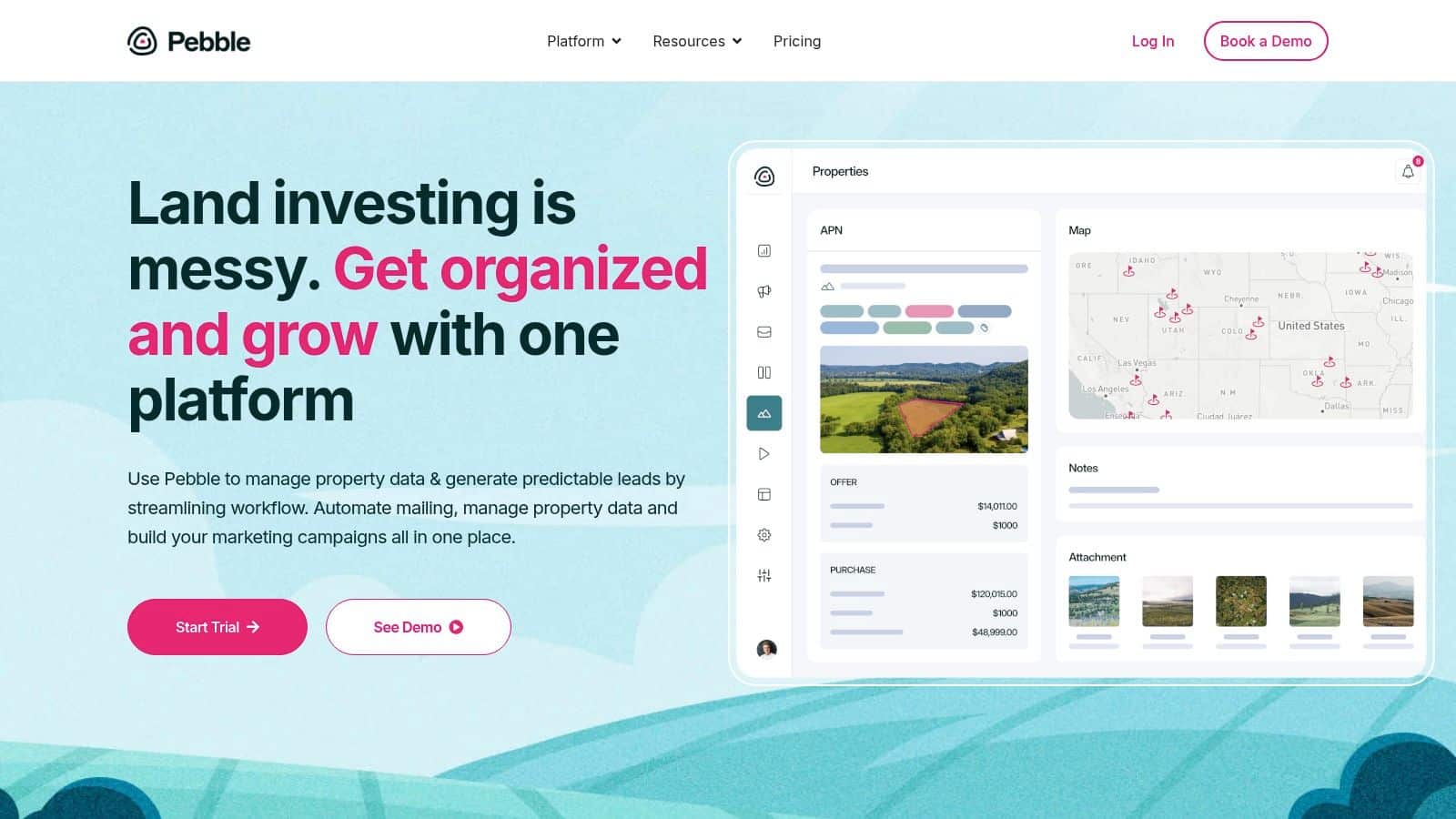
Pebble is the land investor’s CRM, and that specialization is exactly why it deserves a spot here. It centers seller and buyer pipelines, inventory, neighbor letter marketing, print-and-mail, land websites, phone and SMS, and deal automations. If your business is vacant land, this is one of the few tools built around the actual workflow instead of around generic house wholesaling assumptions.
The best thing about Pebble is focus. It doesn’t try to serve every type of real estate investor, so the land-specific features feel intentional rather than bolted on.
Who it fits best
Pebble is the best fit for land specialists who need a purpose-built workflow for acquisition and disposition. It’s also a good choice for small teams that want a scalable user model without bringing in tools they’ll never use. If your business revolves around parcel inventory, mail campaigns, and land buyers, this is the most directly relevant platform on the list.
It’s not the right move for a traditional house wholesaler who needs broader data tooling. Telecom and mailing usage fees also matter, so you’ll want to watch the true monthly cost. For the right niche, though, Pebble is efficient in a way generic CRMs rarely are.
Top 10 CRMs for Real Estate Investors, Features & Pricing
| Product | Key features | UX & Rating | Price / Value | Target audience | Standout (USP) |
|---|---|---|---|---|---|
| The HighLevel Property Investor Playbook 🏆 | Plug‑n‑play investor templates, CRM + unified inbox, funnels, paid calendars, payments, reputation, Conversation AI | ★★★★★ Mobile‑first, AI‑native, 24/7 support | 💰 Starter $97/mo · Unlimited $297/mo · unlimited contacts/sub‑accounts | 👥 Solo investors → agencies scaling/white‑label | ✨ End‑to‑end stack + native AI; fast onboarding & training |
| REI BlackBook | Unified CRM, websites/funnels, dialer, ListHQ, Ads & AI add‑ons | ★★★★ Tiered capacity; strong reporting | 💰 Tiered plans; usage fees for SMS/voice/list pulls | 👥 Solo wholesalers → multi‑market teams | ✨ Built‑in list pulling + dispo tools |
| FreedomSoft | List building, dialer, direct mail, heat maps, rehab manager, AI voice agents | ★★★★ Deep investor workflows; clear tiers | 💰 Tiered plans; SMS/voice/AI minute overages | 👥 Growing investor teams needing workflow depth | ✨ Native AI voice agents + deal analysis |
| REsimpli | CRM + dialer/SMS/email, list stacking, skip tracing, accounting, AI agents | ★★★★ Broad single‑vendor toolset; free onboarding | 💰 Plans + AI agent bundles (add'l cost); usage fees apply | 👥 Teams wanting minimal integrations day‑one | ✨ Most complete single‑vendor REI toolset |
| CarrotCRM (InvestorFuse) | Action‑based CRM, "Your Day" dashboard, AI lead scoring, deep site integrations | ★★★★ Fast, light UI; easy adoption | 💰 Moderate pricing; not an all‑in‑one | 👥 Inbound/referred lead investors; lean teams | ✨ Purpose‑built conversion workflows; lightweight |
| REI Reply | CRM, pipelines, SMS/call workflows, missed‑call text‑back, AI assistants | ★★★ Budget‑friendly, conversation focused | 💰 Low headline fee; Twilio pay‑as‑you‑go (no markup) | 👥 Price‑sensitive investors who manage telecom | ✨ Transparent telecom pass‑through; low cost |
| Forefront CRM | Visual pipelines, task mgmt, mobile app, integrations & webhooks | ★★★★ Very clean UI; quick onboarding | 💰 Competitive SMB pricing; add‑ons may apply | 👥 Teams wanting "just CRM" with mobile focus | ✨ Clarity‑first pipeline UX; fast setup |
| Left Main REI (Salesforce‑based) | Salesforce core, calling/SMS, dispo, Property Sales AI, investor portal | ★★★★★ Enterprise‑grade scalability & analytics | 💰 Premium (Salesforce + implementation costs) | 👥 Scaling enterprises needing extensibility | ✨ Enterprise automation + REI AI signals |
| Beast Mode CRM (Podio‑based) | CEO dashboards, offer mgmt, e‑signs, automated SMS/RVM follow‑ups | ★★★★ Proven REI workflows on Podio | 💰 Affordable vs custom Salesforce; some add‑ons | 👥 Teams preferring Podio ecosystem & consultants | ✨ REI‑tuned Podio package with KPI emphasis |
| Pebble (Land Investors) | Property‑centric CRM, inventory board, direct mail, land websites, automations | ★★★★ Land‑focused UX; mobile support | 💰 Clear plan limits; mailing/telecom fees apply | 👥 Land investors focusing on vacant parcels | ✨ Purpose‑built land workflows & mail automation |
Pick the CRM That Matches Your Deal Volume, Not Your Wish List
The right answer depends on who you are right now. Solo wholesalers should start with CarrotCRM if they want a light, action-based system, or REI Reply if text follow-up is the immediate problem. Scaling acquisitions teams should look hardest at HighLevel Property Investor Playbook, REI BlackBook, or REsimpli because those platforms reduce tool sprawl and keep more of the lead-to-close workflow in one place. Land specialists should go straight to Pebble. Agency operators and larger investor firms should look at HighLevel or Left Main REI, depending on whether they want an all-in-one operating system or a Salesforce-based enterprise build.
The fastest way to choose is to map the CRM to your next 90 days, not your ideal future state. In the first 30 days, import your real leads and build only the pipeline stages you'll use. In the next 30, automate missed-call text-back, new lead assignment, and task reminders. In the final 30, tighten reporting, add dispositions, and remove any tool your team still ignores. That sequence forces adoption before complexity.
Don't pick software because it sounds powerful. Pick the CRM that closes your next deal with the fewest steps and the least friction. If your team needs an all-in-one investor operating system with CRM, inbox, funnels, automation, payments, and AI working together, rental property accounting software won't solve the lead problem, but HighLevel will remove a lot of the operational drag that slows investors down.
If you want one system that can handle lead capture, follow-up, appointments, payments, and reputation in the same workspace, HighLevel is built for that job. The Property Investor Playbook gives real estate investors a faster path to launch, with templates and automations that support the daily lead-to-close workflow instead of forcing you to assemble it yourself. Visit HighLevel and see whether it's the stack that can replace the tools slowing your deals down.
